SocietySeWA Legal Desk
“Always with you on the path of justice.”
Sahakar News Desk · societysewa.in
New redevelopment Government Order, 30 September 2026 (SGRYO-2026/C.R.108/14-S): the step-by-step procedure every society committee must now follow
पुनर्विकासाचा नवा शासन आदेश, 30 सप्टेंबर 2026 (सगृयो-2026/प्र.क्र.108/14-स): प्रत्येक संस्थेच्या समितीने आता पाळावयाची संपूर्ण कार्यपद्धती
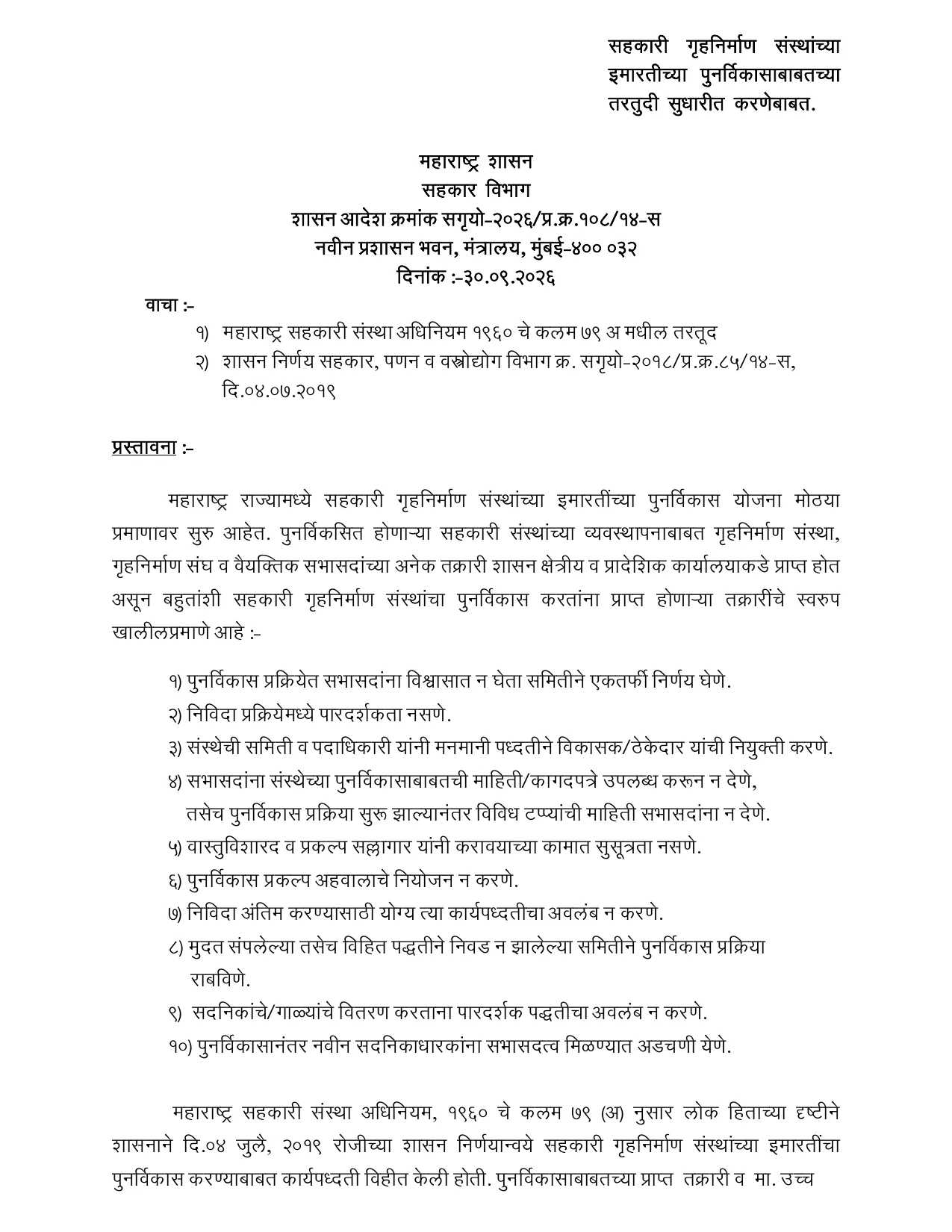
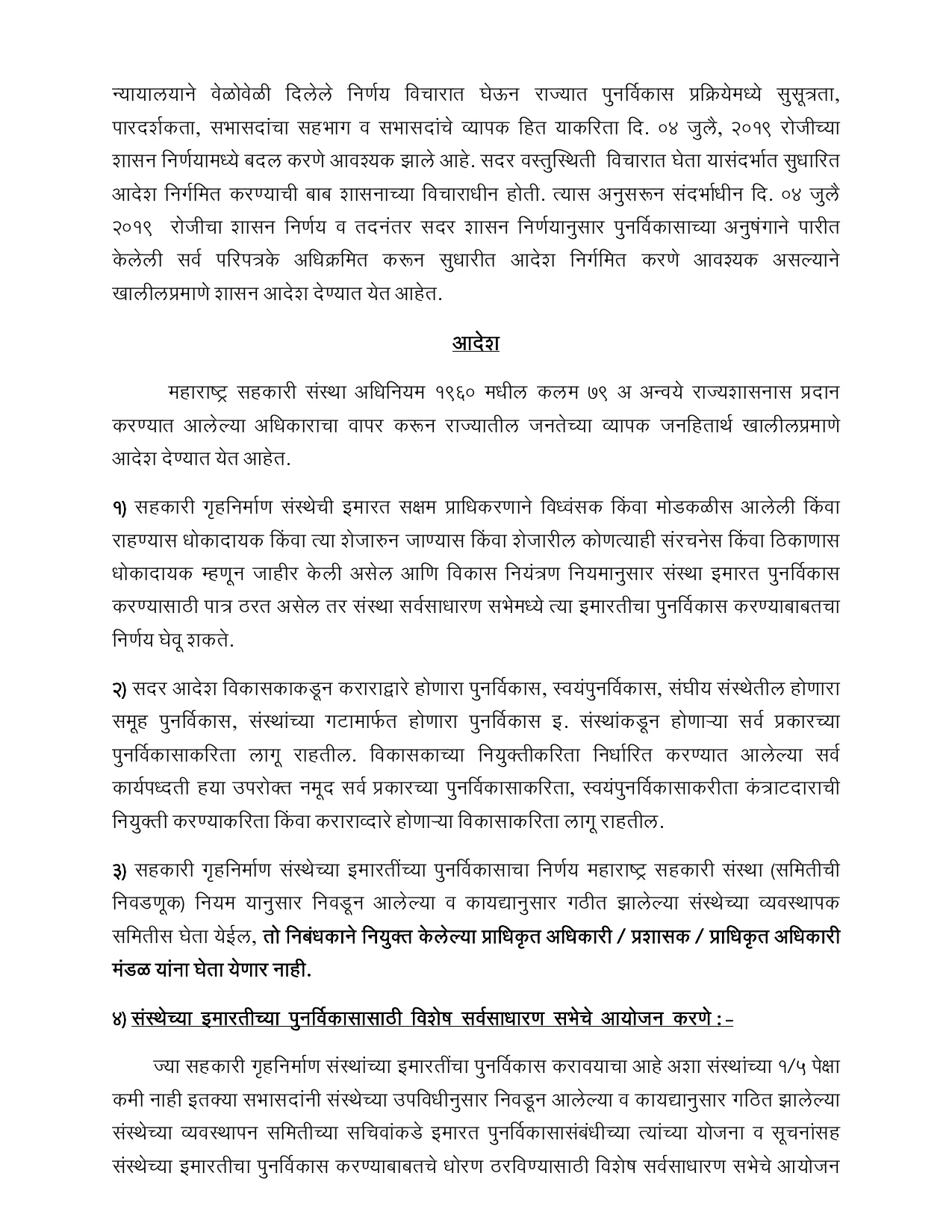
Source document: Co-operation Department, Government of Maharashtra · शासन आदेश क्रमांक सगृयो-2026/प्र.क्र.108/14-स; सांकेतांक 202609301657141847 · 2026-09-30
What changed on 30 September 2026
Government Order SGRYO-2026/C.R.108/14-S of 30 September 2026, Co-operation Department, Maharashtra, issued under section 79A of the Maharashtra Co-operative Societies Act 1960, supersedes the redevelopment Government Resolution of 4 July 2019 (No. SGRYO-2018/C.R.85/14-S, then the Co-operation, Marketing and Textiles Department) and every circular issued under it.
It applies to every form of redevelopment undertaken by a society — redevelopment by a developer under agreement, self-redevelopment, group redevelopment within a housing federation, redevelopment through a group of societies, and so on. The developer-appointment procedure applies equally to appointing a contractor for self-redevelopment (para 2).
The order is silent on schemes already under way: it carries no savings or transitional clause.
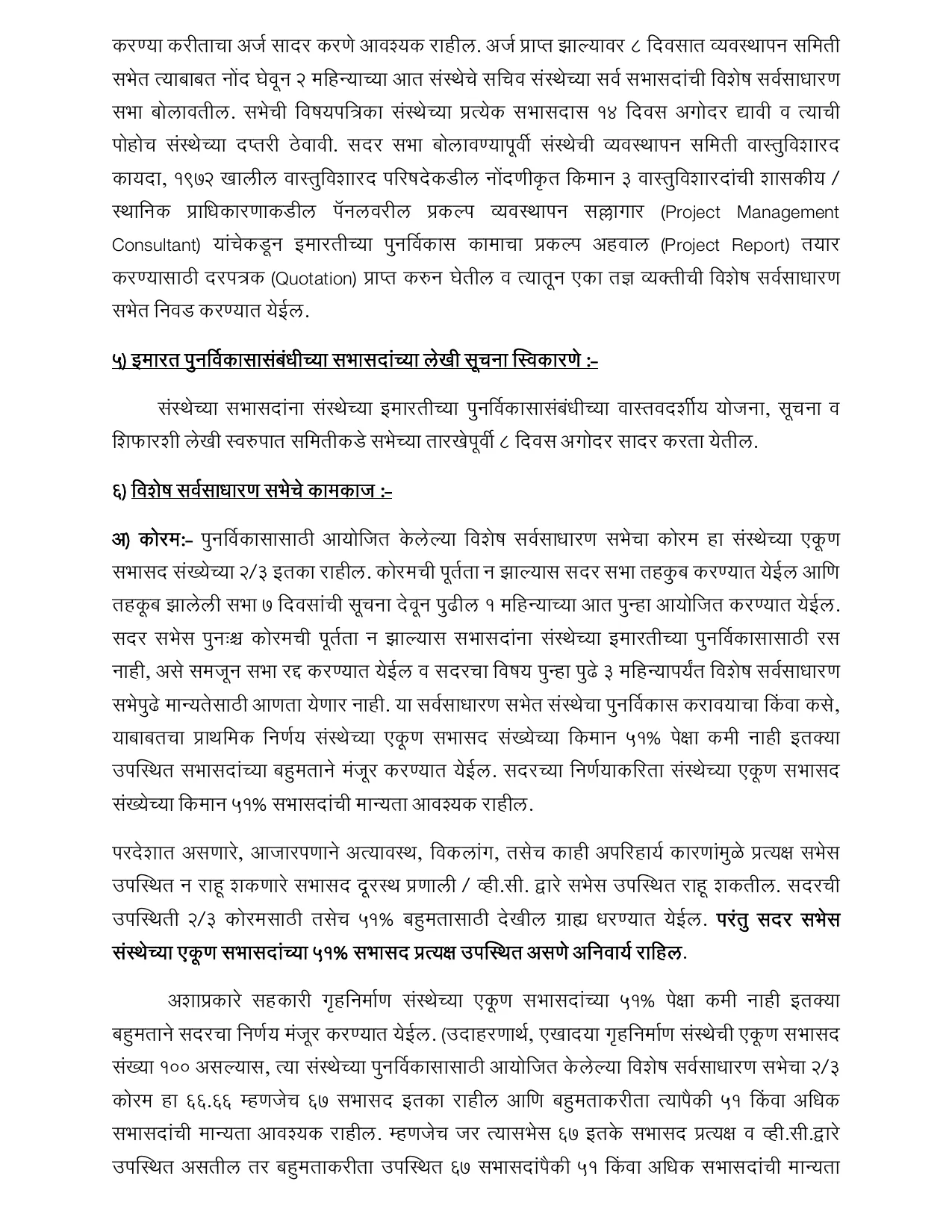
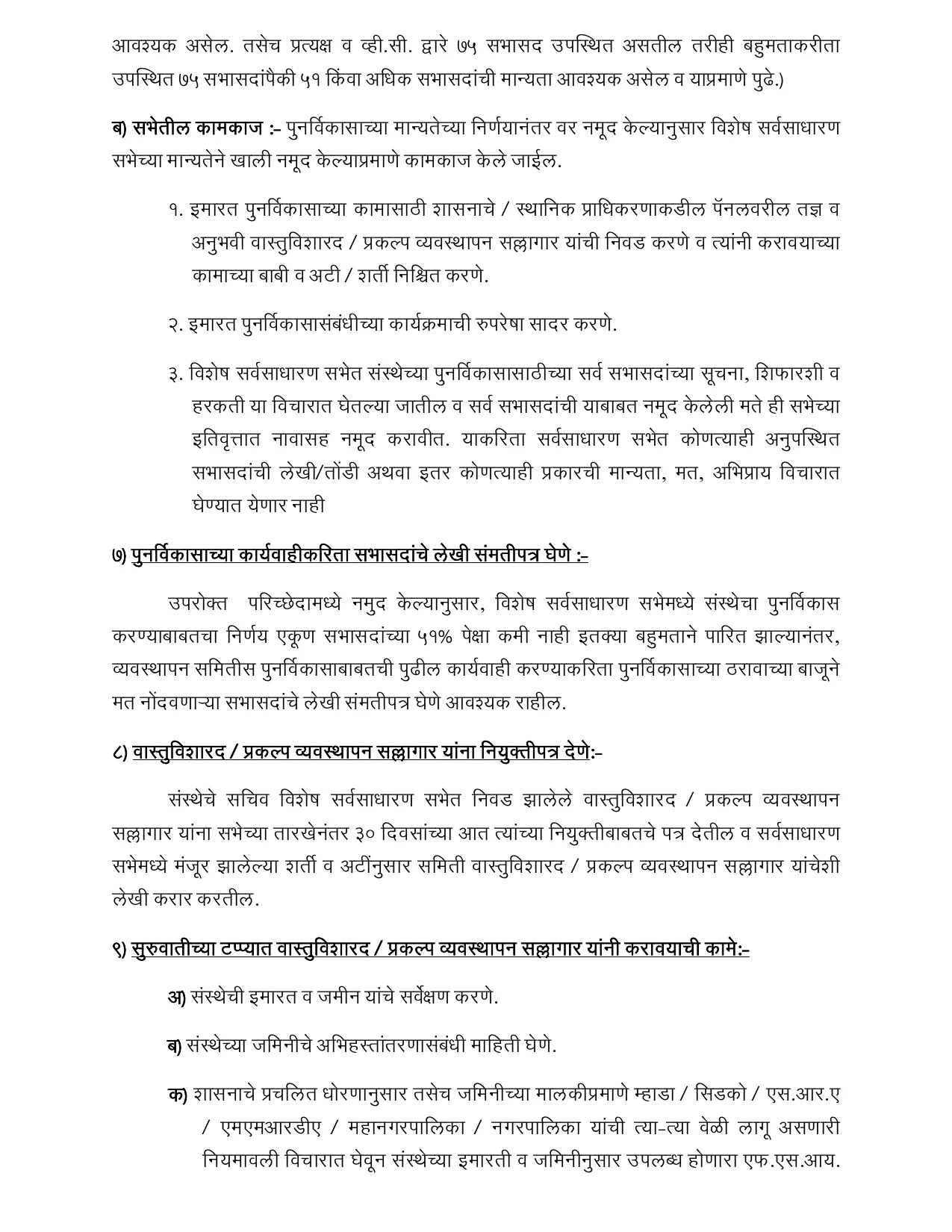
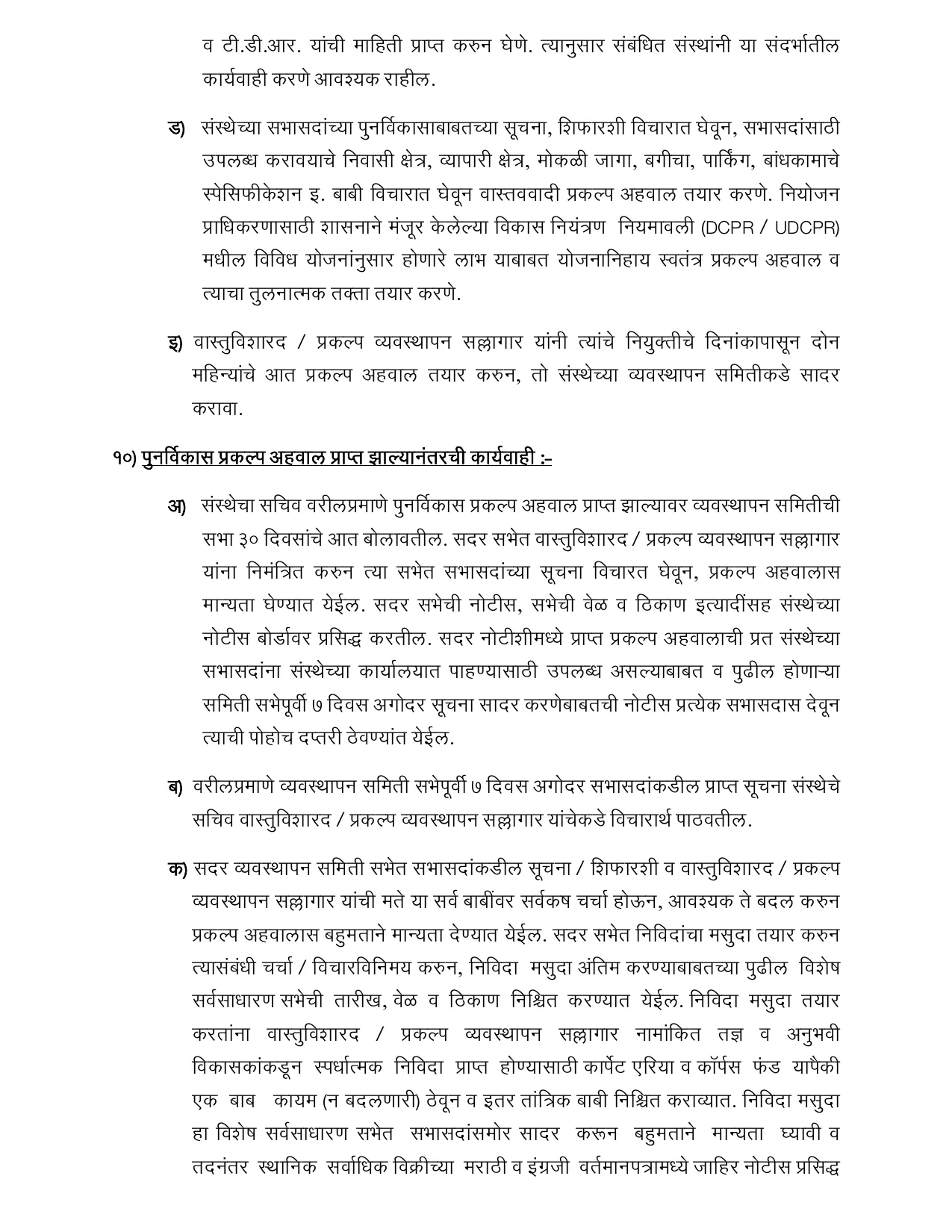
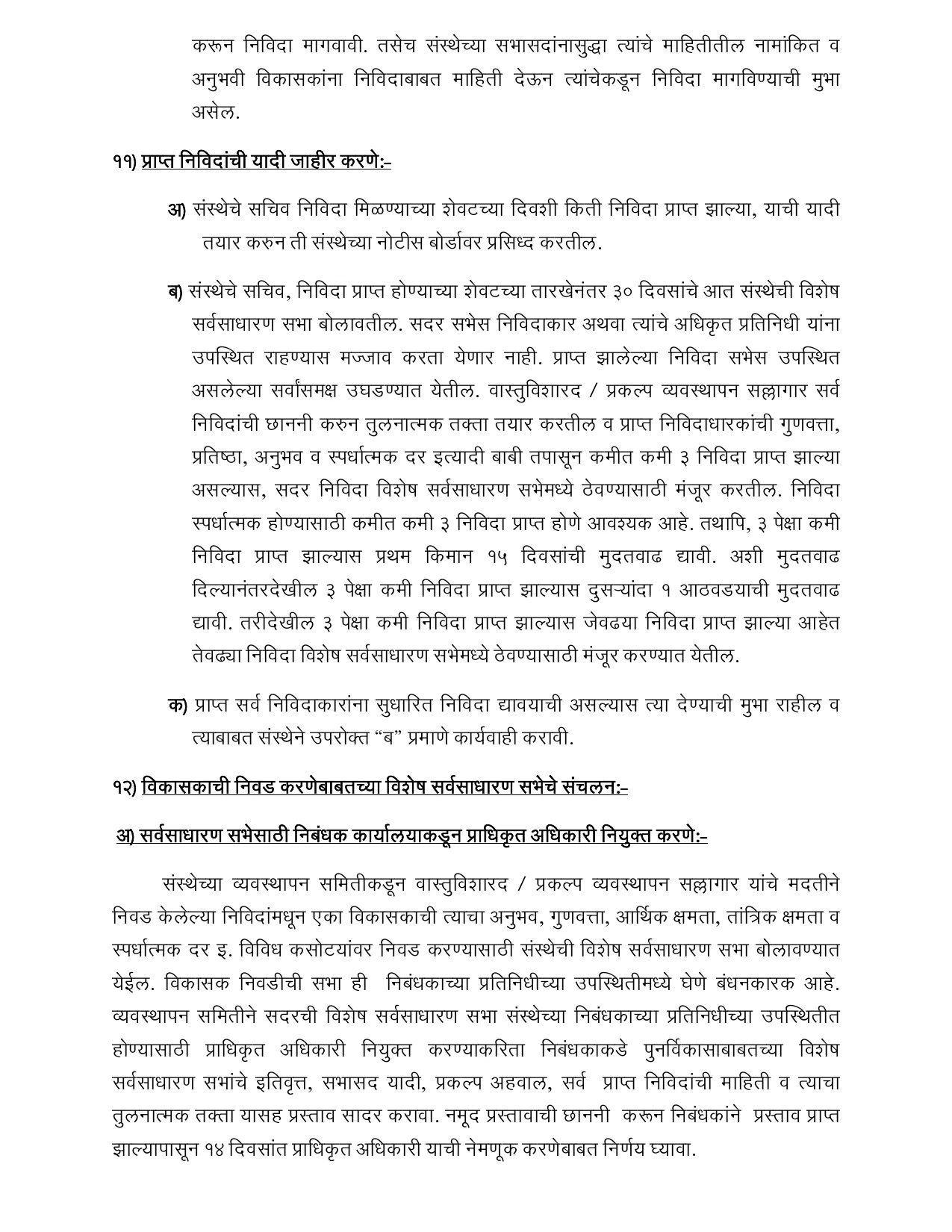
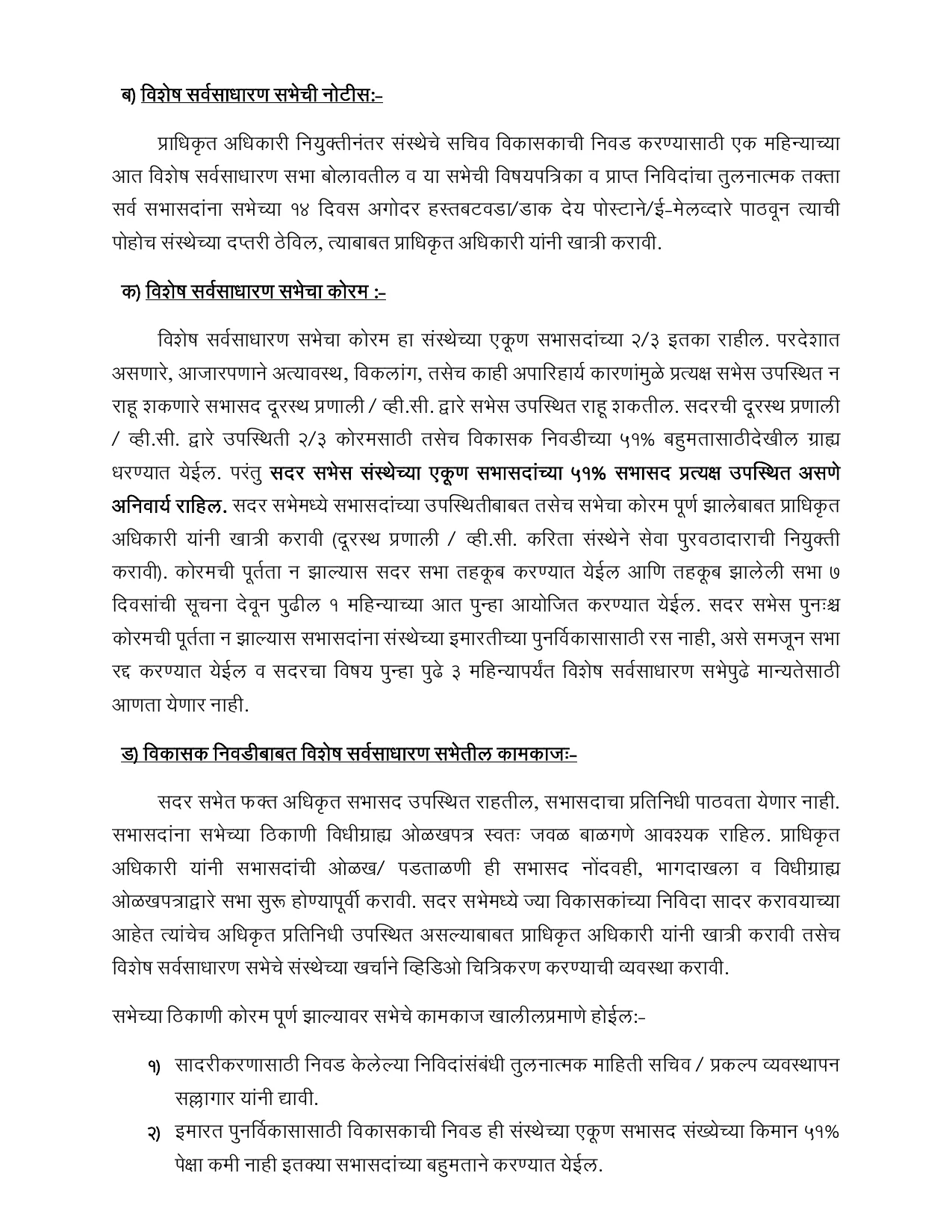
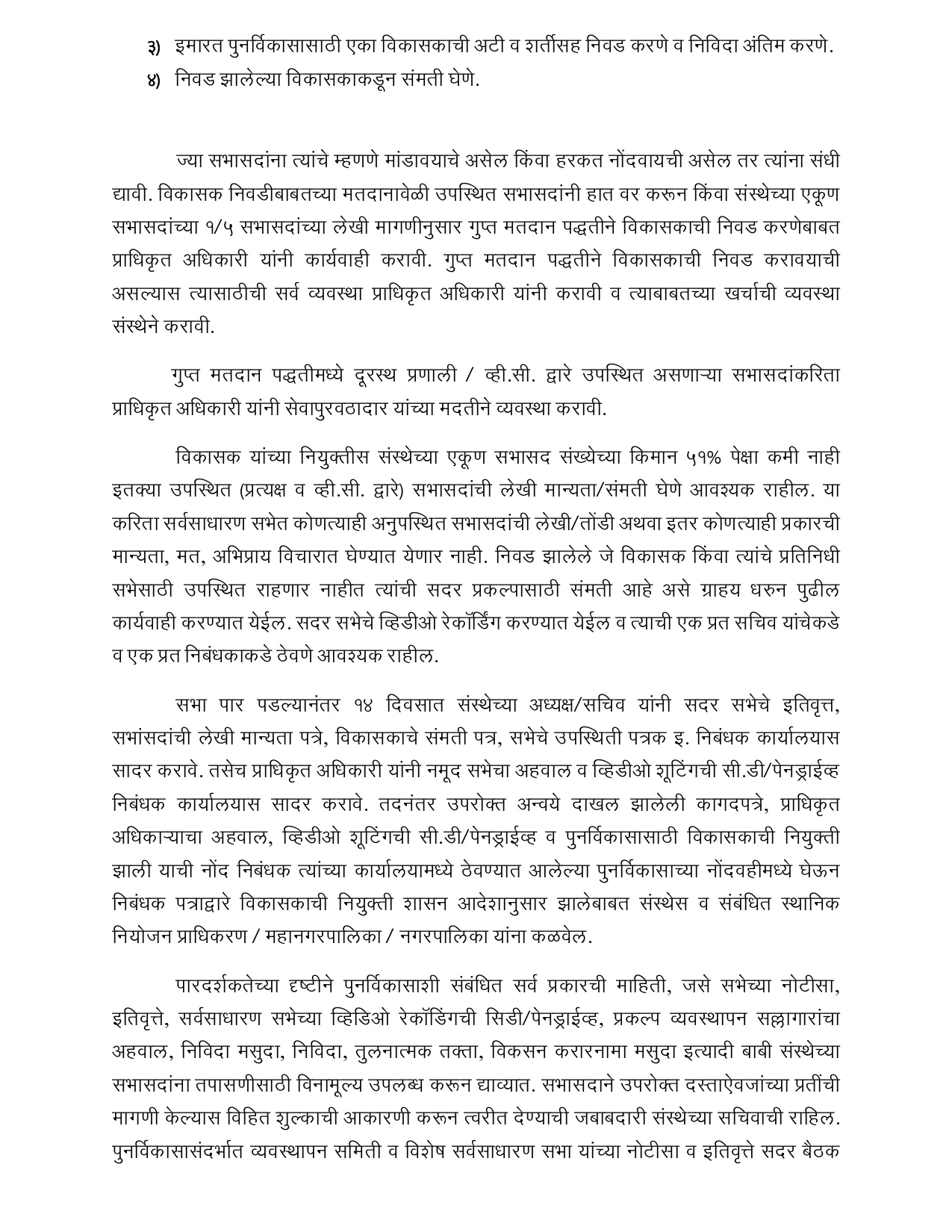
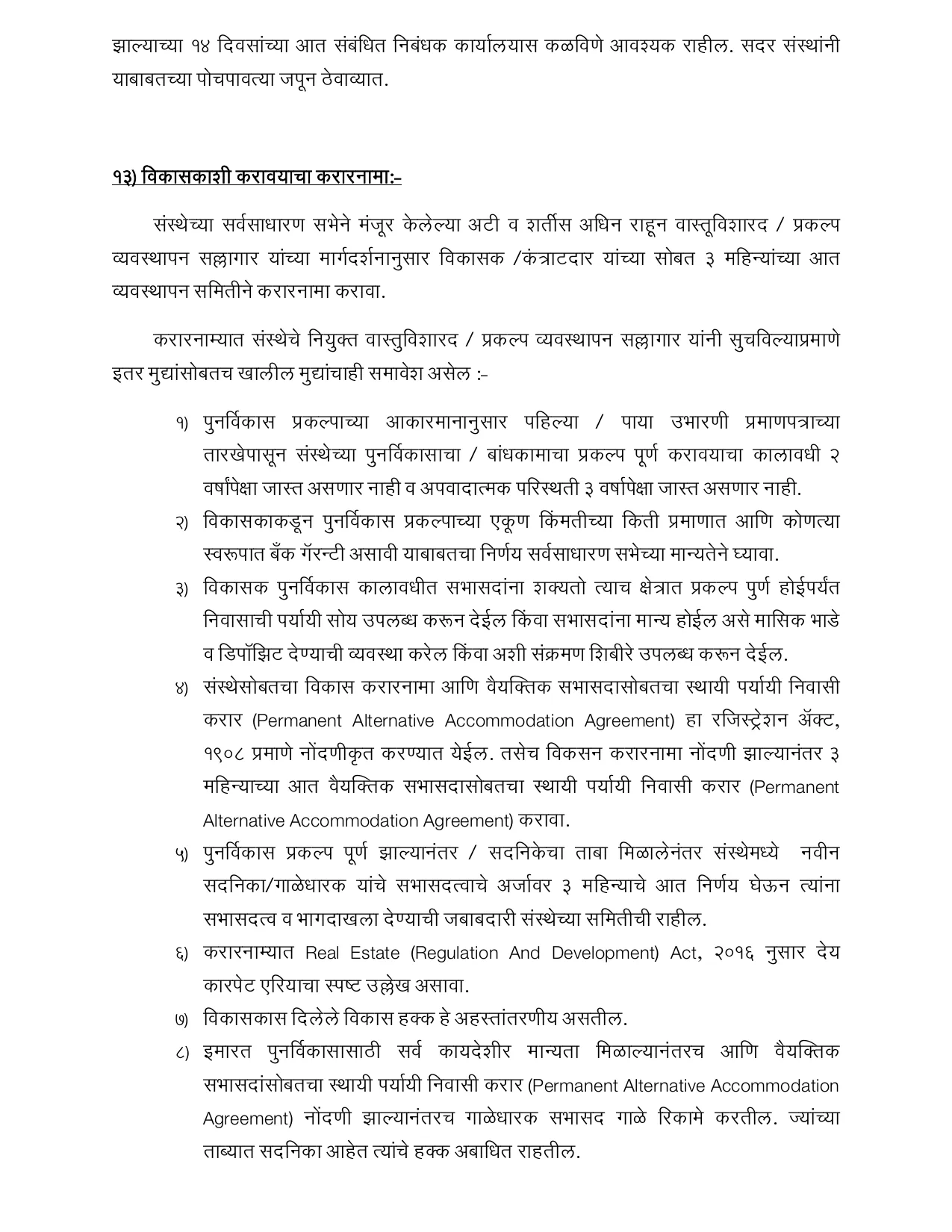
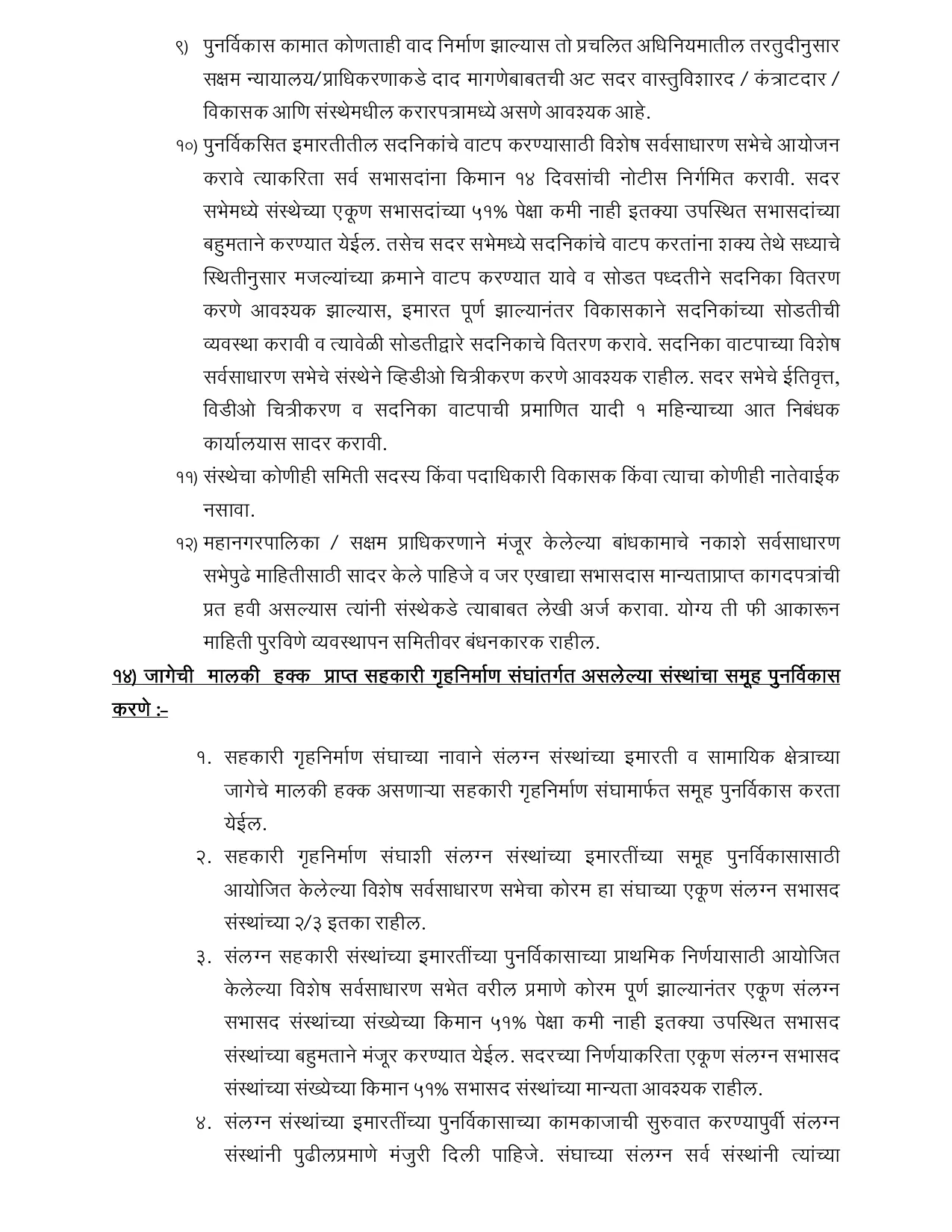
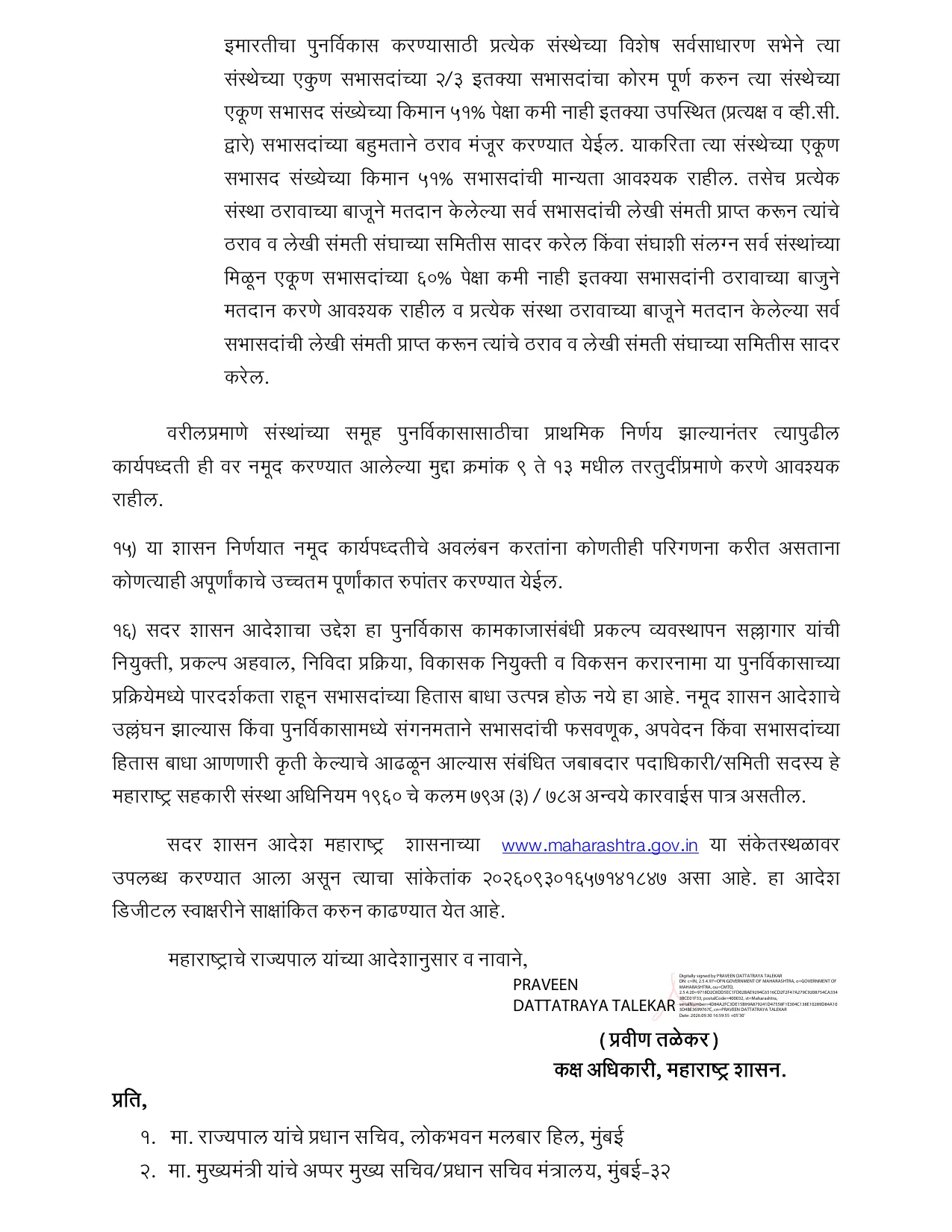
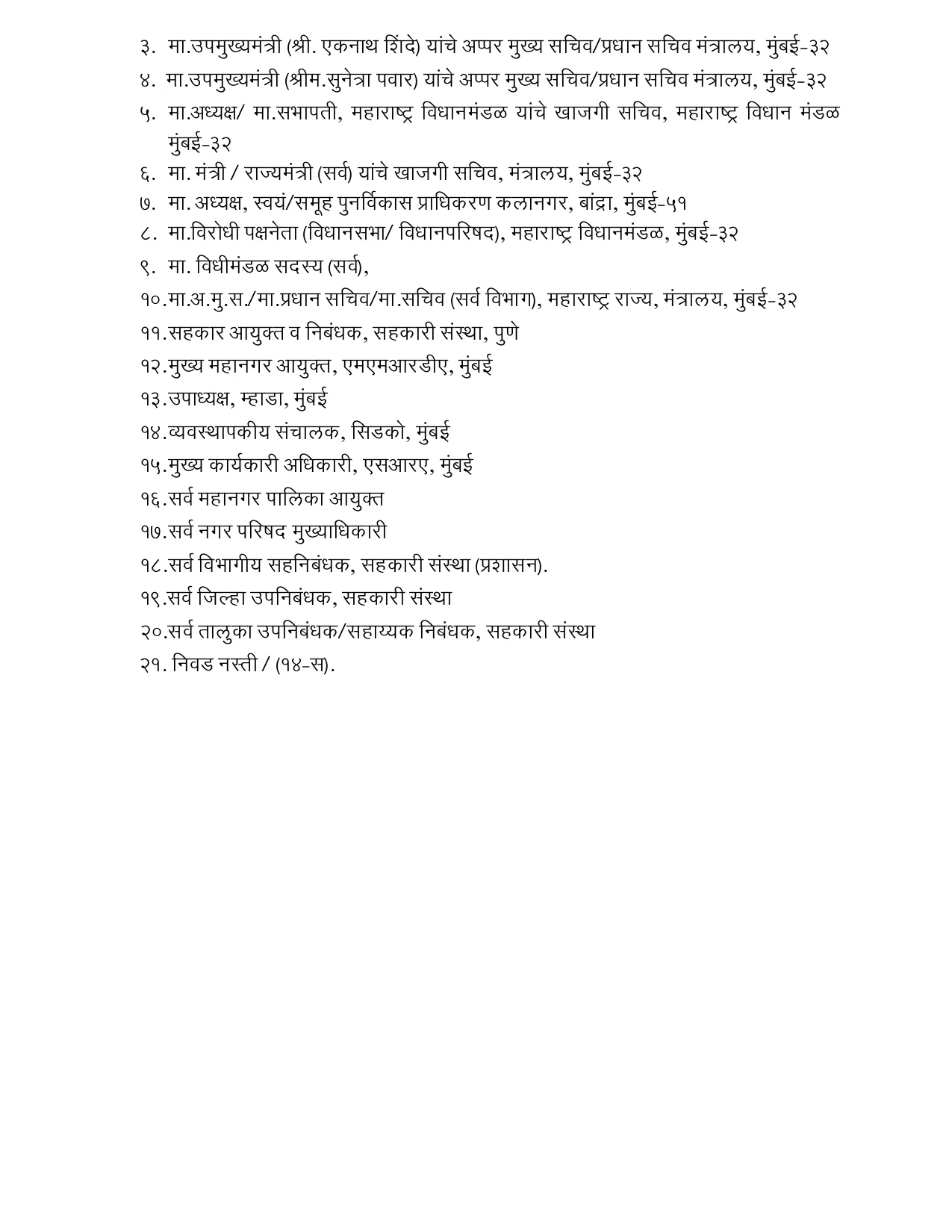
The full order is reproduced at the foot of this page. You can read all twelve pages here without leaving this article.
Who may start it, and who may decide
- •The building must have been declared by the competent authority to be dilapidated, ruinous, dangerous to inhabit, or dangerous to a passage, or to any neighbouring structure or place — and be eligible for redevelopment under the development control rules. Only then may the general meeting resolve to redevelop (para 1).
- •Only a managing committee elected under the Election Rules and constituted under the Act may take that decision. A Registrar-appointed Authorised Officer, Administrator or authorised officer board cannot (para 3).
The procedure, step by step
1 · The requisition. Not fewer than 1/5 of the members apply in writing to the Secretary, with their plans and suggestions, for a special general meeting to settle the society's redevelopment policy (para 4).
2 · Eight days, then two months. The committee takes that application on record at a committee meeting within 8 days, and the Secretary must then call the special general meeting of all members within 2 months of the application (para 4).
3 · Quotations before the meeting is called. The committee first obtains quotations for preparing the Project Report from at least three architects registered with the Council of Architecture under the Architects Act 1972 / Project Management Consultants on the panel of the Government or the local authority. One expert is then selected at the special general meeting (para 4, read with para 6(b)(1)).
4 · Members' written suggestions. Members may file realistic plans, suggestions and recommendations with the committee up to 8 days before the meeting (para 5).
5 · The first special general meeting. The agenda goes to every member 14 days in advance, with the acknowledgment kept in the society's records (para 4). Then:
- •Quorum: 2/3 of the total membership (para 6(a)).
- •Approval: not less than 51% of the total membership. This is a floor that does not fall as attendance rises or drops. The order's own worked example settles it — in a 100-member society the quorum is 66.66, that is 67, and 51 or more approvals are required even if 75 members attend (para 6(a)).
- •Video-conference attendance is not open to everyone. It is for members who are abroad, critically ill, disabled, or prevented by some unavoidable reason from attending in person. Such attendance counts for both the 2/3 quorum and the 51% — but 51% of the total membership must be physically present, which the order makes compulsory (para 6(a)).
- •Fractions are rounded up in every calculation under this order (para 15).
- •If the quorum fails, the meeting is adjourned and reconvened within 1 month on 7 days' notice. If it fails again, the members are taken to have no interest in redevelopment, the meeting is cancelled, and the subject cannot be brought before a special general meeting for 3 months (para 6(a)).
- •The decision taken at this meeting is the primary decision — whether to redevelop at all (para 6(a)).
- •Every member's stated view is recorded by name in the minutes. An absent member's approval, vote or opinion — written, oral or in any other form — is not taken into account (para 6(b)(3)).
6 · Written consent letters. Once the resolution carries, the committee must obtain written consent letters from the members who voted in favour before taking any further step (para 7).
7 · Thirty days, and a written agreement. The Secretary issues the appointment letter to the selected architect/PMC within 30 days of the date of the meeting, and the committee executes a written agreement with them on the terms the general meeting approved (para 8).
8 · The Project Report — two months. The architect/PMC surveys the building and land, obtains the position on conveyance of the society's land, establishes the FSI and TDR available under the MHADA / CIDCO / SRA / MMRDA / municipal rules applicable to that land, and prepares a realistic project report covering residential area, commercial area, open space, garden, parking and construction specifications — plus a separate report scheme by scheme, with a comparative chart, for the benefits available under the DCPR / UDCPR. It must reach the committee within 2 months of appointment (para 9).
9 · Thirty days to put the report to the committee. The Secretary calls a committee meeting within 30 days of receiving the report and invites the architect/PMC to it. The notice, with time and place, goes on the society's notice board and to every member with acknowledgment, and must state that a copy of the report is available for inspection at the society's office and that suggestions must be submitted 7 days before that committee meeting (para 10(a)). Those suggestions are sent to the architect/PMC for consideration (para 10(b)).
10 · The tender draft, and the newspaper notice. At that meeting the report is approved by majority after full discussion and any necessary changes, and the tender draft is prepared — in which either the carpet area or the corpus fund must be held constant (not variable) so that tenders are genuinely comparable. That same committee meeting fixes the date, time and place of the next special general meeting. The draft is placed before that special general meeting and approved by majority, and only then is a public notice published in the highest-circulating local Marathi and English newspapers inviting tenders. Members may also pass the tender information to reputed, experienced developers they know (para 10(c)).
11 · Tenders. On the last day for tenders the Secretary prepares and publishes the list of tenders received on the notice board (para 11(a)). The Secretary then calls a special general meeting within 30 days of the last date for tenders. Tenderers or their authorised representatives cannot be barred from attending, and the tenders are opened in the presence of everyone present. The architect/PMC scrutinises them and prepares a comparative chart, testing quality, reputation, experience and competitive rates. At least three tenders are needed for genuine competition, and it is the architect/PMC who approves the scrutinised tenders for placing before the special general meeting; if fewer arrive, grant a first extension of at least 15 days, then a second extension of one week, and if there are still fewer than three, proceed with those received (para 11(b)). Tenderers may submit revised tenders, and the same procedure then repeats (para 11(c)).
12 · The developer-selection meeting — now supervised by the Registrar. This is the heart of the change.
- •The meeting cannot be held without the Registrar's representative present. The order's own word is binding (para 12(a)).
- •The meeting is convened to select one developer from the shortlisted tenders on the order's own criteria — experience, quality, financial capacity, technical capacity and competitive rates (para 12(a)).
- •The committee first files a proposal with the Registrar — the minutes of the redevelopment special general meetings, the members' list, the project report, the information on all tenders received and the comparative chart. The Registrar must decide on appointing the Authorised Officer within 14 days of receiving that proposal (para 12(a)).
- •After the appointment, the Secretary calls the meeting within one month and sends the agenda and the comparative tender chart to all members 14 days in advance by hand delivery, registered post or email, keeping the acknowledgments in the society's records — which the Authorised Officer must verify (para 12(b)).
- •The quorum is again 2/3 of the total membership, with the same VC rule and the same compulsory 51% physically present. The Authorised Officer satisfies himself about attendance and quorum, and the society appoints the VC service provider. Quorum failure follows the same route: adjourn, reconvene within 1 month on 7 days' notice, and on a second failure a 3-month bar (para 12(c)).
- •At the meeting: only authorised members attend — a member may not send a representative; each member must carry valid photo identification; the Authorised Officer verifies identity against the member register, the share certificate and the photo ID before the meeting begins; only the authorised representatives of the tendering developers are present; and the meeting is video-recorded at the society's cost, one copy of the recording to be kept with the Secretary and one with the Registrar (para 12(d)).
- •The business is: the comparative information on the shortlisted tenders presented by the Secretary/PMC; selection of one developer with terms and conditions and finalisation of the tender; and obtaining the selected developer's consent. Members who wish to speak or record an objection must be given the opportunity (para 12(d)).
- •Voting is by show of hands, or by secret ballot if 1/5 of the total membership demands it in writing — in which case the Authorised Officer makes all the arrangements, including for members attending by VC, at the society's cost (para 12(d)).
- •The developer's appointment requires the written approval or consent of not less than 51% of the total membership present physically or by VC. An absent member's approval, vote or opinion counts for nothing, in any form. A selected developer who does not attend — or whose representative does not — is deemed to have consented, and the process continues (para 12(d)).
- •Within 14 days of the meeting the Chairman/Secretary file with the Registrar's office: the minutes, the members' written approval letters, the developer's consent letter and the attendance sheet. The Authorised Officer separately files his report and the video on CD or pen drive. The Registrar enters the appointment in the redevelopment register kept in his office and informs the society and the planning authority / municipal corporation by letter that the developer was appointed in accordance with the Government Order (para 12). In our view that register entry and that letter will in practice be a society's best evidence that its developer was validly appointed.
13 · Transparency, from the first day. For the sake of transparency, every redevelopment document — meeting notices, minutes, the CD/pen drive of the general meeting video recordings, the PMC's report, the tender draft, the tenders, the comparative chart and the draft development agreement — must be available to members for inspection free of charge; copies must be given promptly on payment of the prescribed fee, and that is the Secretary's personal responsibility. Separately, the **notice and minut
What this means for your society
Three things decide whether your committee’s redevelopment steps survive scrutiny. Count the majority on 51% of the TOTAL membership, not of those present — the order’s own worked example requires 51 approvals in a 100-member society even when 75 attend — and count no absent member’s consent in any form (paras 6(a), 6(b)(3), 12(d)); take written consent letters only from the members who voted in favour (para 7). Do not hold the developer-selection meeting without the Registrar’s Authorised Officer and a video recording at the society’s cost: the proposal goes to the Registrar first and he deci
Facing this in your society?
Get the compliance handled — and your society legally protected.
Our advocates take on AGM procedure, notices and agendas, statutory registers, records and dues recovery for housing societies across Maharashtra. Tell us about your society and we will prepare a free compliance review for it.
No obligation. We reply within 24 hours.
A SocietySeWA News Desk report on the document linked above. It is not itself a Government circular or order, and not a circular of this firm — please read the original before acting on it.
General information for Maharashtra co-operative housing societies — not legal advice on any specific matter.
SocietySeWA Legal Desk
13 October 2026