Vertical Property Card for flatsNow the power is in your hands. Send your suggestions, objections and innovations
Maharashtra's draft Vertical Property Card rules are open for objections until 26 December 2026. Tell the Government what the card should map and solve, without adding paperwork.
Submission window closes on 26 December 2026 (objections must reach on or before that date).
your say by 26 Dec
SPECIMEN
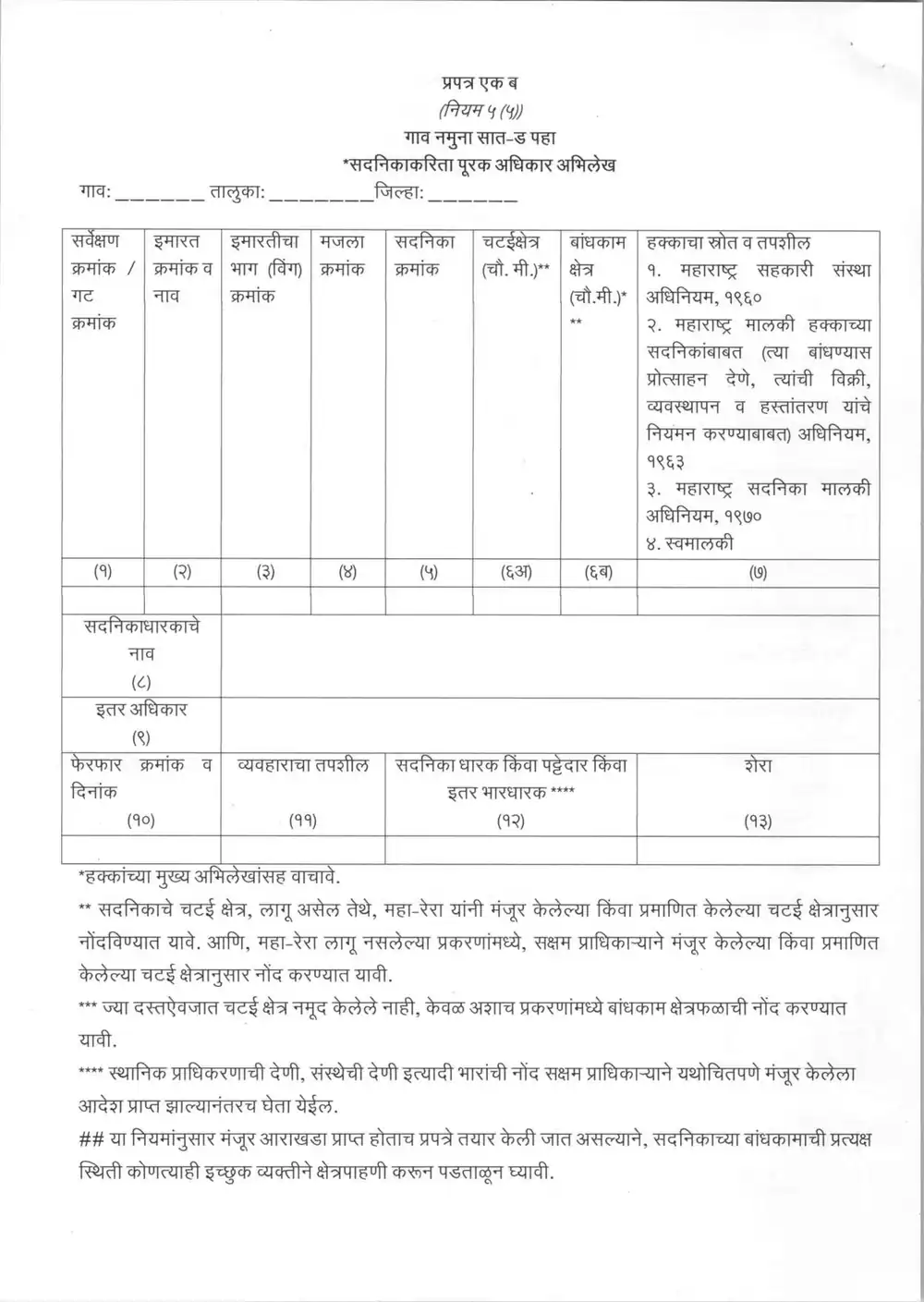
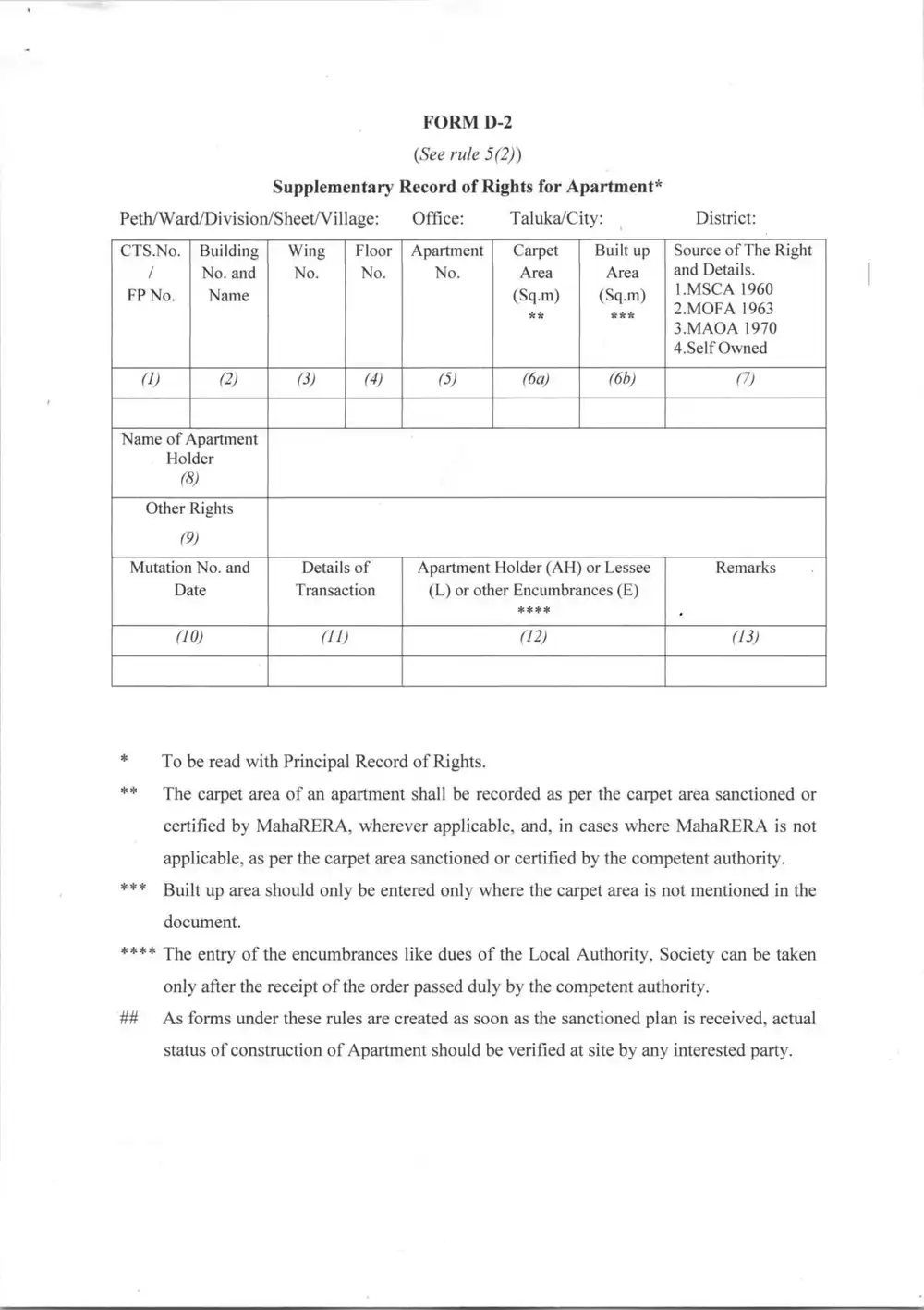
| (1) न.भू.क्र./अं.भू.क्र. C.T.S./F.P. No. | (2) इमारत Building | (3) विंग Wing | (4) मजला Floor | (5) सदनिका Apt. No. | (6a) चटई क्षेत्र Carpet (sq.m) | (6b) बांधीव Built-up | (7) हक्काचा स्रोत Source of right | (8) सदनिकाधारक Apartment holder | (9) इतर हक्क Other rights | (10) फेरफार क्र./दि. Mutation | (12) AH / L / E |
|---|---|---|---|---|---|---|---|---|---|---|---|
| 1234/अ | A, उदाहरण CHS | A | 4 | A-402 | 58.40 | — | MCS Act 1960 | श्री. अ. ब. उदाहरण | — | 5671 / 12.01.2027 | AH |
| 1234/अ | A, उदाहरण CHS | A | 4 | A-403 | 61.20 | — | MOFA 1963 | सौ. क. ड. उदाहरण | — | 5672 / 12.01.2027 | AH · E |
** मंजूर / महारेरा प्रमाणित चटई क्षेत्र · Carpet area as sanctioned/certified
Specimen only, drawn from Form D-2 in the draft (p.31). Names and numbers are made up.
Your flat may soon get its own record
The draft proposes a separate record for every flat, kept as a supplement to the existing land record or property card (r.5, r.12). The State has now published these draft rules for public comment.
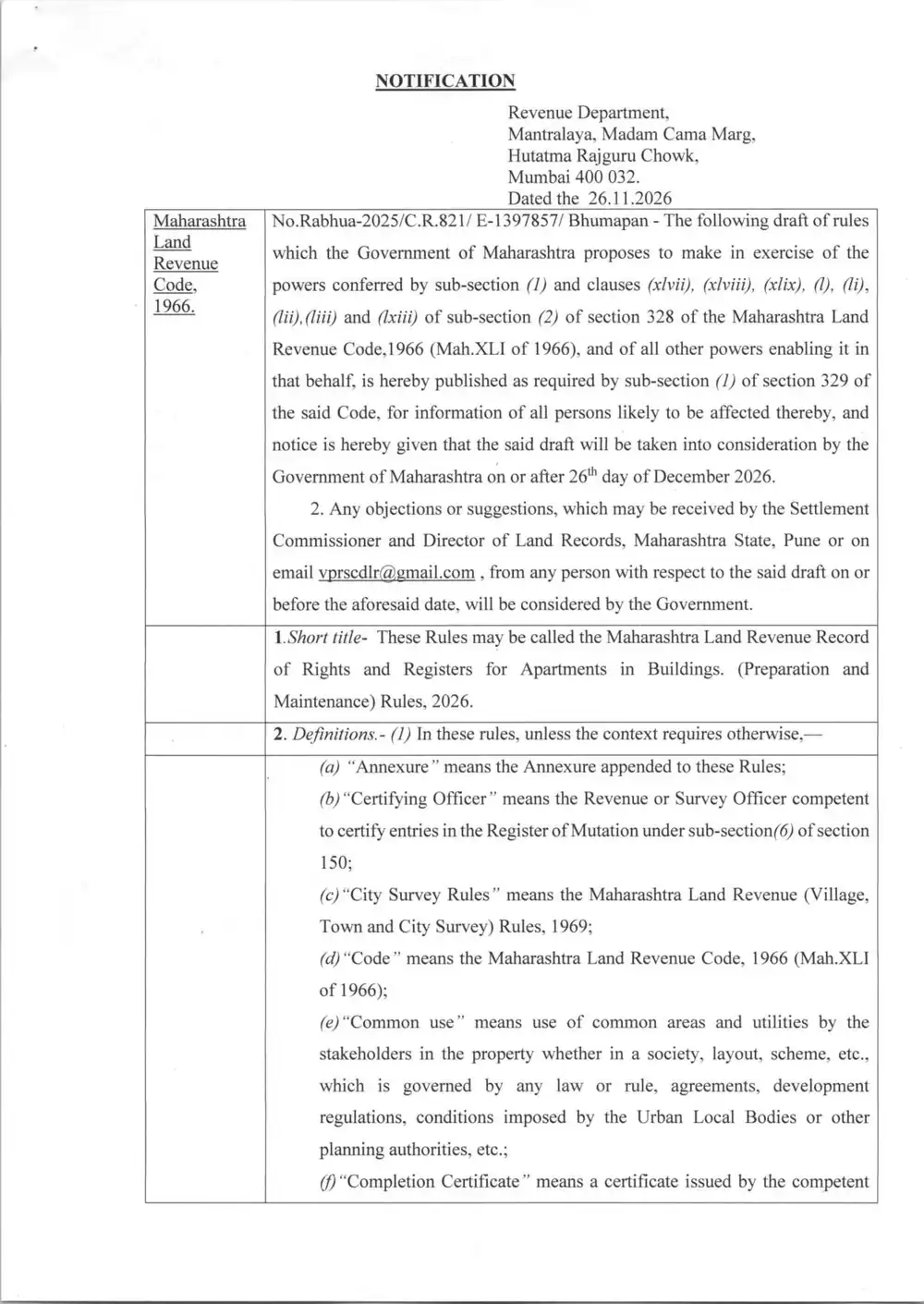
These are only draft rules. The Government will take them up on or after 26 December 2026, and it has said it will consider objections and suggestions received on or before that date. Anyone can send them. You do not need to be a lawyer.
So here is the real question: do you want these rules written without your voice? This article explains the draft in plain words, shows the gaps we found, and helps you send your objection or suggestion before the deadline.
What the draft rules say
The draft is called the Maharashtra Land Revenue Record of Rights and Registers for Apartments in Buildings (Preparation and Maintenance) Rules, 2026 (r.1, p.19). In plain words:
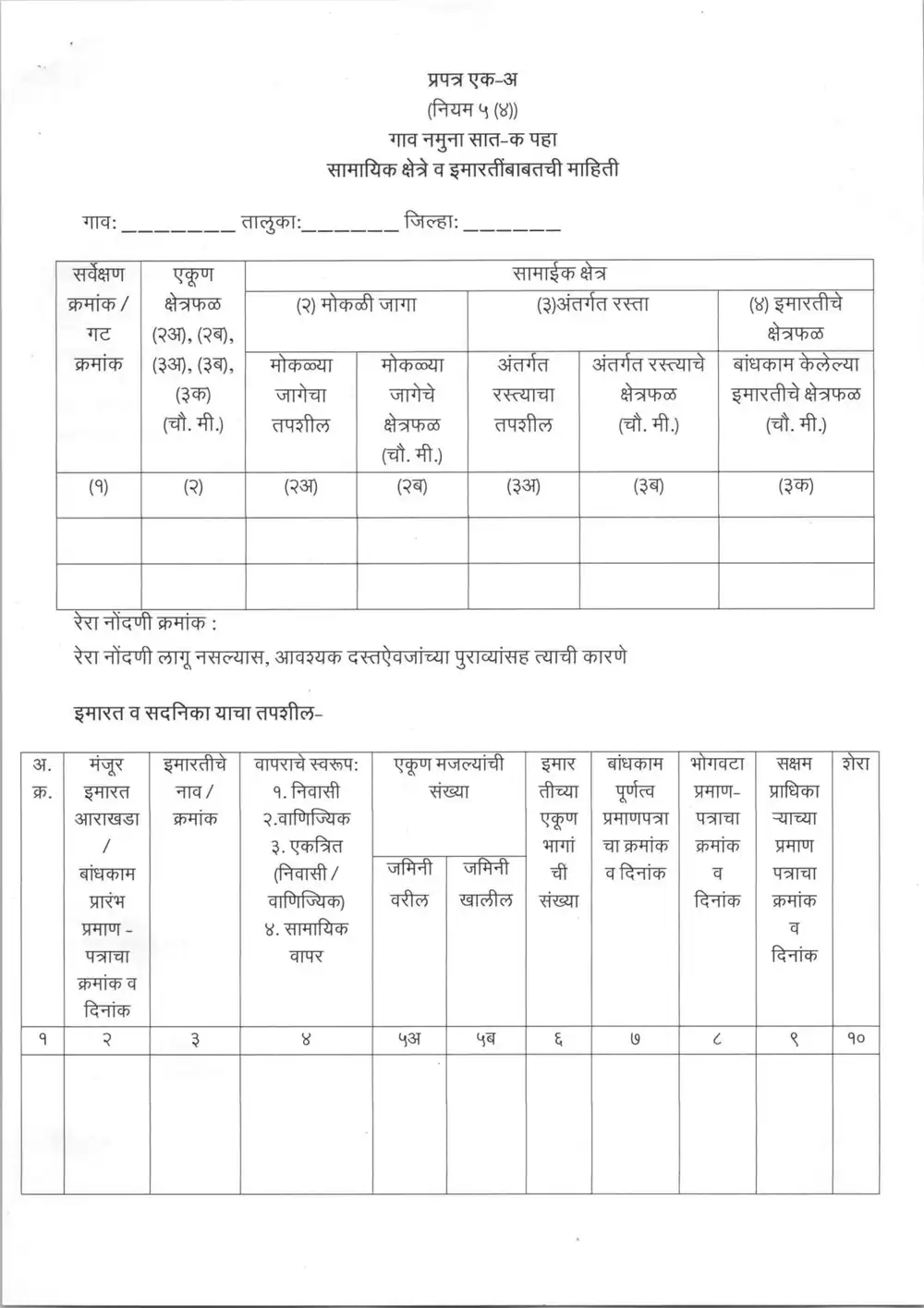
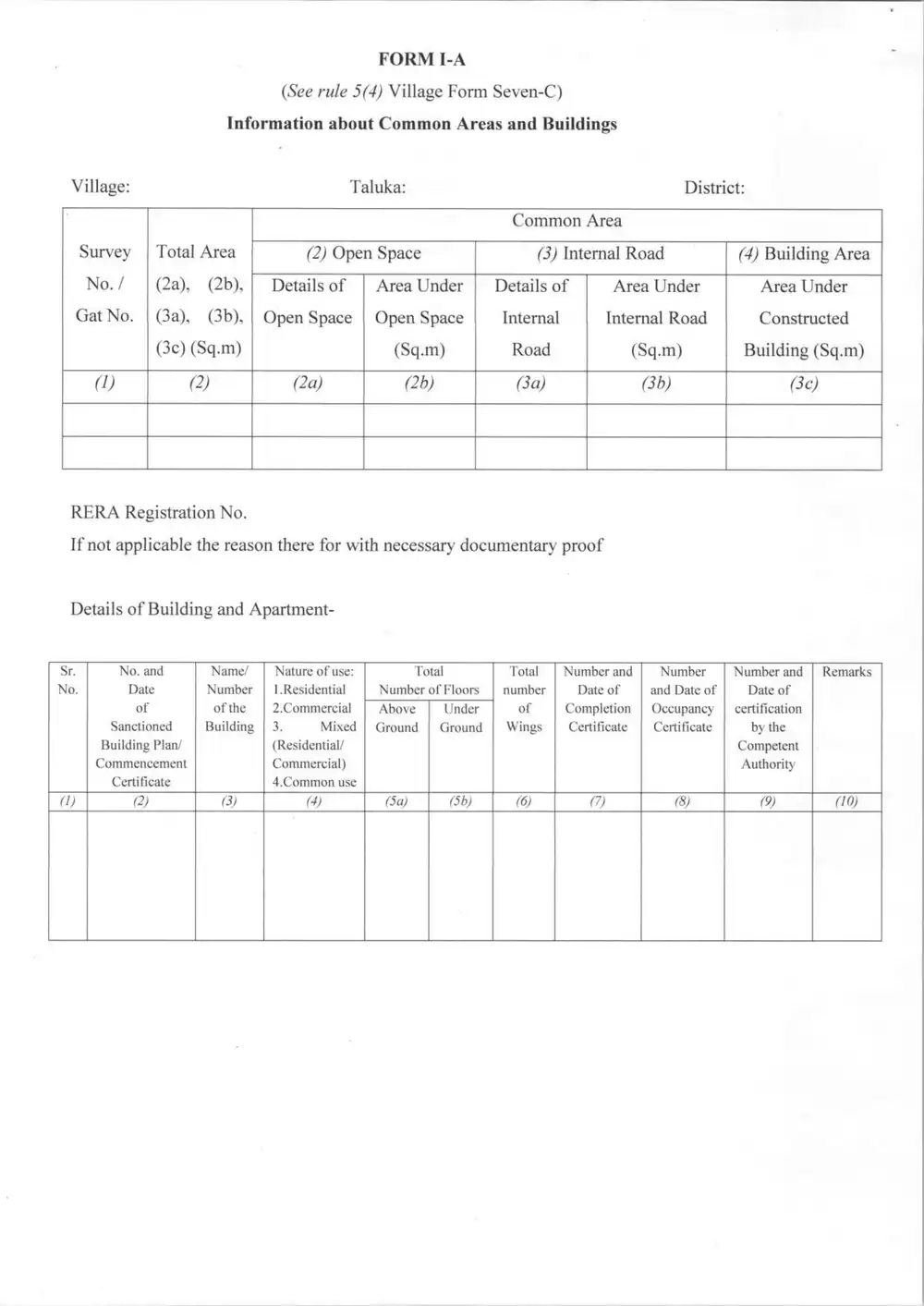
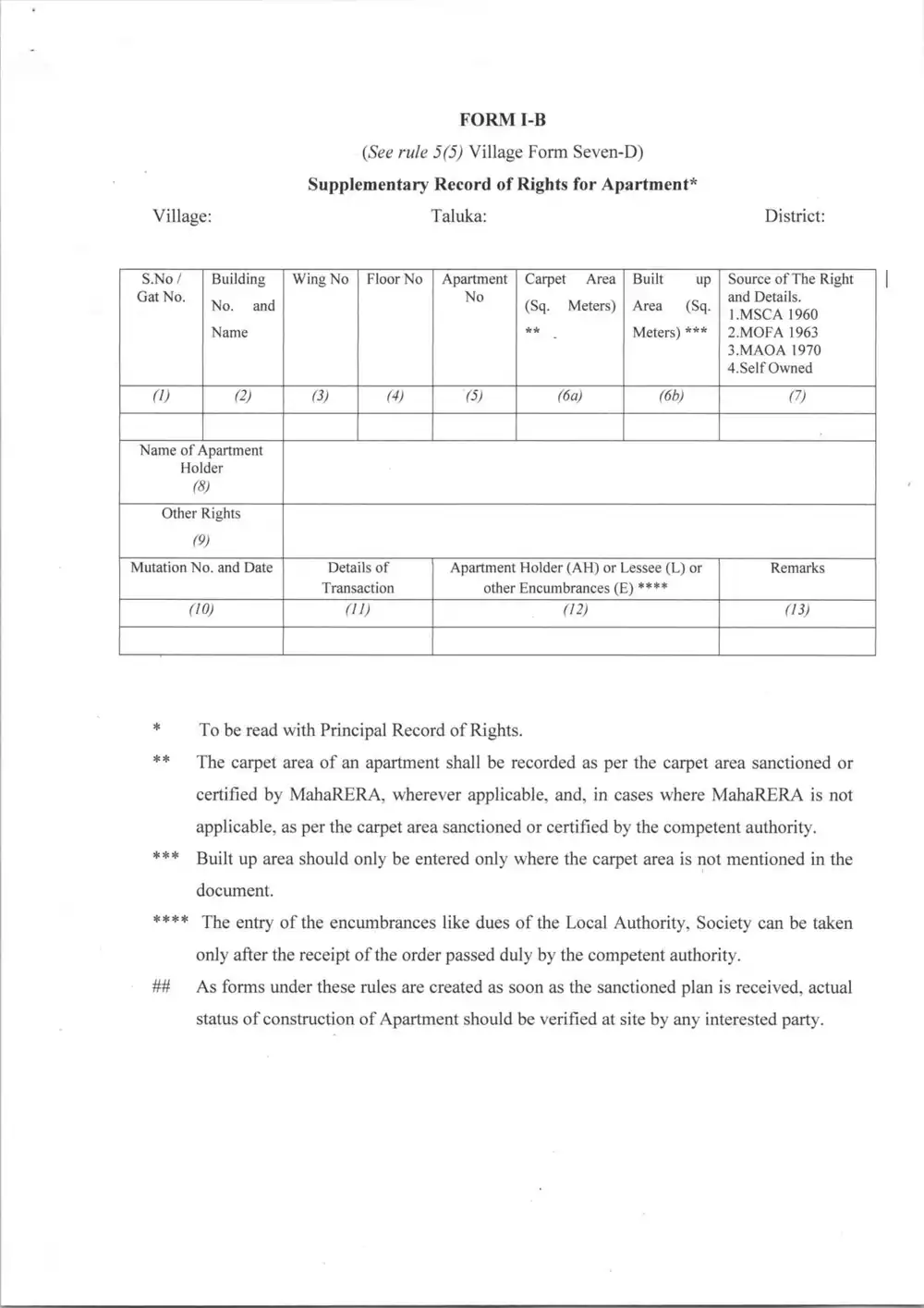
- A record for each flat. Where the area is city-surveyed (s.126), the flat gets a "Supplementary Property Card" in Form D-2, and the building details go in Form D-1. In other areas, the flat record is Form I-B ("7-D") and the building record is Form I-A ("7-C"), kept with the village record (r.5, pp.22-23).
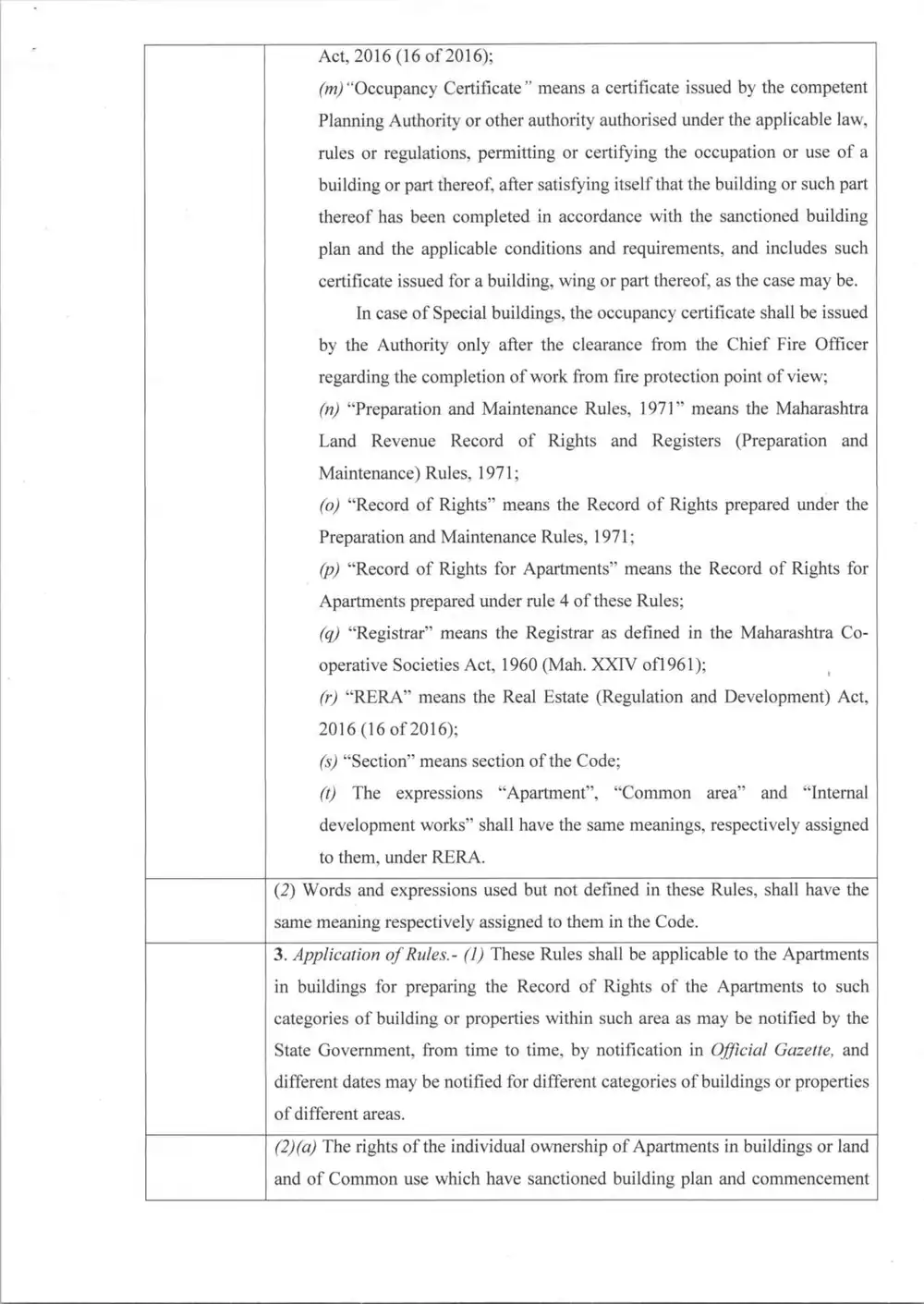
- Only where notified. The rules apply only to the areas and categories of buildings the State notifies in the Gazette, and different dates can be set (r.3(1), p.21). Nothing starts automatically.
- Who is eligible. Buildings with a sanctioned plan and commencement certificate, or with a conveyance, deemed conveyance or deed of apartment along with the sanctioned plan (r.3(2), pp.21-22). If papers are missing, the competent planning authority may certify the plan, or give a certificate approving or regularising the building (provisos, p.22).
- What is recorded. Your individual right in the flat under the MCS Act 1960, MOFA 1963 or the Maharashtra Apartment Ownership Act 1970, and your common-use rights in land and common areas (r.4, p.22). The area shown is the carpet area from the sanctioned plan, or built-up area if carpet area is not mentioned (r.5(6), p.23).
- Who applies. For existing buildings, the land holder, promoter, or the Chairman/Secretary/authorised person of the society or association may apply in Form E, once the area is notified. A single flat holder can also apply, with documents for the whole building (r.7(1), (3), p.24).
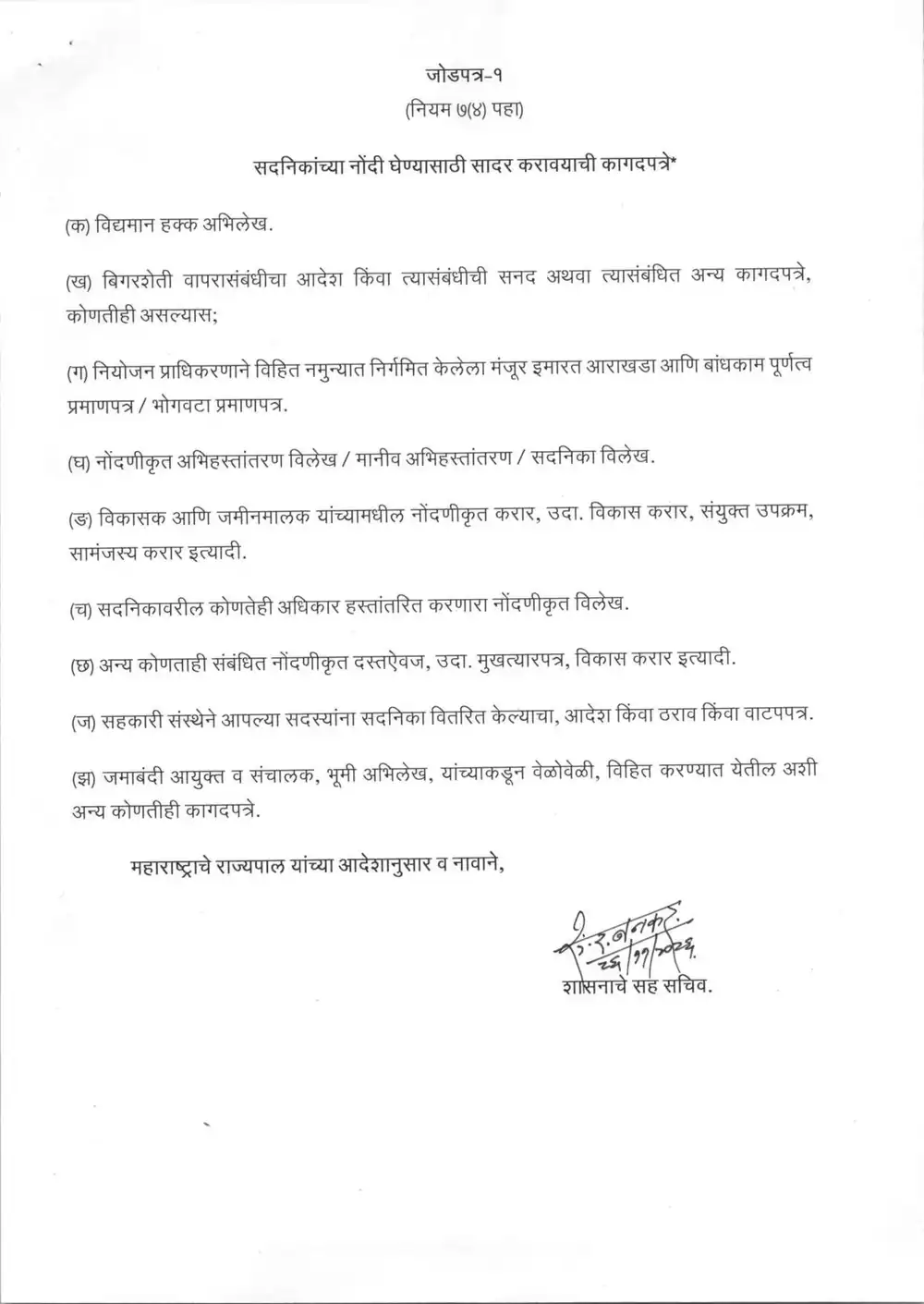
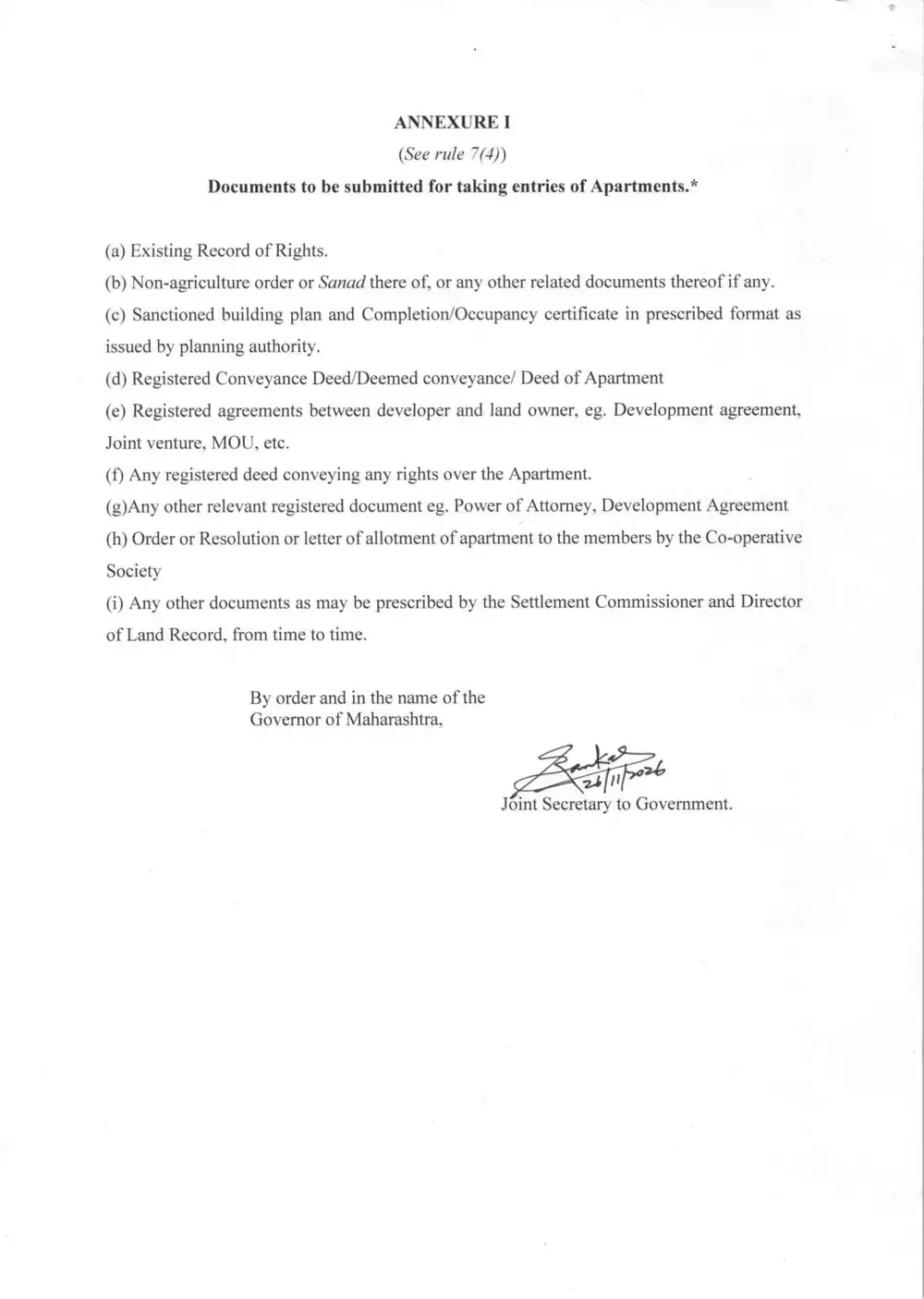
- Documents. Annexure I lists them: existing record of rights, NA order, sanctioned plan with completion/occupancy certificate, registered conveyance/deemed conveyance/deed of apartment, developer-landowner agreements, other registered deeds, and the society's allotment letter or resolution. A fee "as specified by the State Government" is also payable, but no amount is given (r.7(4), p.24; Annexure I, p.34).
- Property Card at first sale. When the first agreement to sale is registered, the Property Card in the name of the land holder, promoter, developer, society, company or association must be submitted. The Registering Officer verifies it and informs the buyer about "the risk of the document" before execution (r.7(8), p.25). The first purchaser is then entered by mutation (r.7(9), p.25).
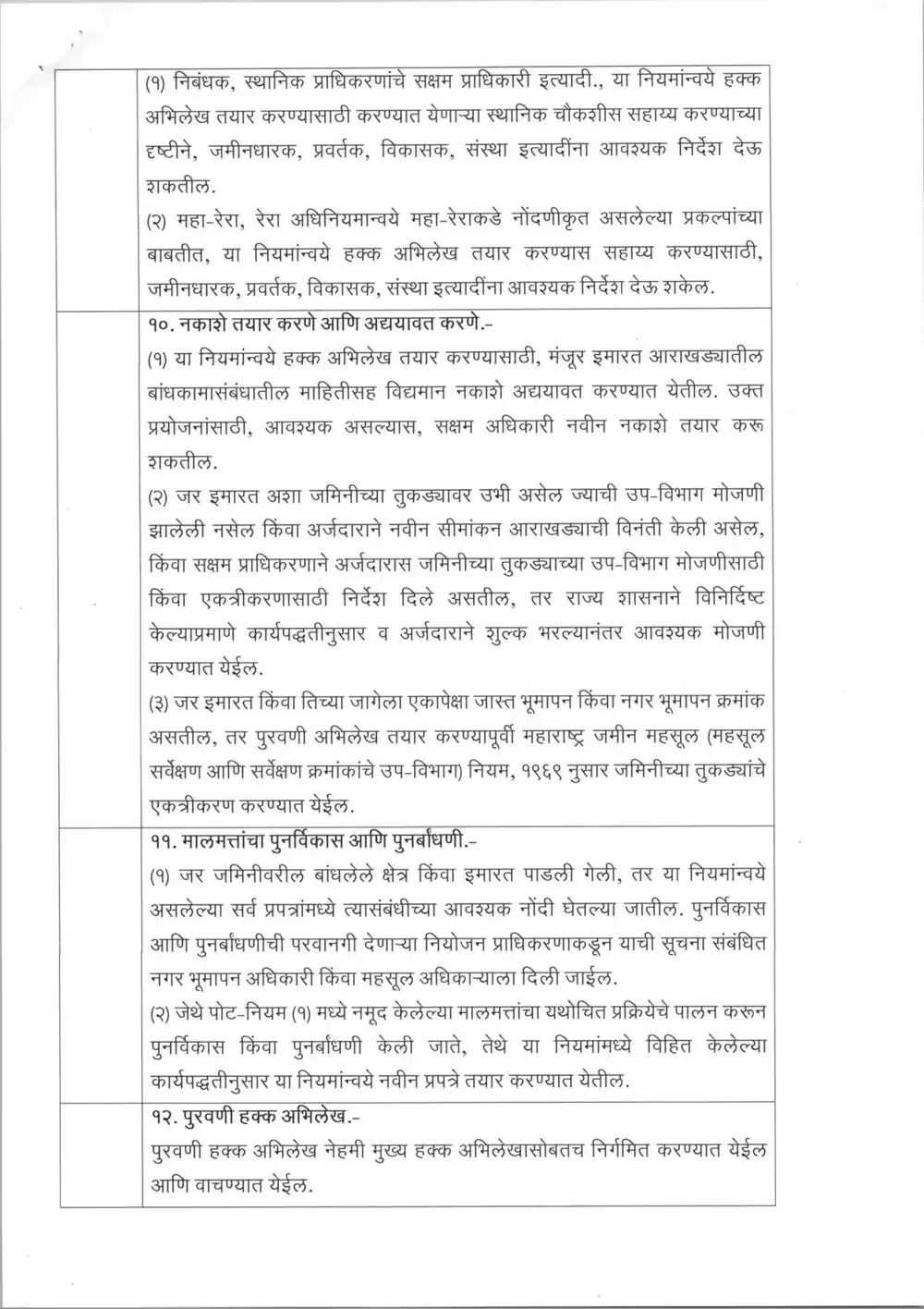
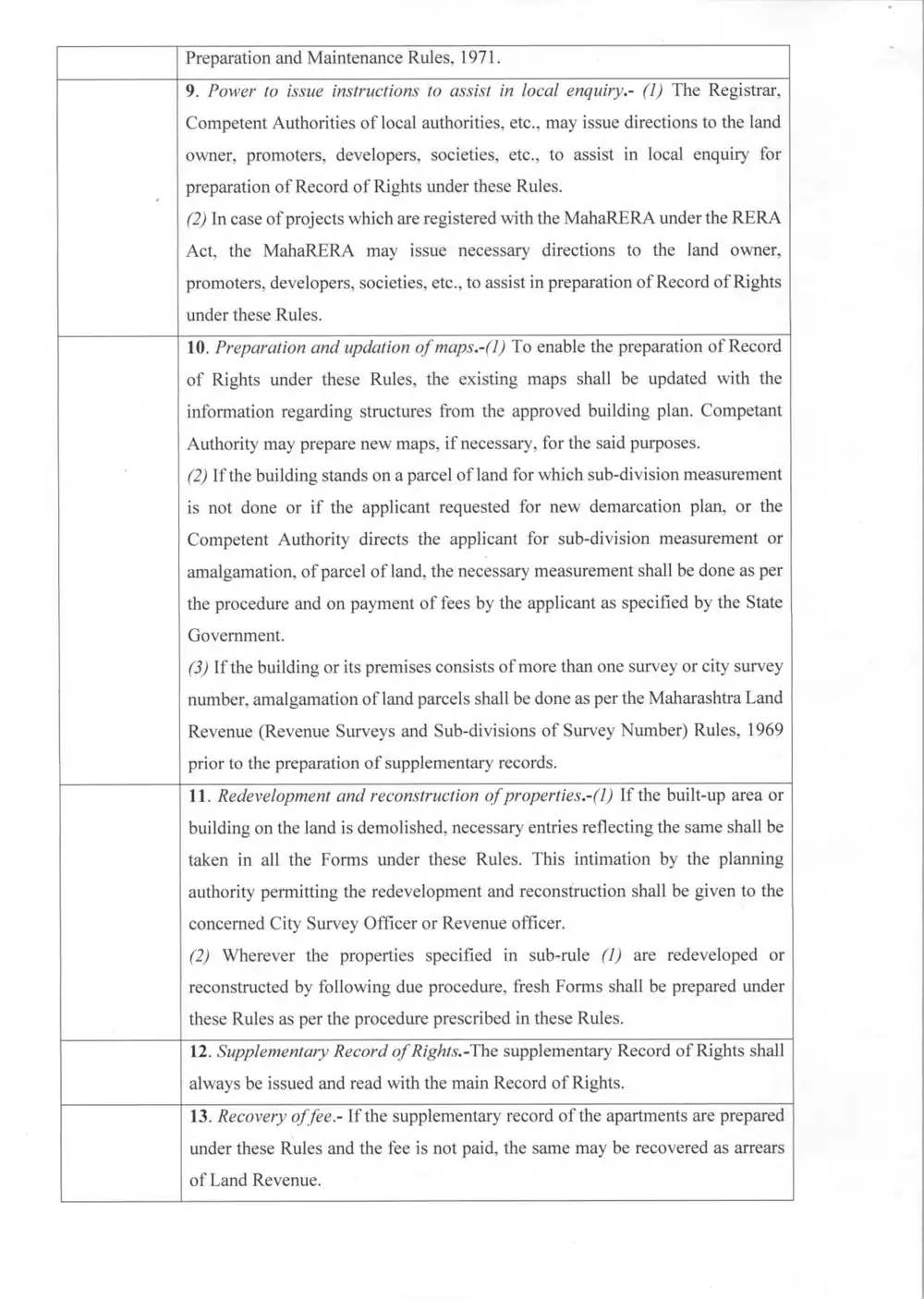
- Redevelopment. If the building is demolished, all forms are updated; after redevelopment, fresh forms are prepared (r.11, p.26).
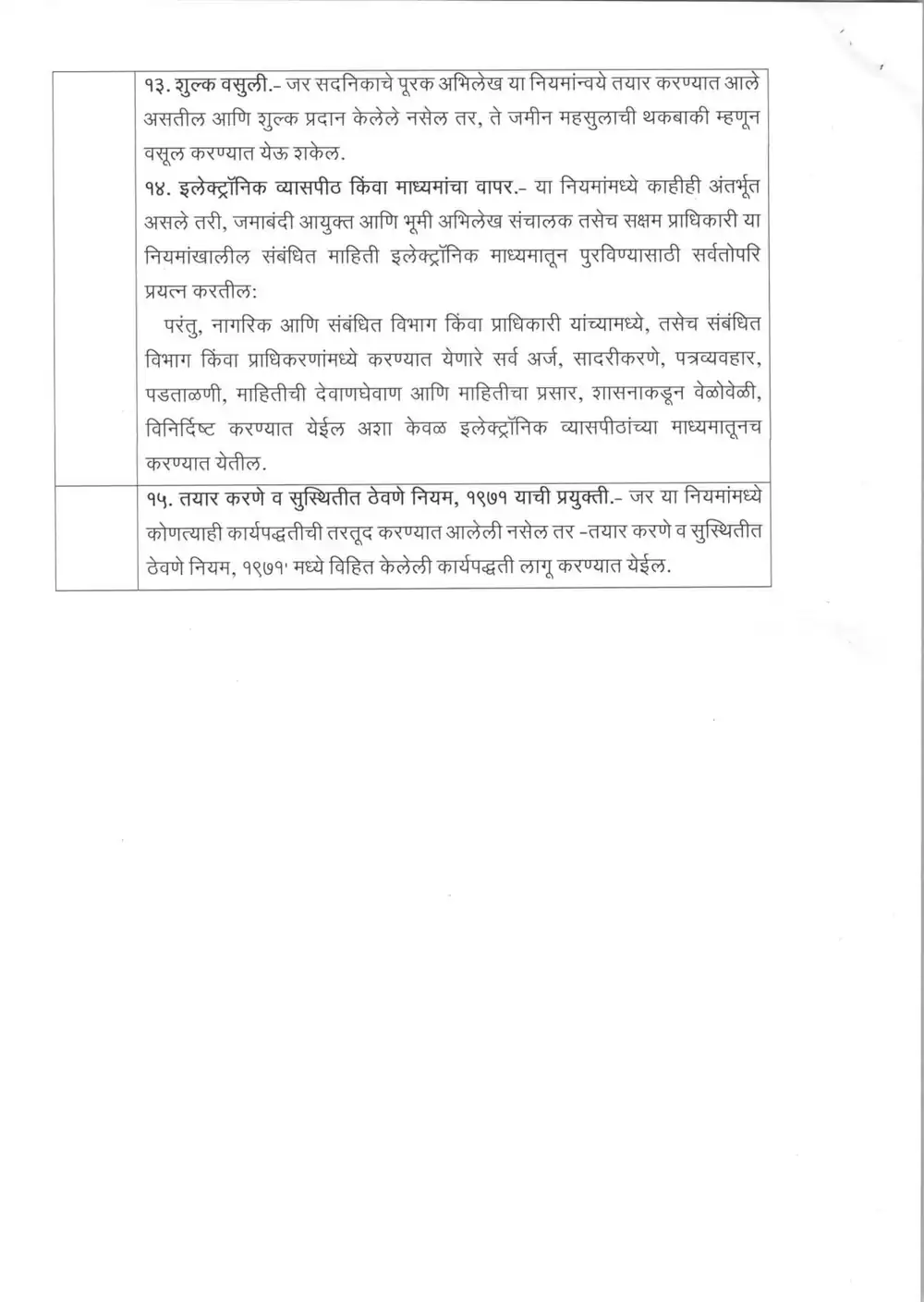
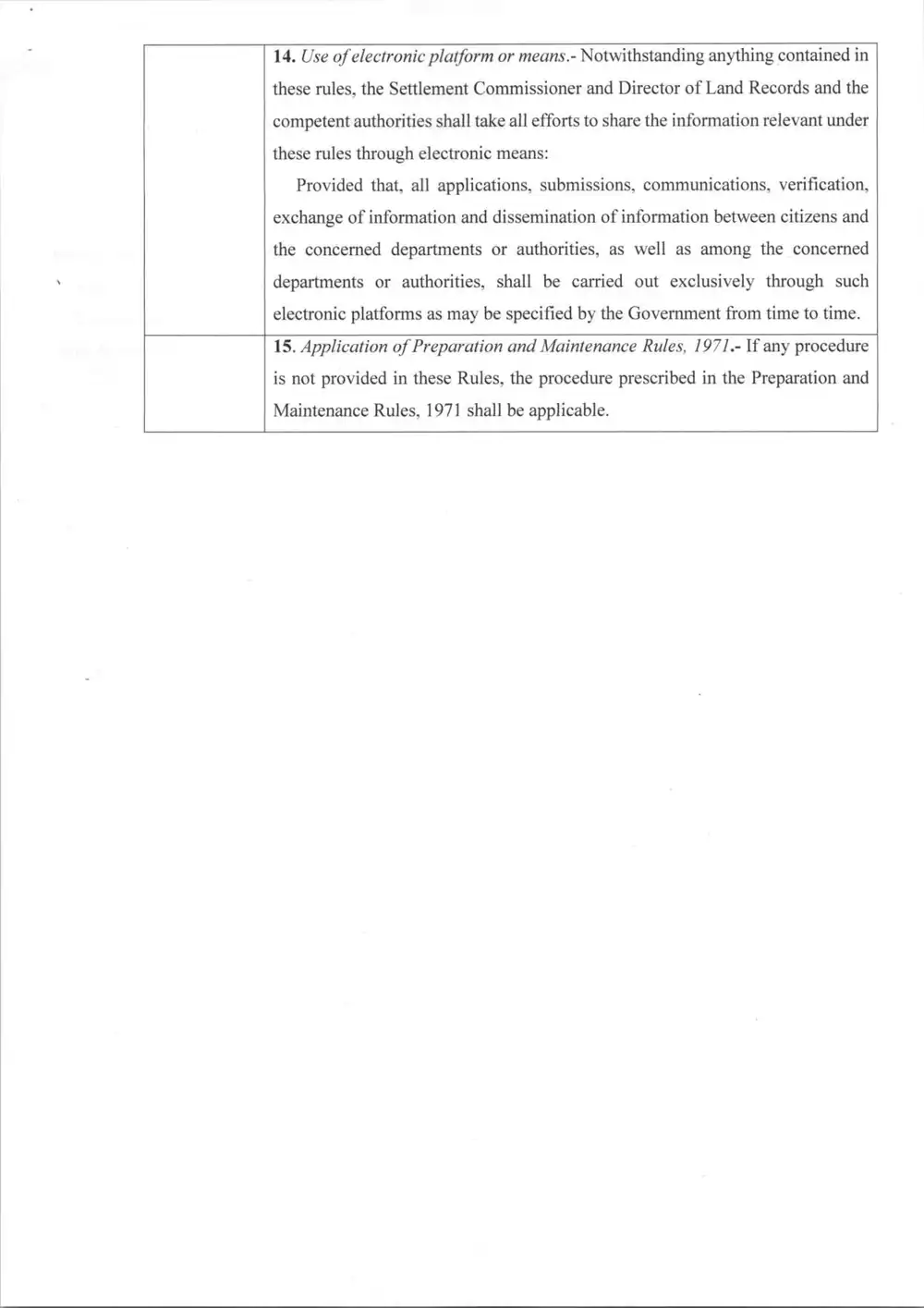
- Online only. Applications, submissions and communications are to be carried out exclusively on electronic platforms the Government will specify (r.14, p.27).
- Fees. If a fee is unpaid, it can be recovered as arrears of land revenue (r.13, p.26). The amount is not fixed in the draft (r.7(4), r.10(2), pp.24, 26).
- No entry without a sanctioned plan. No entry is made unless there is a final sanctioned plan or the competent authority has regularised the apartments (r.7(11), p.25).
What it means for your society and you
If your area is notified, your society's Chairman or Secretary could be the one filing Form E for the whole building (r.7(1), p.24). That makes your society's papers the base of every flat's entry. So the state of those papers matters.
- The record is built on the sanctioned plan, not on what is standing on site. The forms themselves warn that actual construction status should be checked at the site by any interested party (note ##, p.29).
- Societies that have no conveyance or deemed conveyance yet, and old buildings without an occupancy certificate, depend on a regularisation certificate from the planning authority (r.3 provisos, p.22). The draft gives no standard for it.
- The Registrar, competent authorities of local authorities and, for RERA-registered projects, MahaRERA may direct land owners, promoters, developers and societies to assist in the local enquiry (r.9, p.26). Expect requests for papers.
Keep these papers ready (from Annexure I, p.34, and Form E, pp.32-33):
- Existing record of rights (7/12 or property card)
- NA order / sanad, and any permission for restricted tenure land (Form E item 3)
- Sanctioned building plan and commencement certificate
- Completion certificate and occupancy certificate
- Registered conveyance / deemed conveyance / deed of apartment, with Index II
- Registered developer-landowner agreement (DA / JV / MOU)
- Registered Deed of Declaration, if any (Form E item 10)
- Any other registered deed or POA conveying rights
- Society's allotment letter, order or resolution for each member
- Your identity proof and a passport photograph (Form E)
Put dues, mortgage and lease details in one folder too: the flat record has a column for "other encumbrances" (Form I-B / D-2 column 12, p.29).
Gaps we found
We read the draft line by line. These are the gaps. Each one is a reason to write in.
- No fee is fixed. r.7(4), r.10(2) and r.13 all speak of fees, but no amount appears anywhere (pp.24, 26).
- No time limits. Nothing says how long the officer has to verify, enter or mutate. r.7(7) only says the officer shall verify "immediately after the receipt" of the documents, with no time limit for the steps that follow (p.25).
- No notice, correction or appeal. The draft has no rule for notice to affected persons, correcting an entry or appealing; it falls back on the 1971 Rules (r.15, p.27), which are not reproduced.
- "Shall" in English, "may" in Marathi. r.7(2) says the promoter or society "shall make an application" in English (p.24), but the Marathi says "अर्ज करता येईल", which means "may apply" (Marathi p.7).
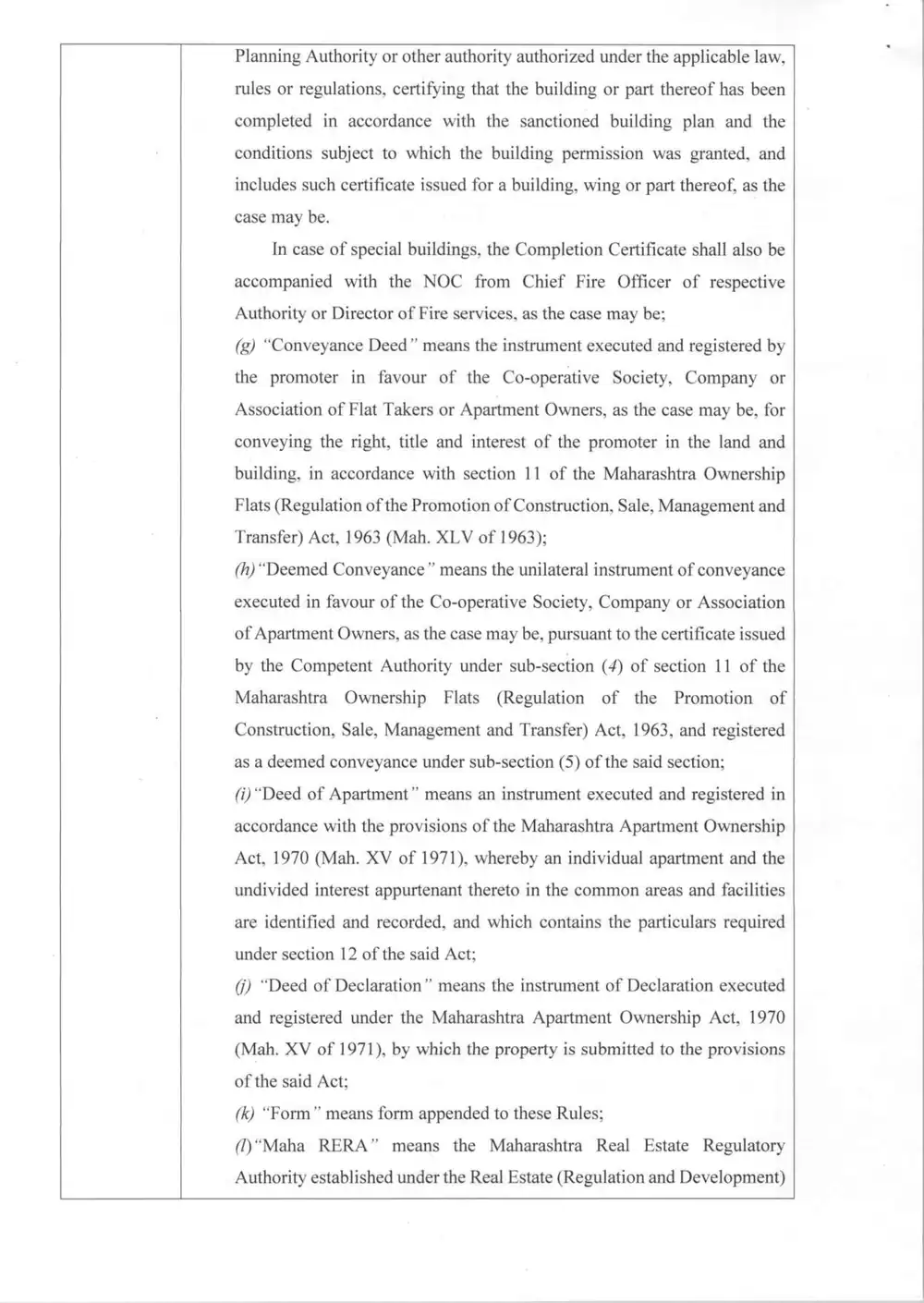
- "Competent authority" is never named. It is used in rr.3, 7, 9 and 10 without a definition (pp.22-26). Also, r.2(1)(p) says the record is prepared "under rule 4", while the forms are in rule 5 (p.21).
- Society dues as encumbrance. Form note **** allows dues of a local authority or society to be entered only after an order of the "competent authority" (p.29). It does not say who that is. Banks' mortgages are not shown separately; there is only a general "other encumbrances" column (p.29).
- Societies and old buildings. There is no standard or procedure for regularisation where a society has no conveyance or deemed conveyance, or an old building has no occupancy certificate (r.3 provisos, p.22; r.7(11), p.25).
- Record before construction. The forms are created as soon as the sanctioned plan is received, so the card may show a flat that is not yet built (note ##, p.29). The building forms (I-A/D-1) have columns for completion and occupancy certificates, but the flat card (I-B/D-2) has no field for construction or occupancy status.
- Plan area or RERA area? r.5(6) takes the area from the sanctioned plan (p.23), but the form note refers to carpet area certified by MahaRERA (note **, p.29).
- Redevelopment. r.11 says fresh forms are prepared after redevelopment, but not what happens to members' entries meanwhile, or by when (p.26).
- Online only, but Form E asks for a photo and signature. r.14 requires exclusively electronic filing on a platform not yet named (p.27), yet Form E requires an affixed photograph and the applicant's signature (pp.32-33). There is no fallback for people who cannot file online.
- Two document lists. Form E lists 15 documents; Annexure I lists 9, and they differ. Annexure I(c) mentions a "prescribed format" but none is provided in the draft (pp.32-34).
- Mutation and nomination. Later mutations simply follow the 1971 Rules (r.7(10), p.25). The draft does not say how a nomination in a society is treated. In our view, a nominee is not automatically the owner, so a nomination alone should not change the name on the card.
The Vertical Property Card we should get
Most owners already hold a sale deed or agreement, a society share certificate, and the society's 7/12 or property card. When someone dies, bringing the legal heirs on record is a separate task, and a society nomination is separate again. These papers sit in different offices and often do not match.
We suggest the new card be one record that points to each of these documents and is kept up to date from data the offices already exchange (for example r.8 intimation by the Registering Officer). It should solve problems without adding paperwork for the member.
We also suggest that the card update automatically when a deed is registered, with Index-II data flowing from the IGR Maharashtra registration system.
Tap a number to see why that field is on the card.
PROPOSED
अ. मालमत्ता · A. Property
ब. धारक · B. Holders
| # | नाव · Name | हिस्सा · Share | आधार (ऐच्छिक) · Aadhaar (optional) | पडताळणी · Verified |
|---|---|---|---|---|
| 1 | श्री. अ. ब. उदाहरण | 50% | XXXX-XXXX-1234 | ✓ |
| 2 | सौ. क. ड. उदाहरण | 50% | XXXX-XXXX-5678 | ✓ |
| 3 | ||||
| 4 |
क. मालकी दस्त · C. Title (Index-II)
| दस्त · Document | नोंदणी क्र. · Reg. No. | दिनांक · Date | दु.नि. · SRO | सूची-२ |
|---|---|---|---|---|
| विक्री करार · Agreement for sale | 1234/2015 | 12.03.2015 | उदाहरण-२ | ✓ IGR |
| विक्री खत · Sale deed | 5678/2027 | 10.01.2027 | उदाहरण-२ | ✓ IGR |
ड. संस्था · D. Society
इ. नामनिर्देशन व वारस · E. Nominee and heirs
फ. बोजा · F. Encumbrances
| बँक तारण · Bank mortgage | Example Bank · 15.03.2015 |
| संस्था थकबाकी · Society dues | none (s.154B-29 no certificate) |
| मालमत्ता कर · Property tax | none |
| न्यायालय आदेश · Court order | none |
ग. फेरफार · G. Mutations
| क्र. · No. | दिनांक · Date | तपशील · Details | सूचना · Alert |
|---|---|---|---|
| 5671 | 12.01.2027 | विक्री खत 5678/2027 (IGR) | SMS ✓ Email ✓ |
- Buyer verification: one look shows holders, title deed, society membership and dues.
- Bank loan: the lender sees mortgage and encumbrances, and can note its charge, without chasing several offices.
- Resale: fewer rounds for NOC, share transfer and registration, because the papers are already linked.
- Death of a member: heirs and nominee are shown separately, so a nominee is not mistaken for the owner.
- Double-sale fraud: an alert to the holder on every change, and a dated history, make a second sale easy to catch. IGR sync also brings a registered sale to the card at once.
- Society records mismatch: the card is mapped to the society's share register and allotment letters, so differences surface and get fixed once.
- Redevelopment entitlement: the member's area and status are preserved while the building is under redevelopment.
- Disputes: parking, joint shares and dues are written down in one place.
- Protection for societies (our suggestion): if holders confirm their own data, the rules could state that the society is not responsible for members' title data.
What it must not become: no separate application by each member, no fee for every update, no new affidavits, and no repeated visits to offices. Verification should be done once, at society level, using records the society and the offices already hold.
How to send your objection or suggestion
The draft says objections or suggestions must reach the Settlement Commissioner and Director of Land Records, Maharashtra State, Pune, or the email vprscdlr@gmail.com, on or before 26 December 2026 (p.19). The draft gives no street address, only "Pune", and no prescribed form.
- By email: send to vprscdlr@gmail.com. Put the notification number in the subject line.
- By post: address it to the Settlement Commissioner and Director of Land Records, Maharashtra State, Pune. Use speed post or courier so you get a tracking receipt.
- Send by 24 December, not on the last day. A mail that bounces or a post that is delayed leaves you no time to fix it.
- Keep a copy of the letter, the sent email and any receipt.
- Societies: if you wish, your committee or general body can pass a resolution and the society can send its own letter as well. This is an option, not a requirement of the rules.
Tick the points you agree with in the builder below, choose objection, suggestion or both, and the letter is made for you.
Build your email to the Government
Choose what you are sending, tick the points you agree with, add anything of your own. The letter is written below in your words-ready form; change anything before sending. It goes from your own email ID, with SocietySeWA in CC.
1. What are you sending?
2. Letter language
3. Tick the points you want to raise
30 point(s) selected
4. Anything else? (optional)
5. Your details
These details will be used to fill your signature.
Questions people ask
Is this law already in force?
No. These are draft rules published for objections. The Government will take them up on or after 26 December 2026 (p.19). Even after they are made, they apply only to areas and building categories the State notifies (r.3(1), p.21).
Do I have to apply for my flat's record?
The draft is unclear. The English text of r.7(2) says the promoter or society "shall" apply for new buildings, while the Marathi says "may". For existing buildings r.7(1) says "may apply", and only after the area is notified (pp.24; Marathi p.7).
Who can apply in Form E?
The land holder, promoter/developer, or the Chairman, Secretary or other authorised person of the society or association, or an individual flat holder with documents for the whole building (r.7(1),(3), p.24).
What will it cost?
The draft does not say. It speaks of fees "as specified by the State Government from time to time" (r.7(4), p.24) and measurement fees (r.10(2), p.26), and an unpaid fee is recoverable as land revenue arrears (r.13, p.26). No amount is given.
What if my society has no conveyance or the building has no occupancy certificate?
The competent planning authority may give a certificate approving or regularising the building or layout under an existing law, rule or State policy (r.3(2) proviso, p.22). The draft does not set any standard or procedure for this, which is why we suggest asking for one.
Will the property card show my society's dues or my bank loan?
Form I-B / D-2 has a column for encumbrances (column 12), and note **** says dues of the Local Authority or Society are entered only after an order of the competent authority. Bank mortgages are not separately mentioned (p.29). Nothing else is stated in the draft.
Can I send an objection if I am only a tenant or not a society member?
Yes. The draft invites objections or suggestions "from any person" (p.19).
How to apply for a property card for a flat in Maharashtra?
Not yet possible: the rules are draft. Under the draft, once your area is notified, the society, promoter, land holder or an individual flat holder applies in Form E to the Dy. Supdt. of Land Records / City Survey Officer with Annexure I documents (r.7, pp.24-25; Form E pp.32-33). Under the draft, filing is proposed to be only on an electronic platform the Government has yet to specify (r.14, p.27).
Can a new society get a property card for its flats?
Under the draft, for buildings after the rules start, the society, promoter or association applies in Form E once the sanctioned plan and commencement certificate (or conveyance with plan) are received, in an area the Government has notified (r.3(1), p.21). English says "shall"; Marathi says "may" (r.7(2), p.24; Marathi p.7). Draft only.
Is the vertical property card the same as a 7/12 for flats?
Under the draft, it is a supplement, not a replacement. In city-surveyed areas the draft provides a Supplementary Property Card (Form D-2); elsewhere Form I-B ("7-D") with building Form I-A ("7-C"), kept with the village record (r.5, pp.22-23; r.12, p.26).
What documents are needed for a flat property card?
Under the draft, Annexure I lists: existing record of rights; NA order/sanad; sanctioned plan with completion/occupancy certificate; registered conveyance, deemed conveyance or deed of apartment; developer-landowner agreements; other registered deeds; society allotment letter; any other document the Settlement Commissioner prescribes (p.34). Form E lists 15 items (pp.32-33).
Is there a fee for the vertical property card?
The draft fixes no amount. Applications go with documents and "fees as specified by the State Government from time to time" (r.7(4), p.24). Unpaid fees are recoverable as arrears of land revenue (r.13, p.26).
Will existing societies and old buildings get a property card?
The draft allows buildings built before the rules start to apply for the first record in Form E, but only after the area is notified (r.7(1), p.24; r.3(1), p.21). A final sanctioned plan or regularisation is needed for entries (r.7(11), p.25). Draft only.
Read the full draft (34 pages)
The complete notification as published, page after page: Marathi pages 1 to 18, English pages 19 to 34. Scroll inside the box like a PDF.
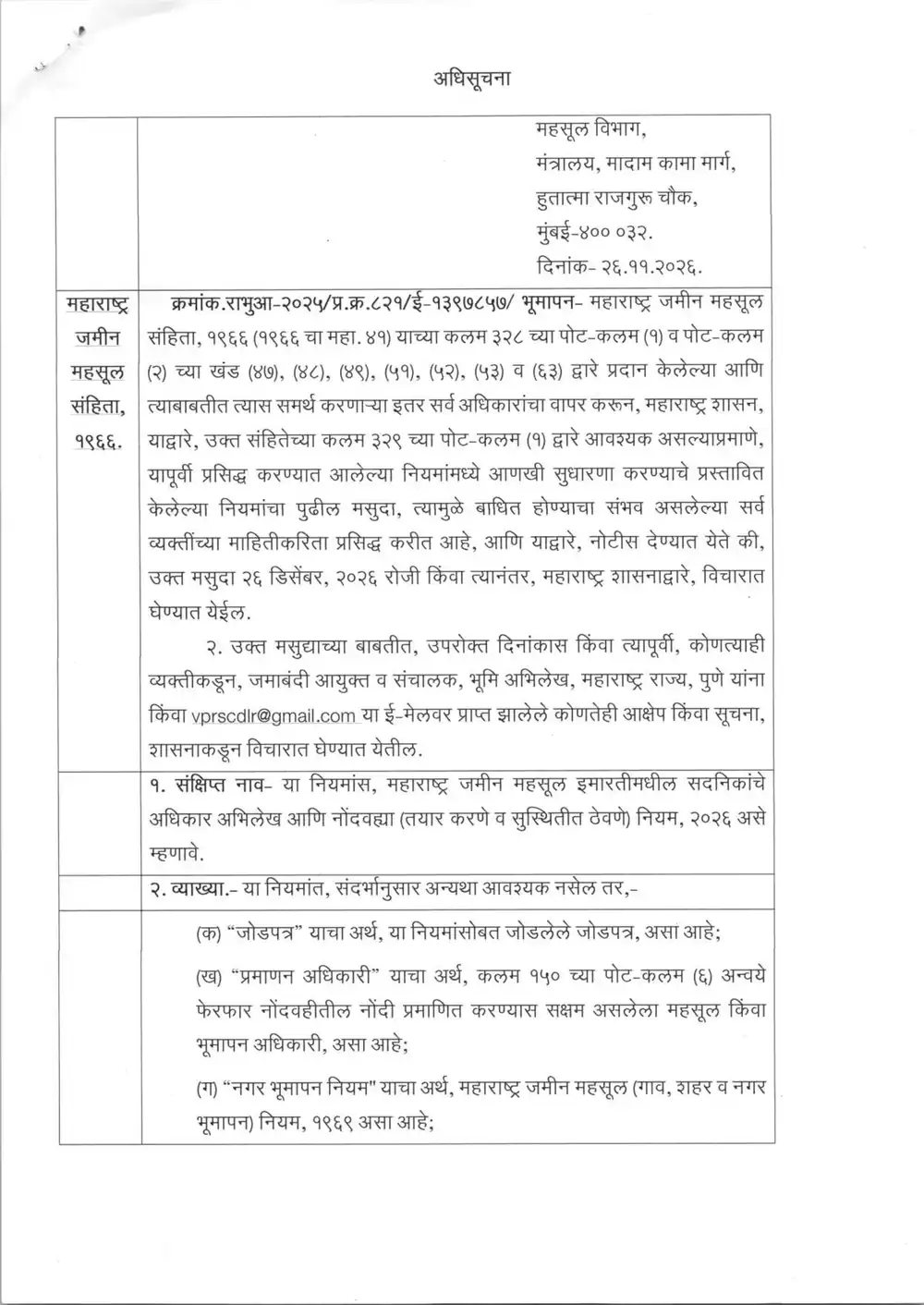
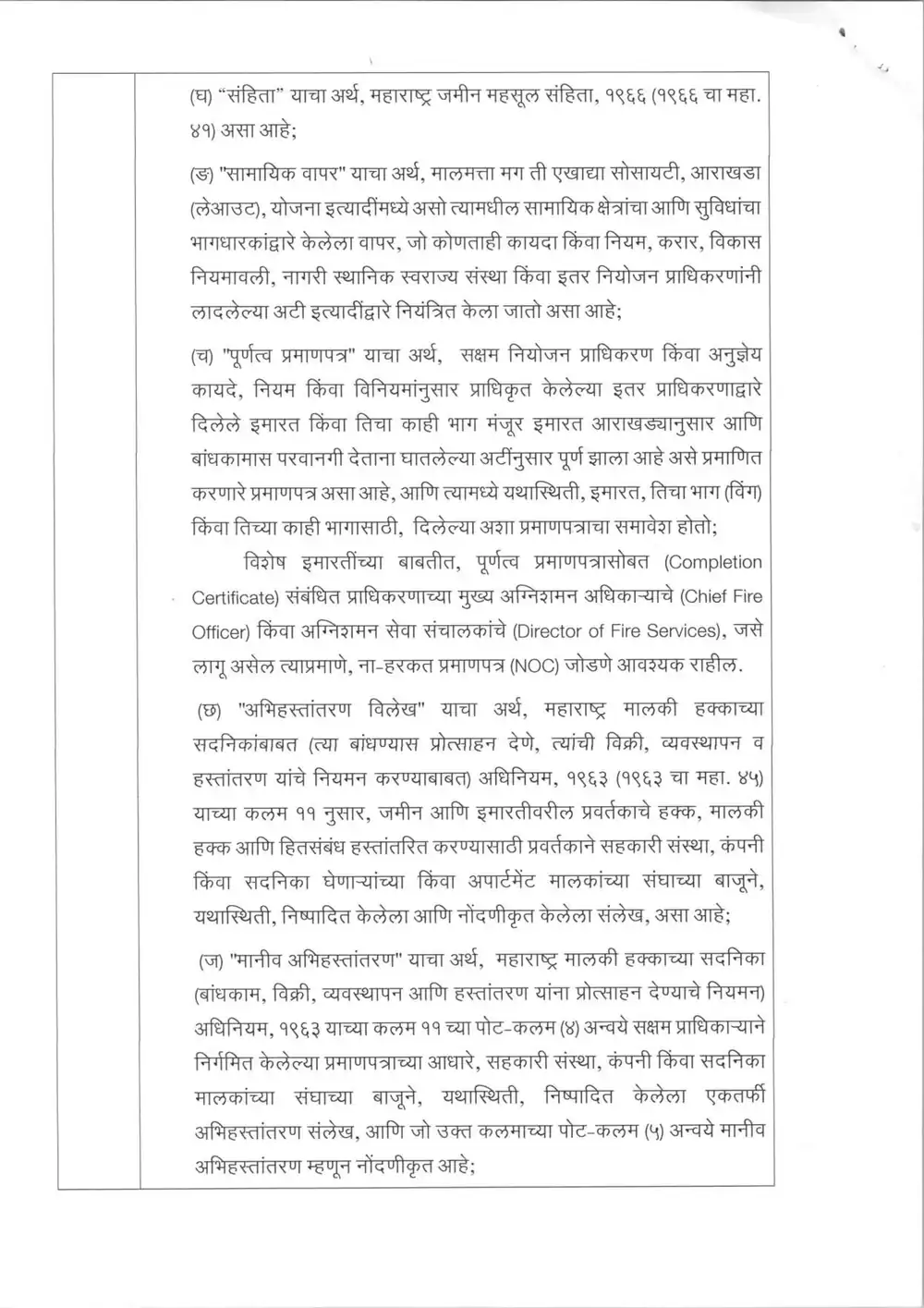
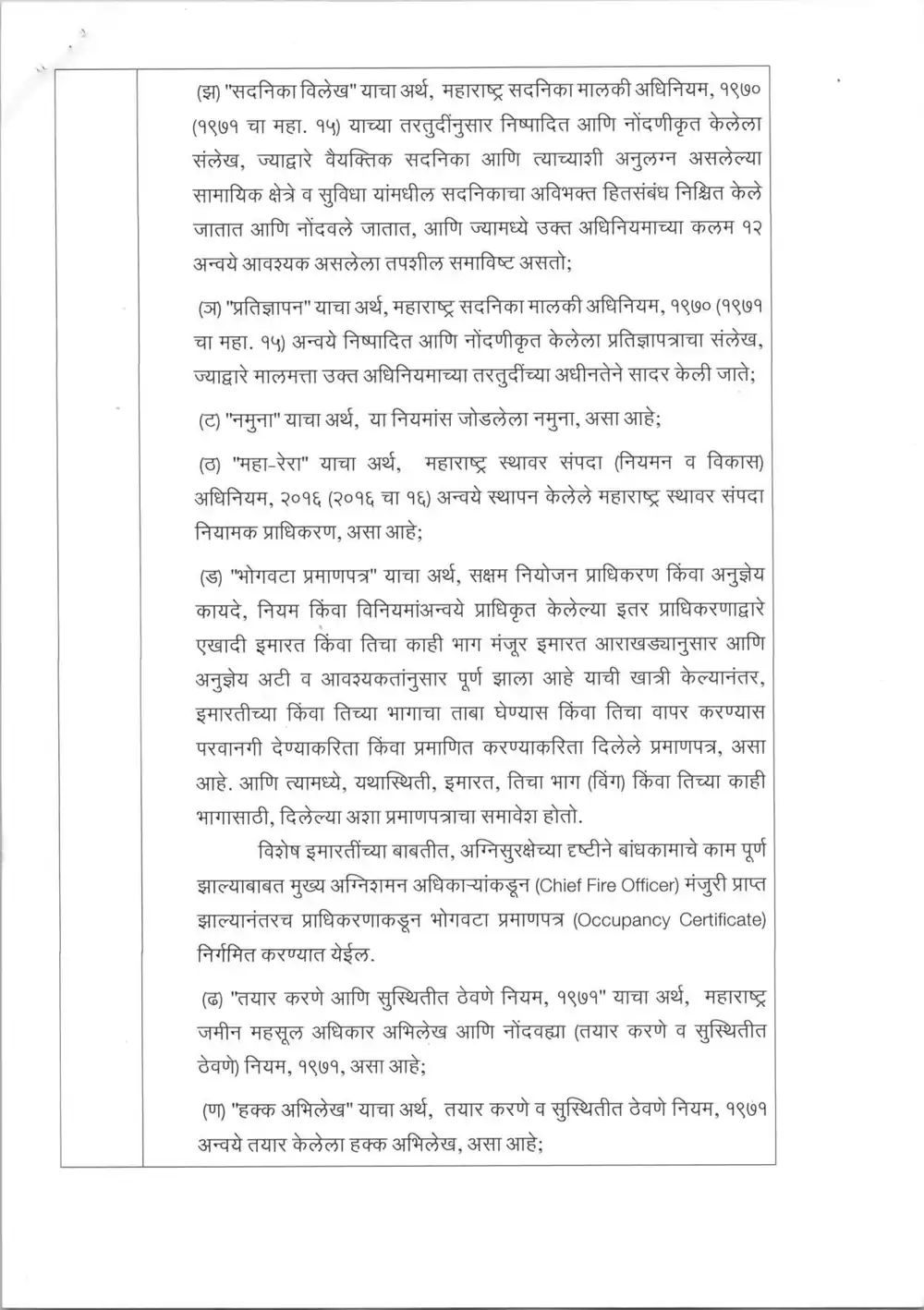
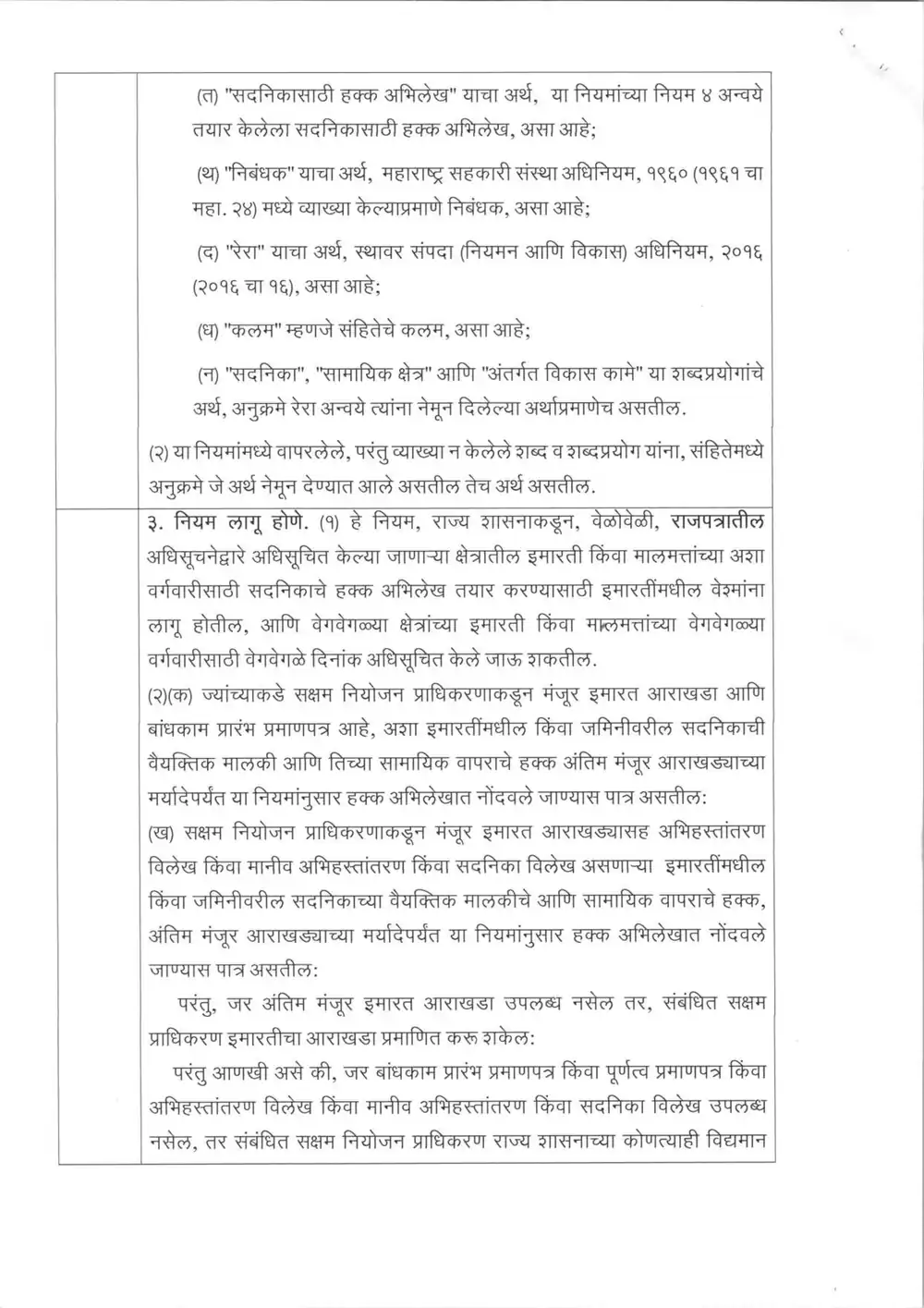
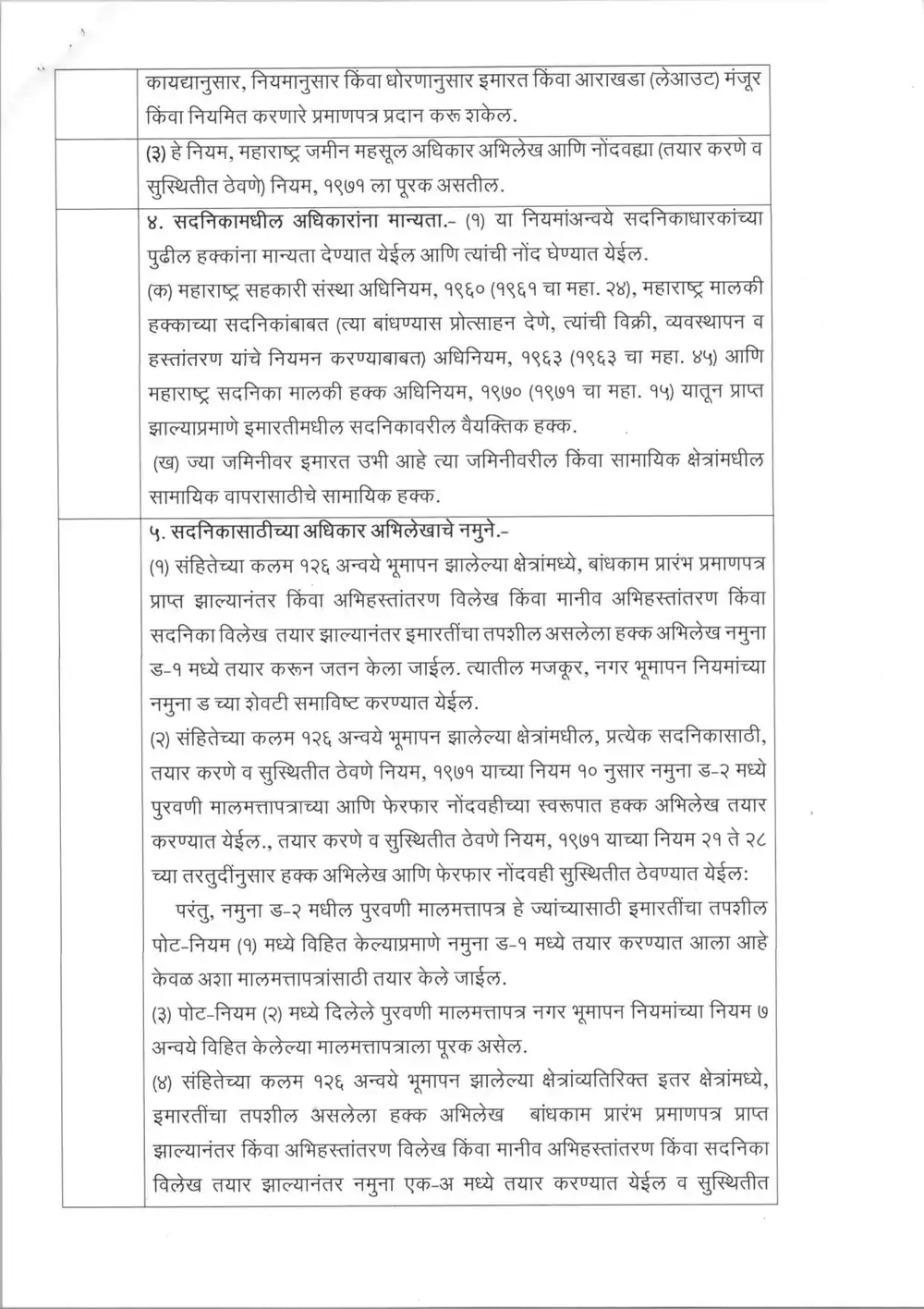
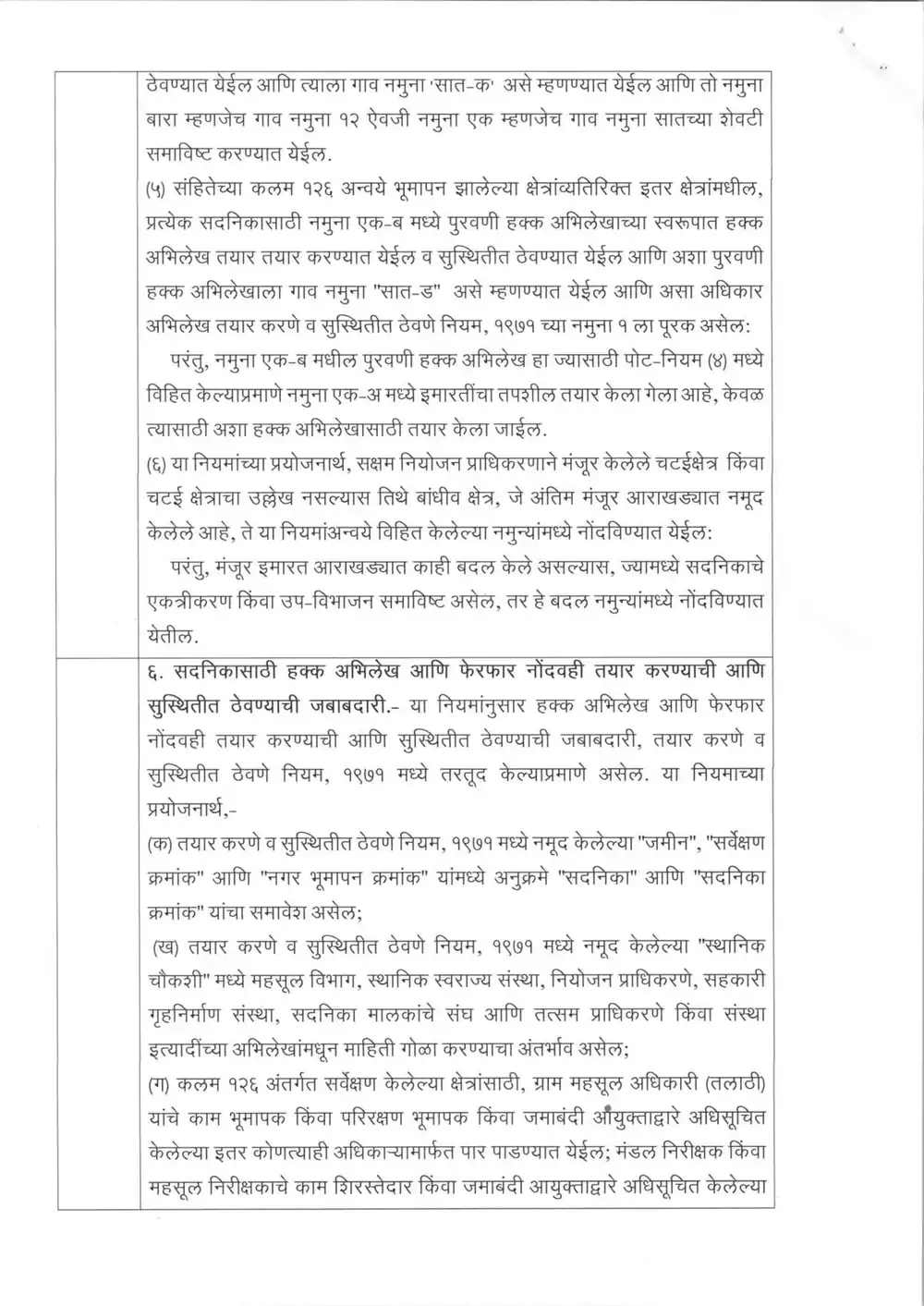
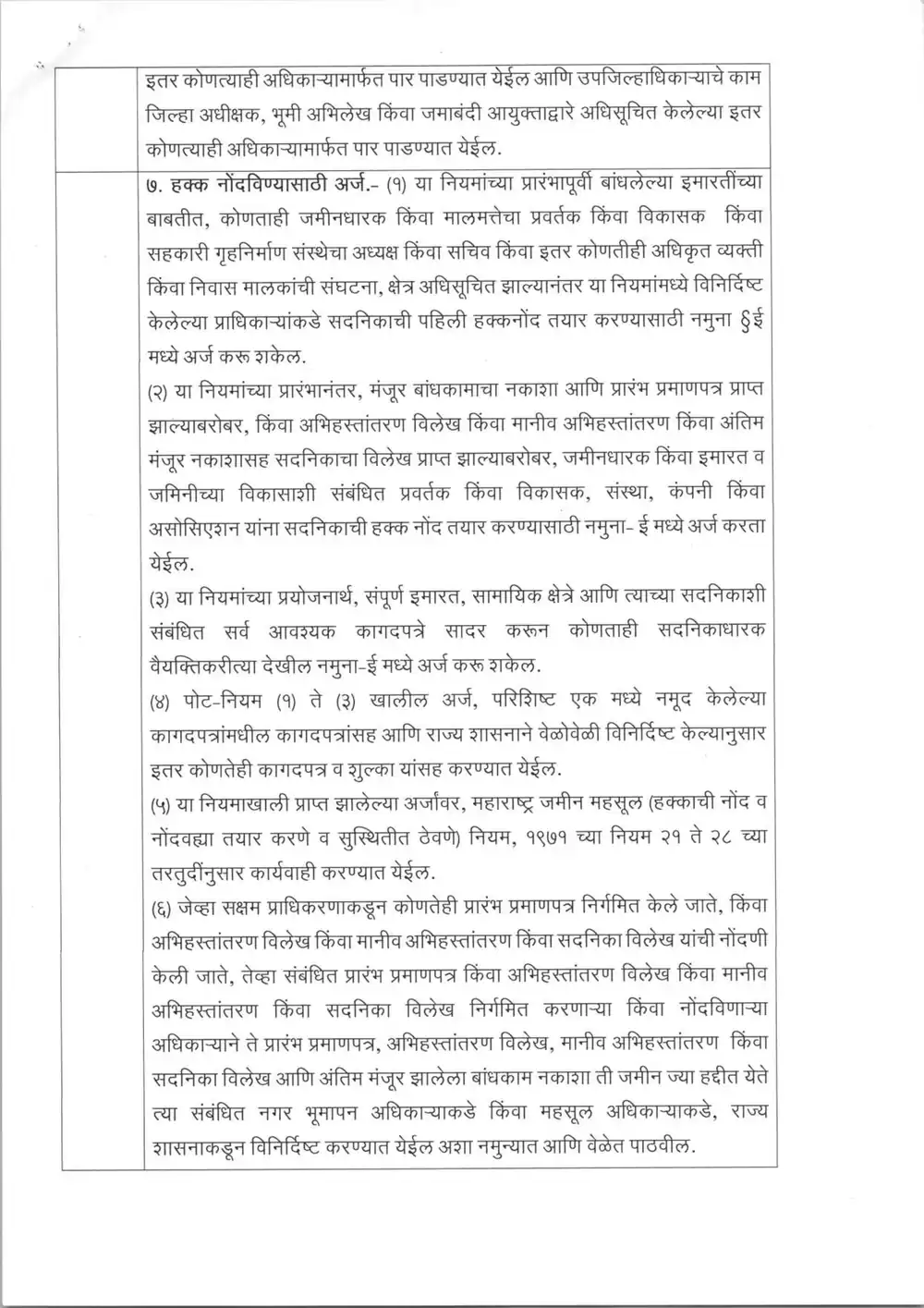
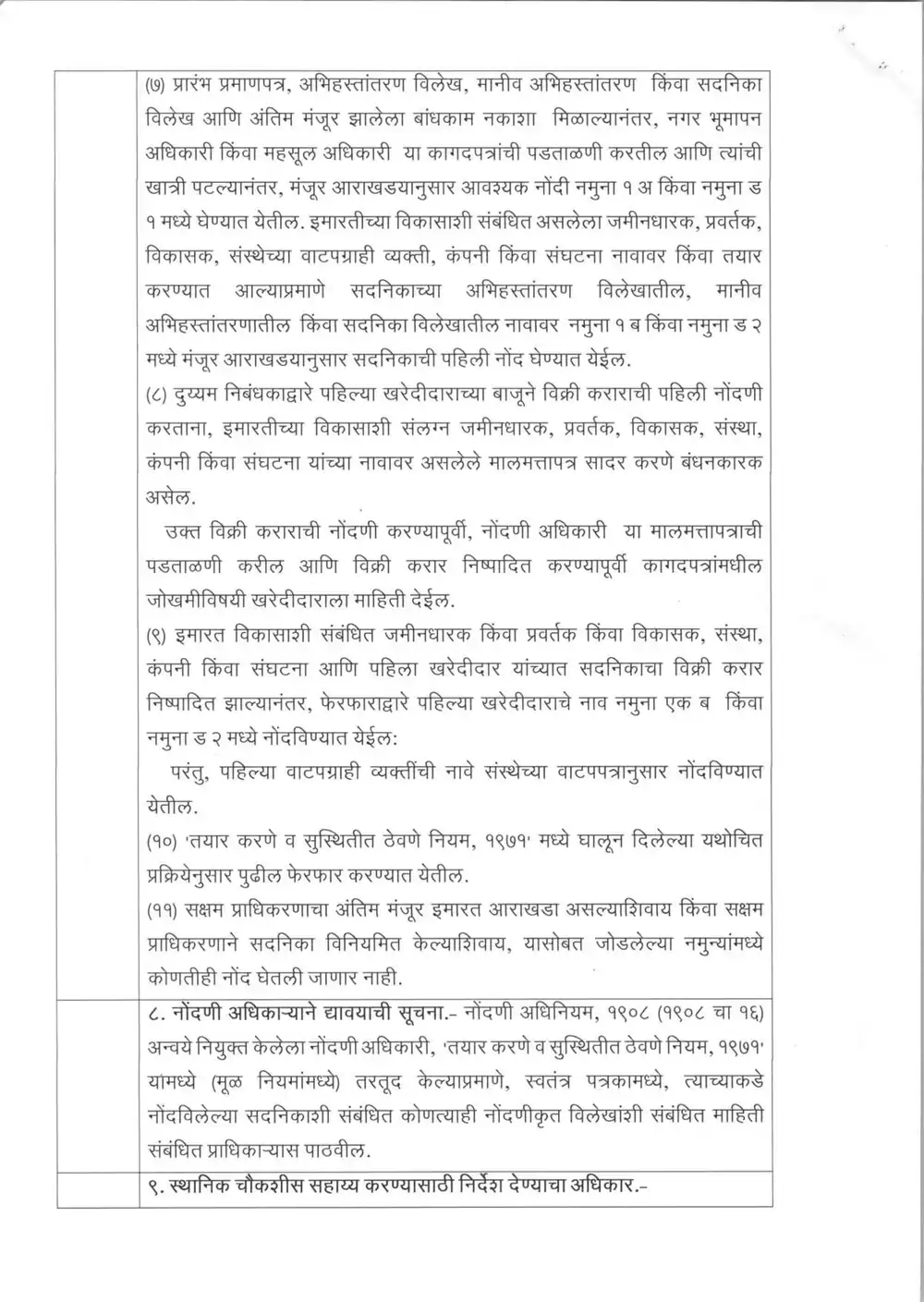
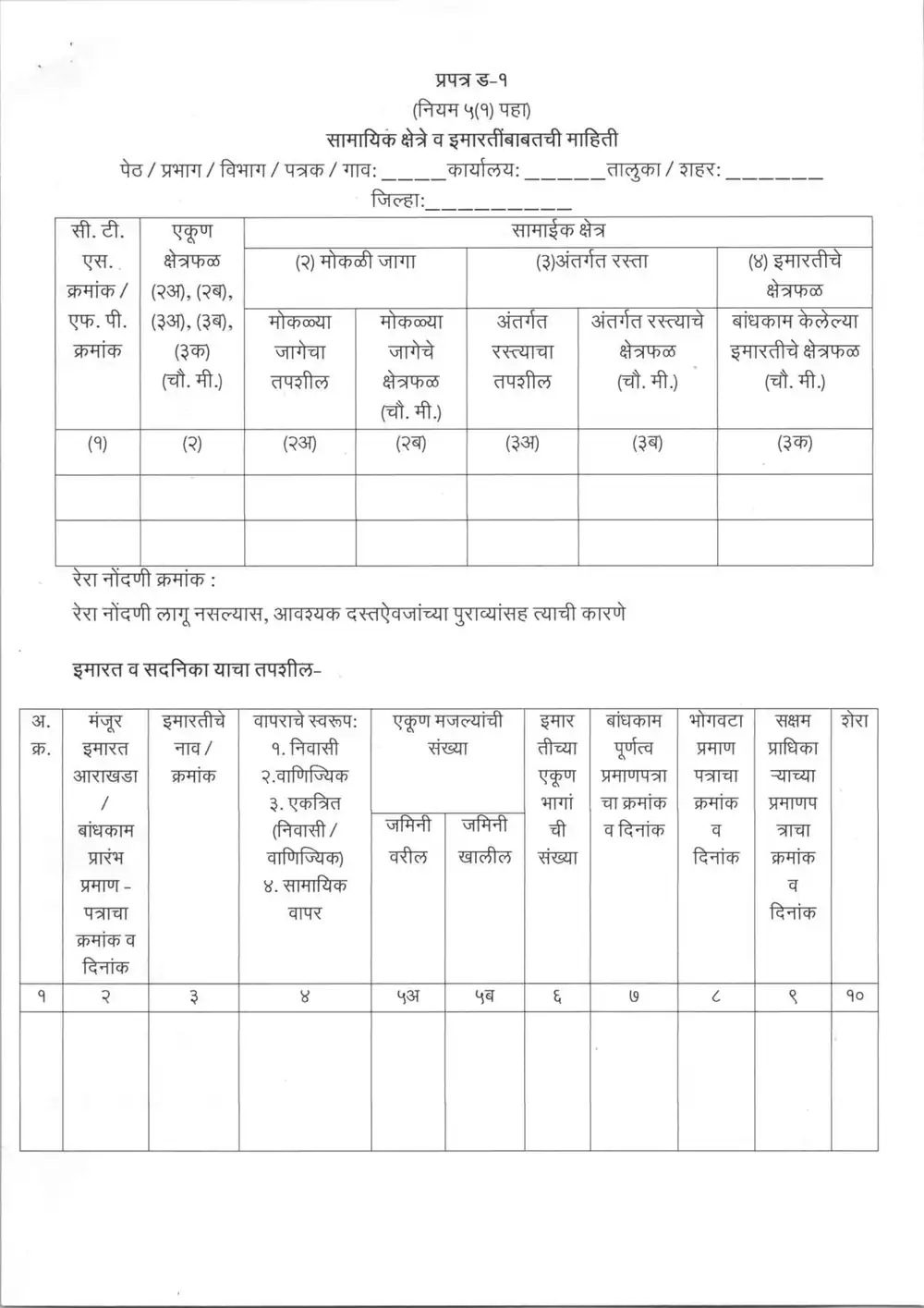
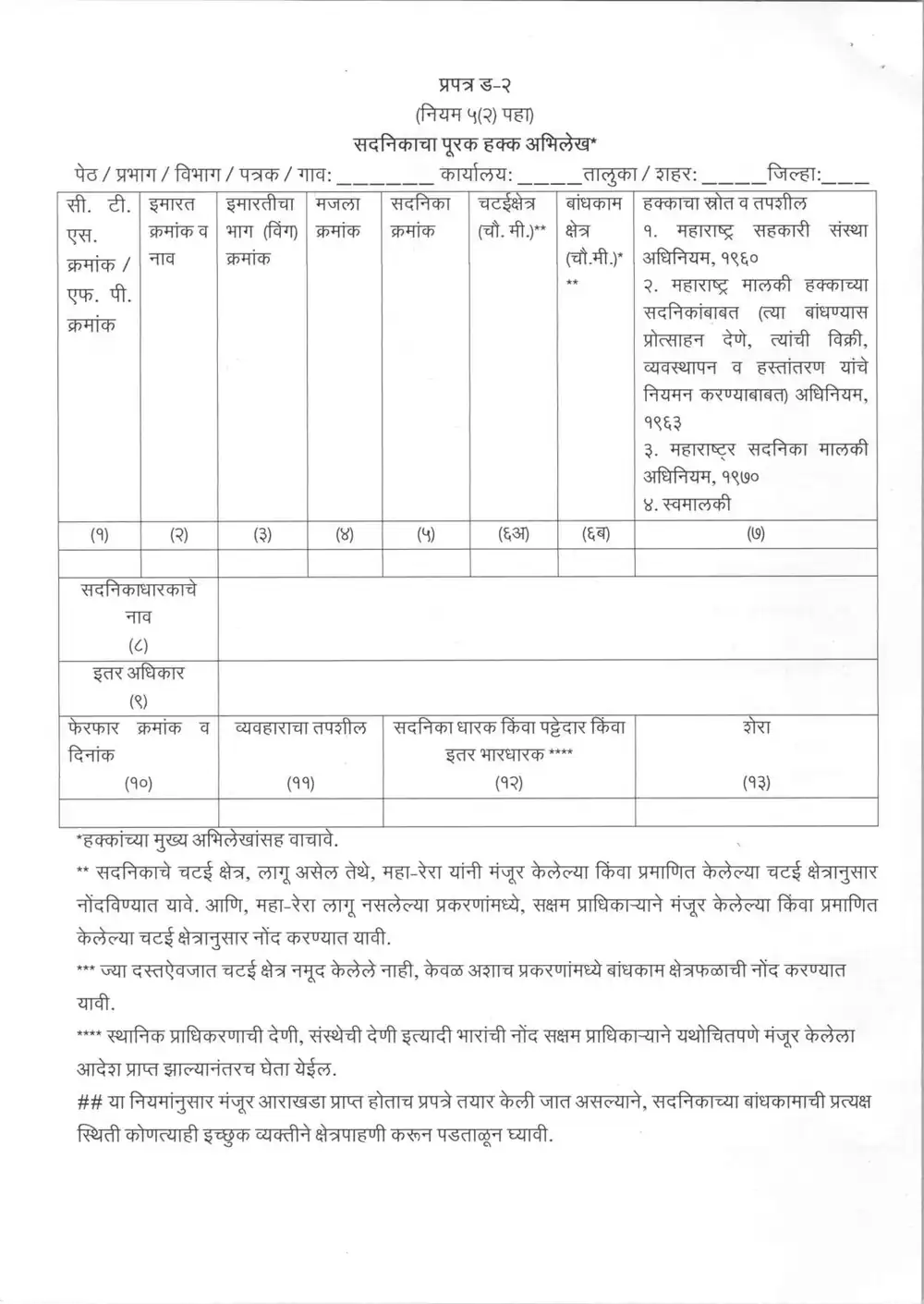
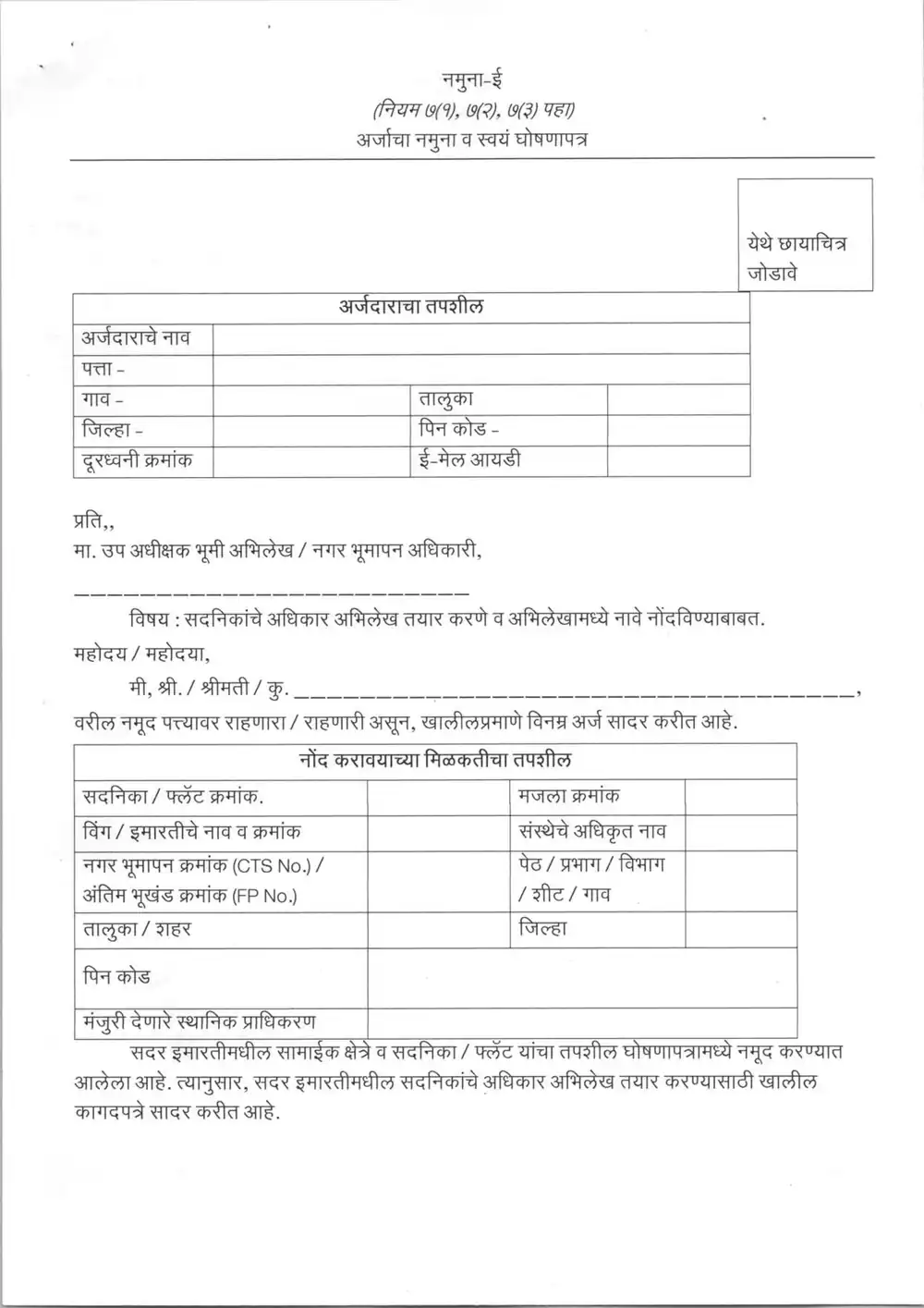
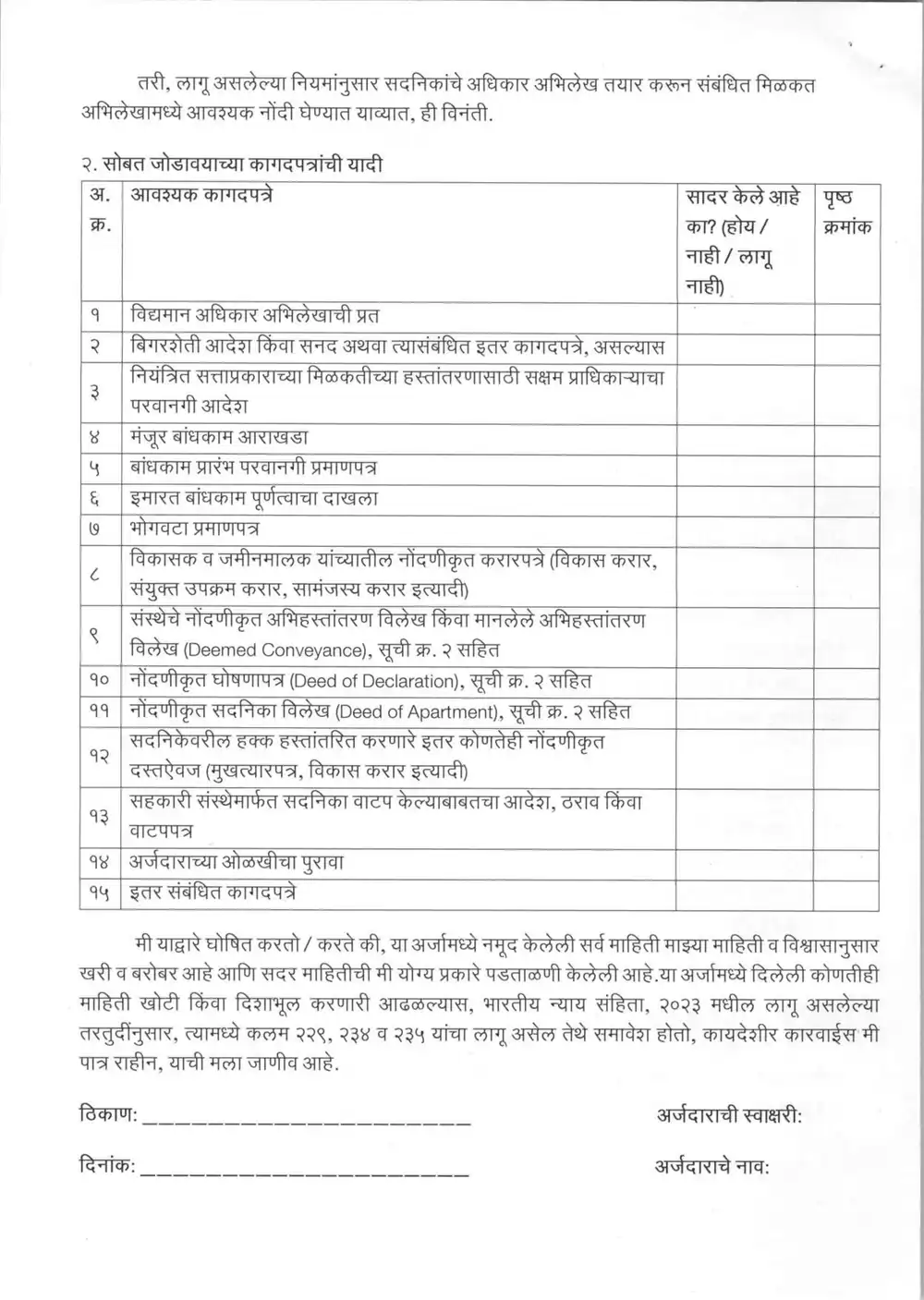

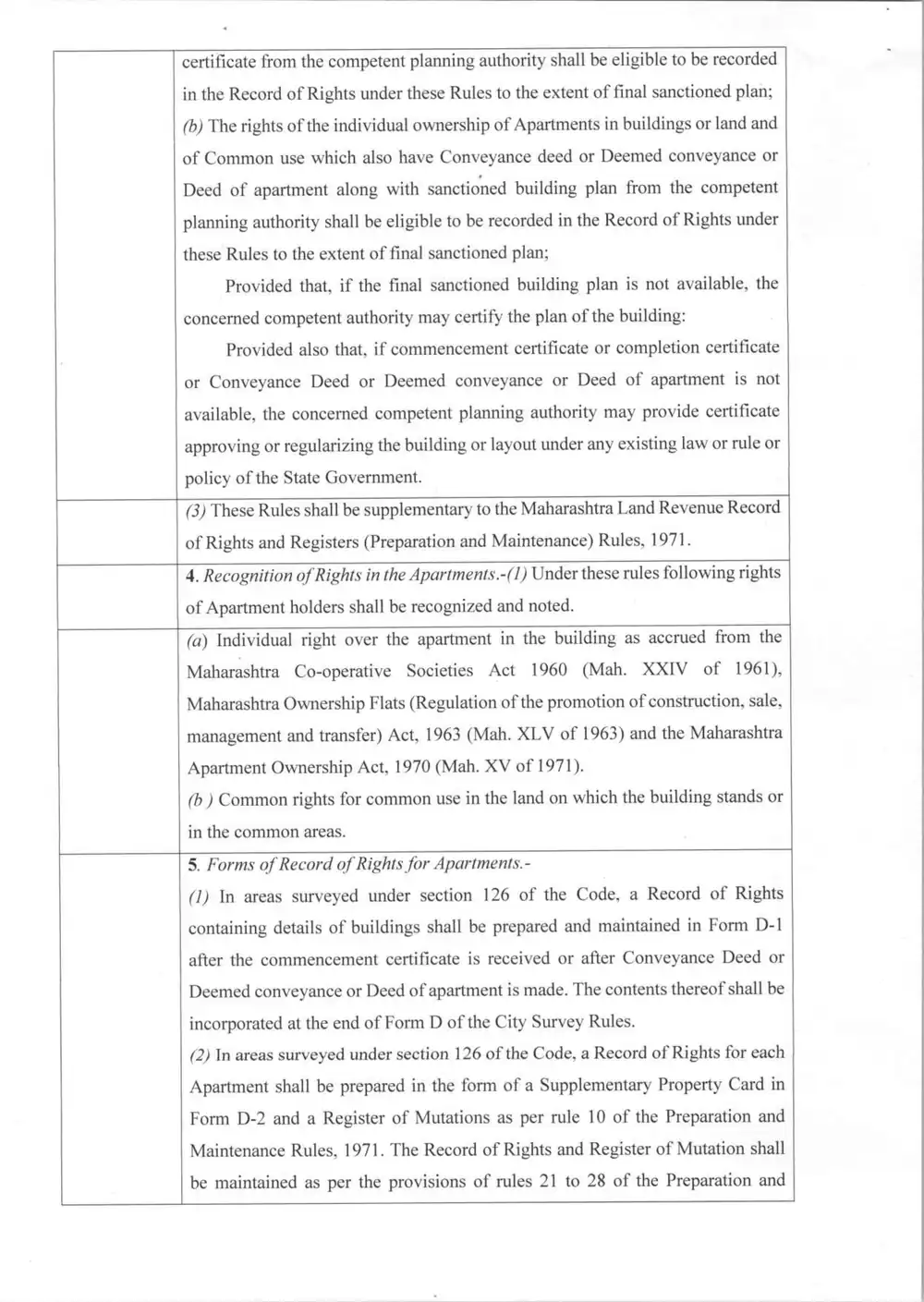
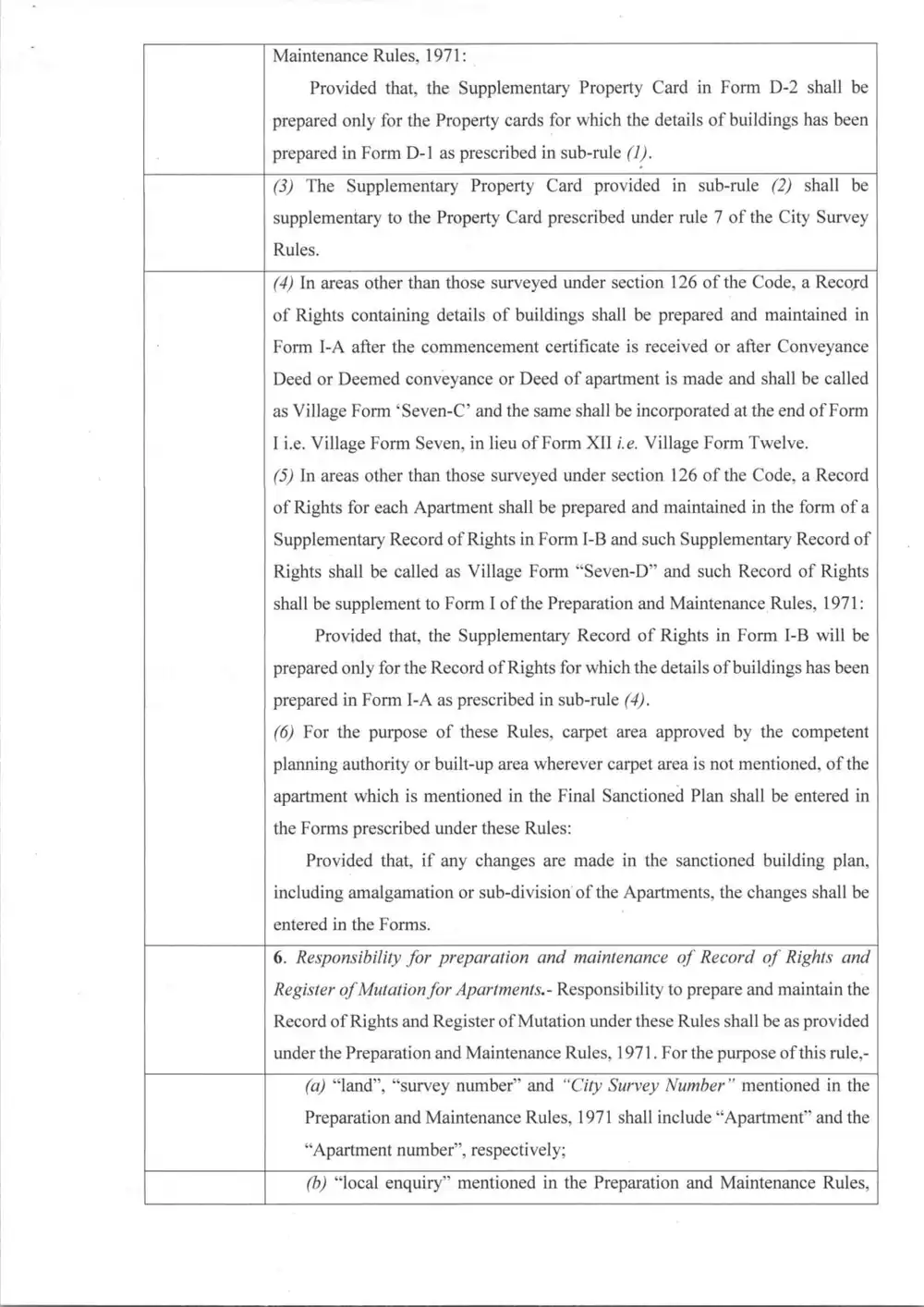
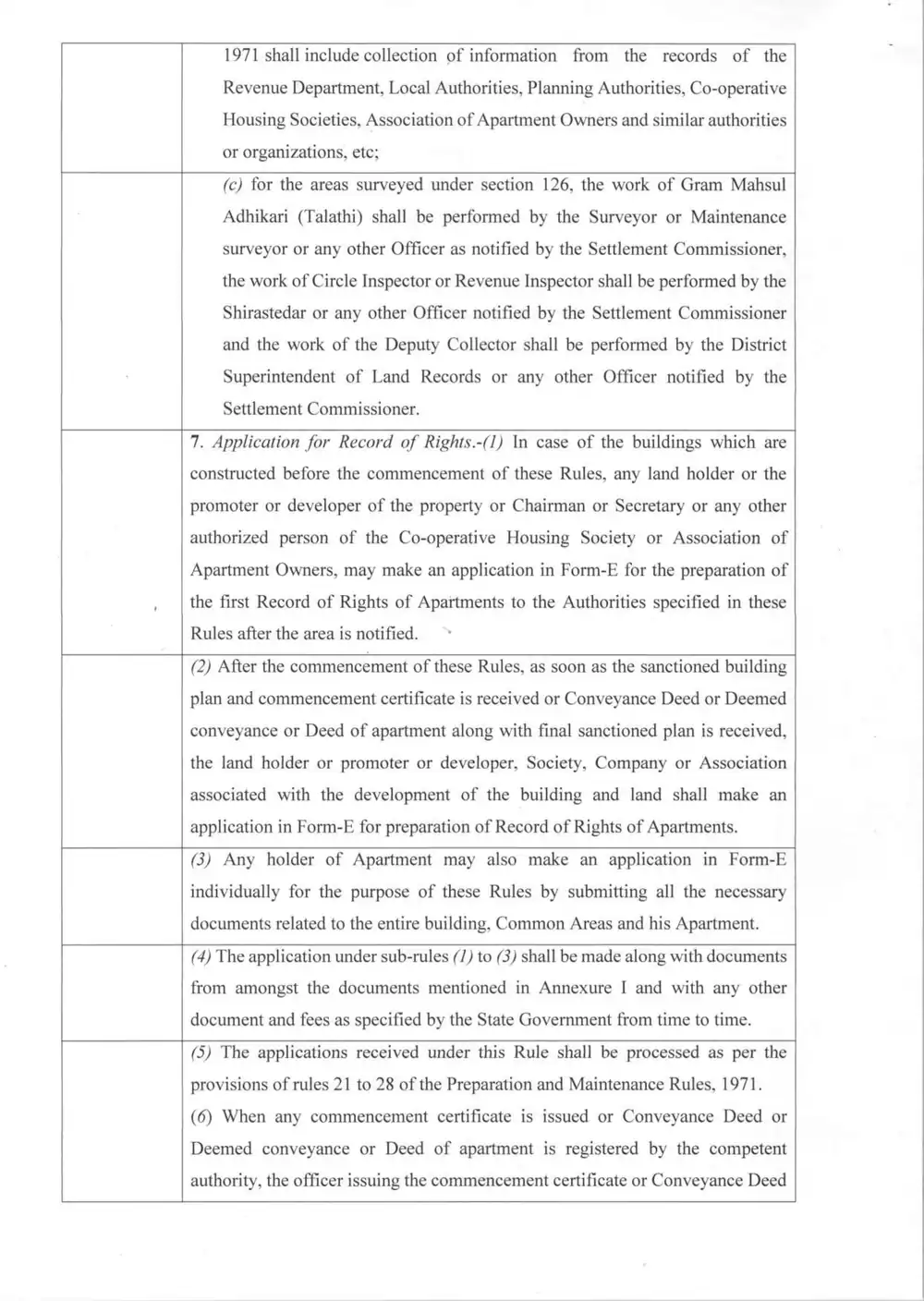
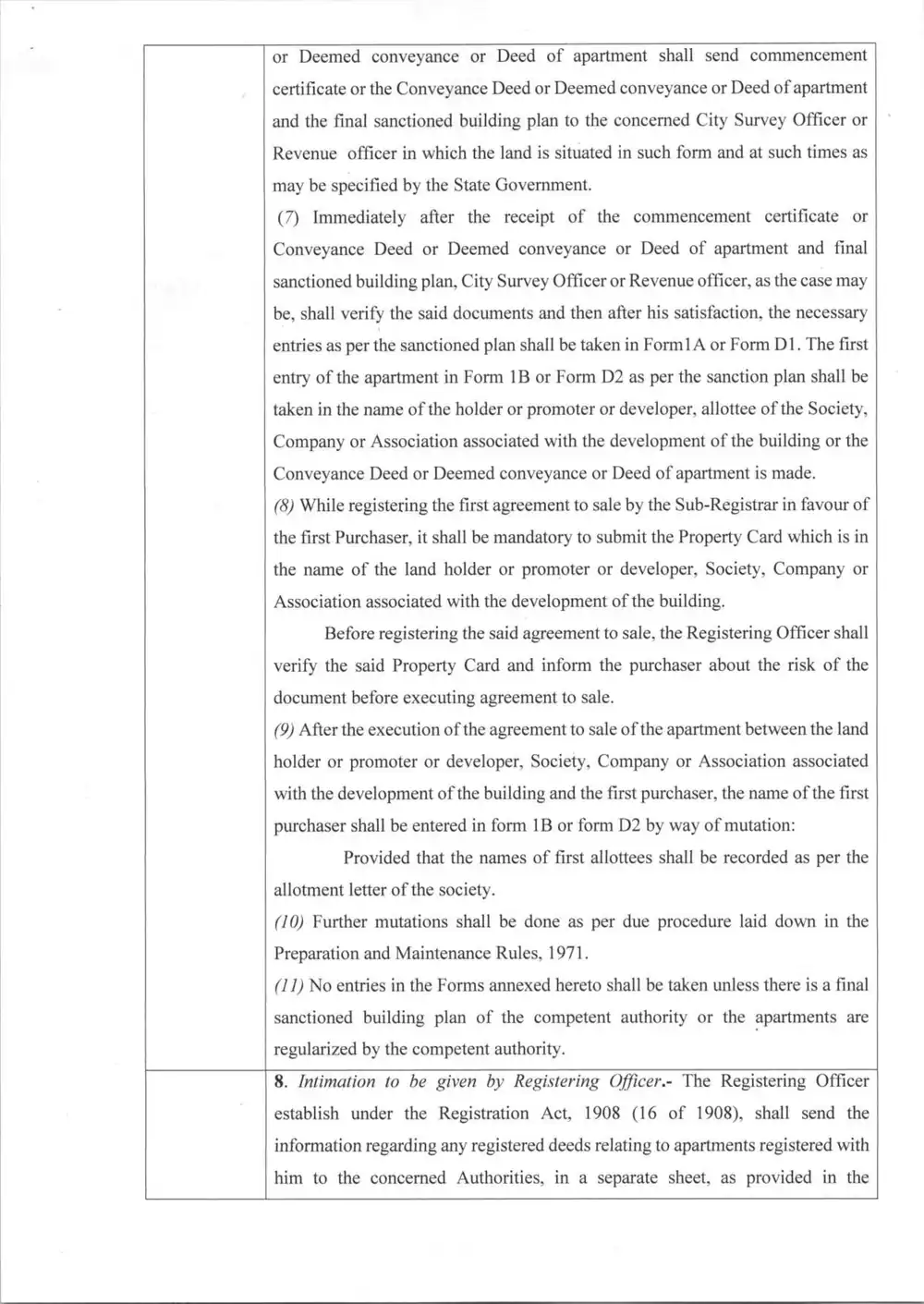
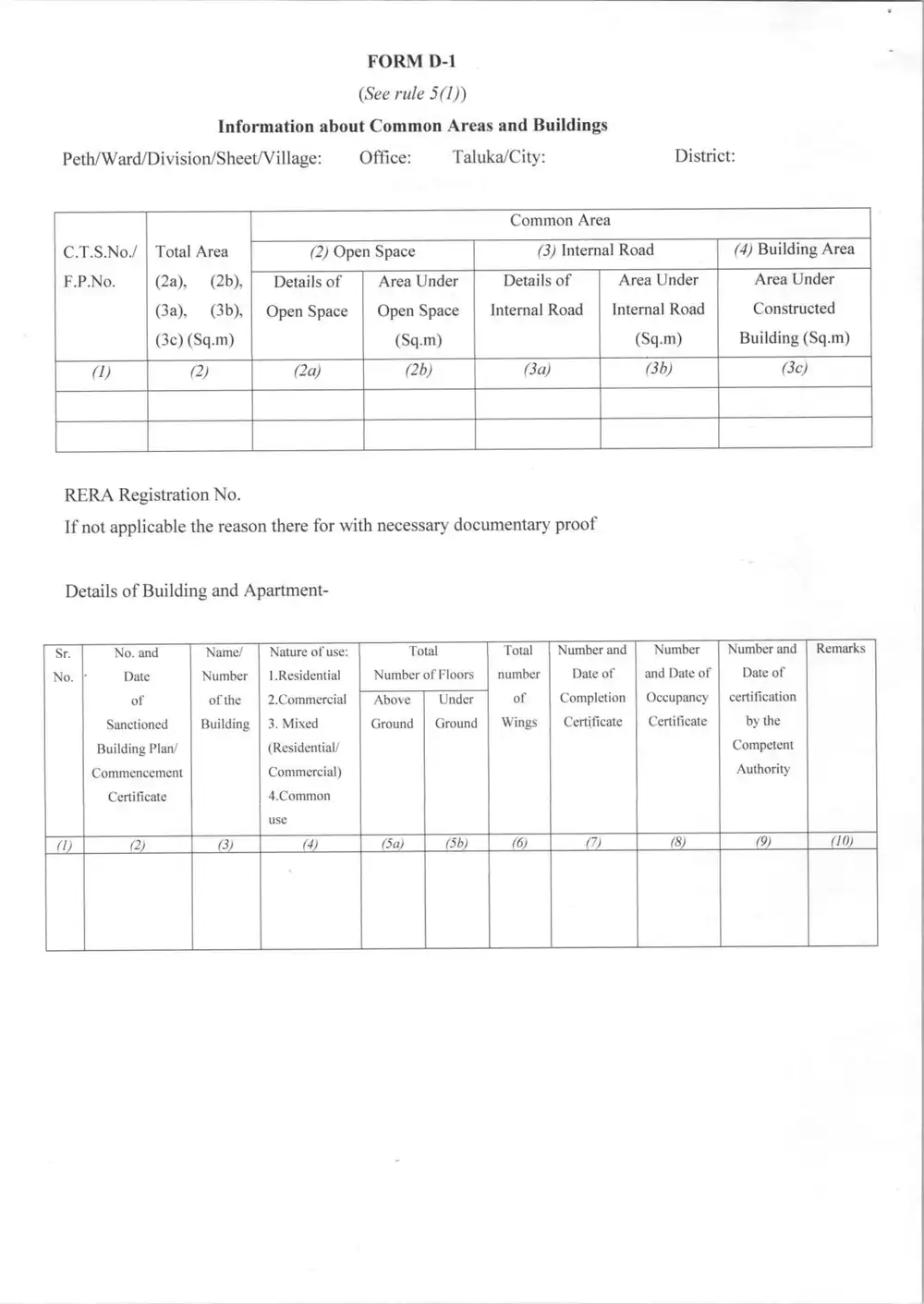
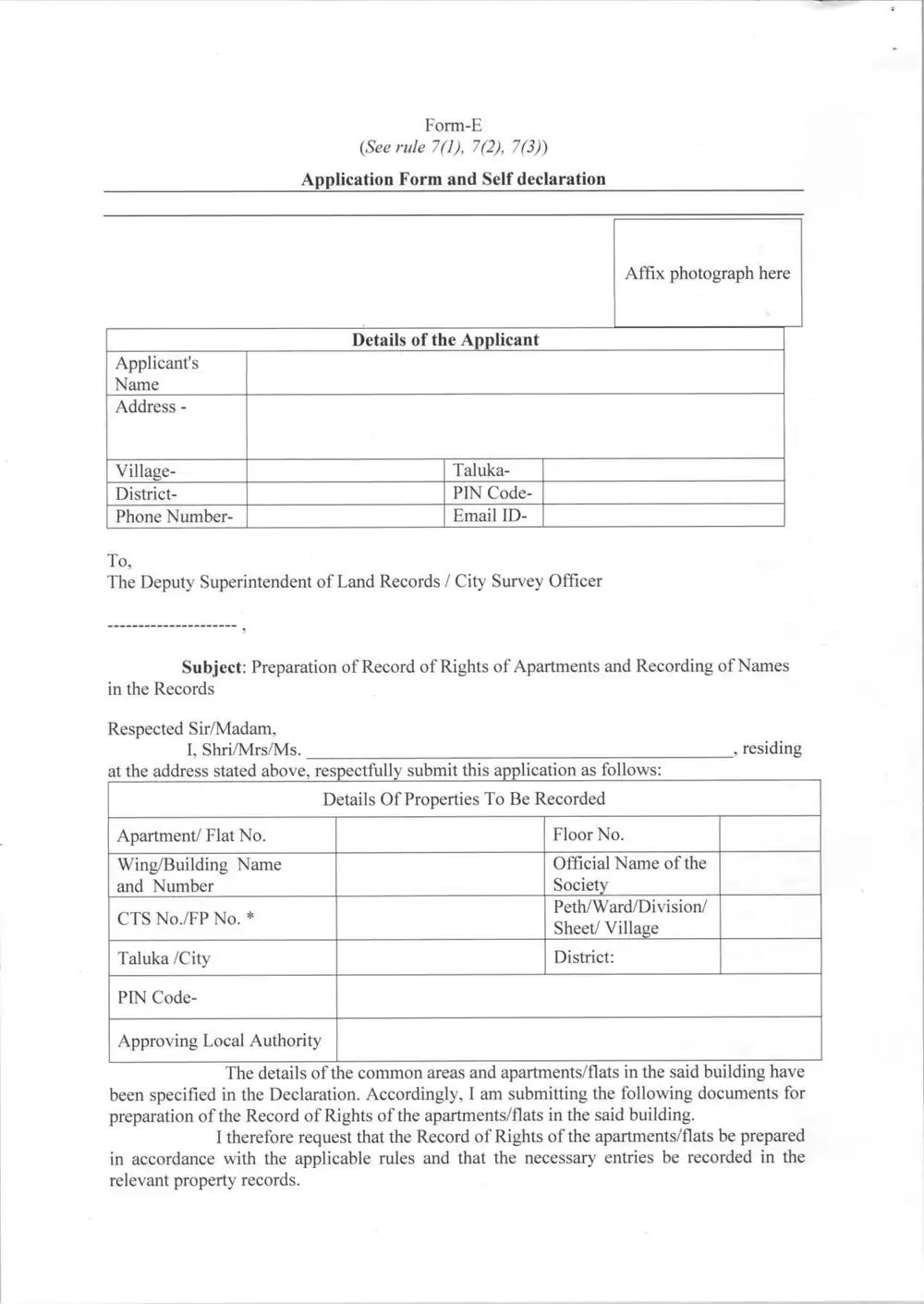
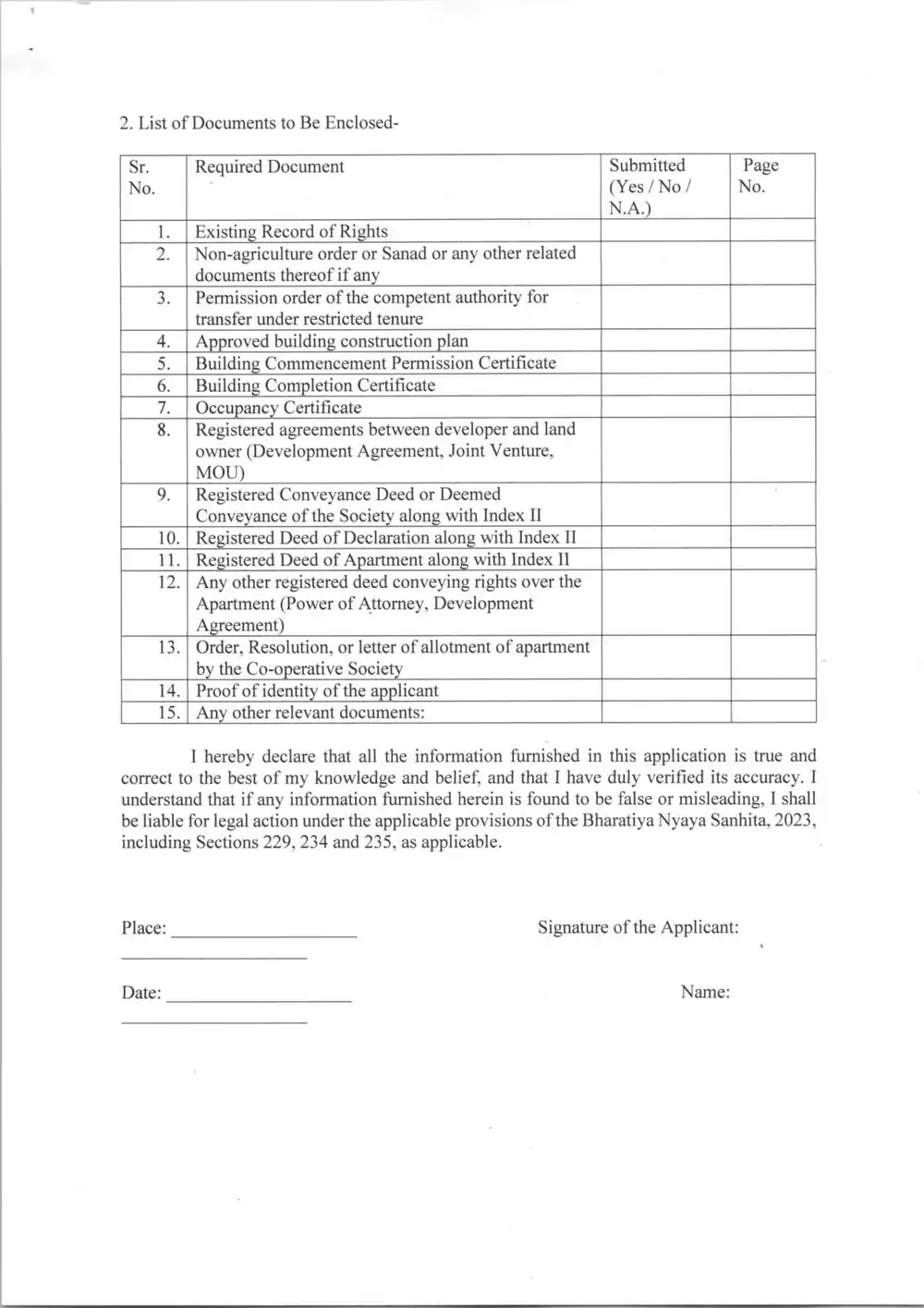
Source: Revenue Department draft notification dated 26.11.2026, published on bhumiabhilekh.maharashtra.gov.in