AGM Toolkit 2026
तुमच्या संस्थेची वार्षिक सर्वसाधारण सभा — कायद्याप्रमाणे, वेळेत.
The whole AGM, start to finish, for a Maharashtra co-operative housing society — the law in plain words and 30 ready formats: notice, agenda, minutes, budget, Form O, annual returns, handover. Separate Marathi and English editions, 90 pages each. Written by a practising advocate, quoted from the Gazette.
8 days left to post the AGM notice
For an AGM on 30 September, the notice must reach members by 15 September — fourteen clear days must fall between posting and the meeting [Bye-law 98; MBL 3(v)]. Post it on the 16th and the meeting is challengeable.
Launch price until 30 September 2026. Standard price ₹999 from 1 October.
Instant download and emailed copy · No account, no address · UPI, card or net banking
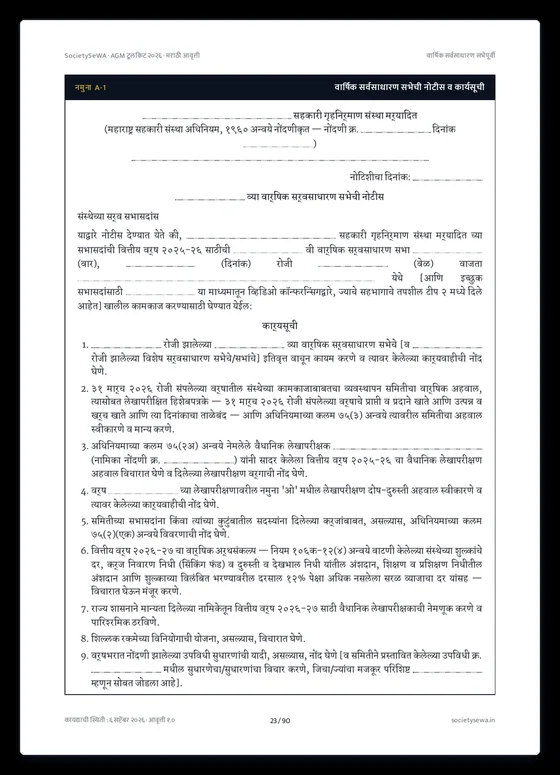
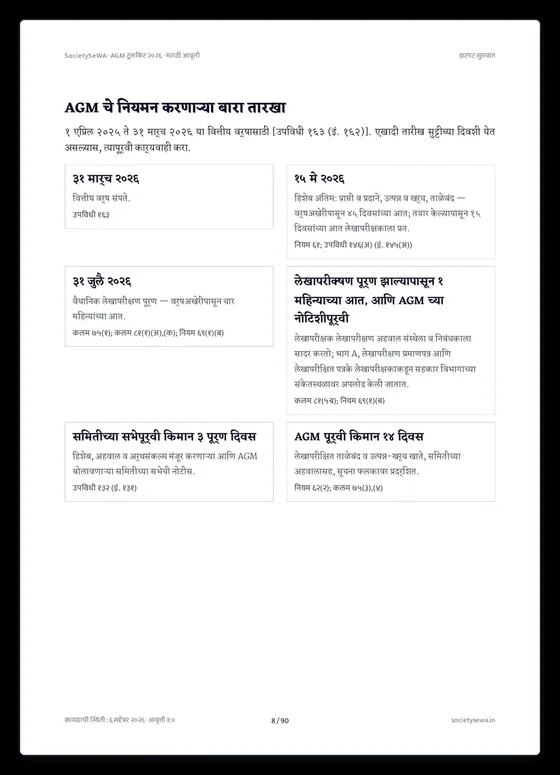
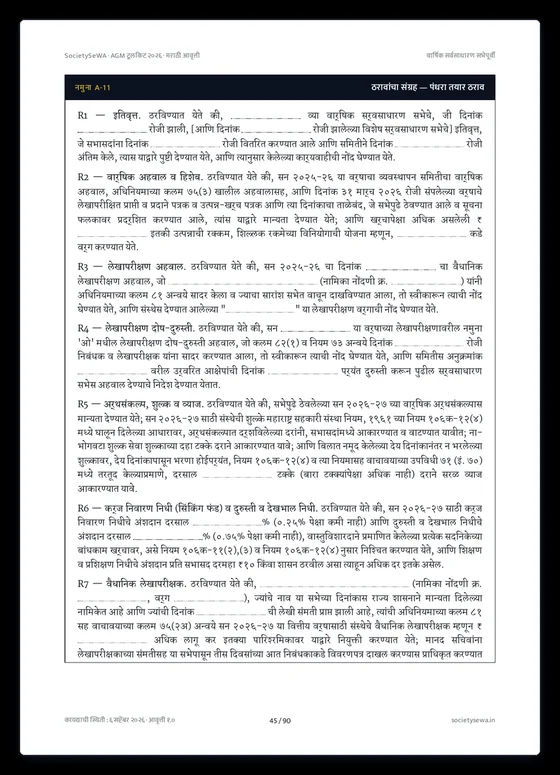
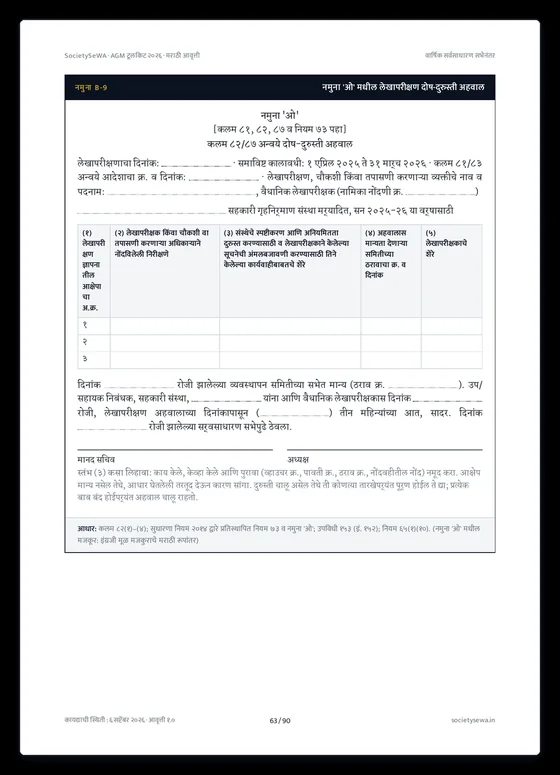
- Marathi edition cover
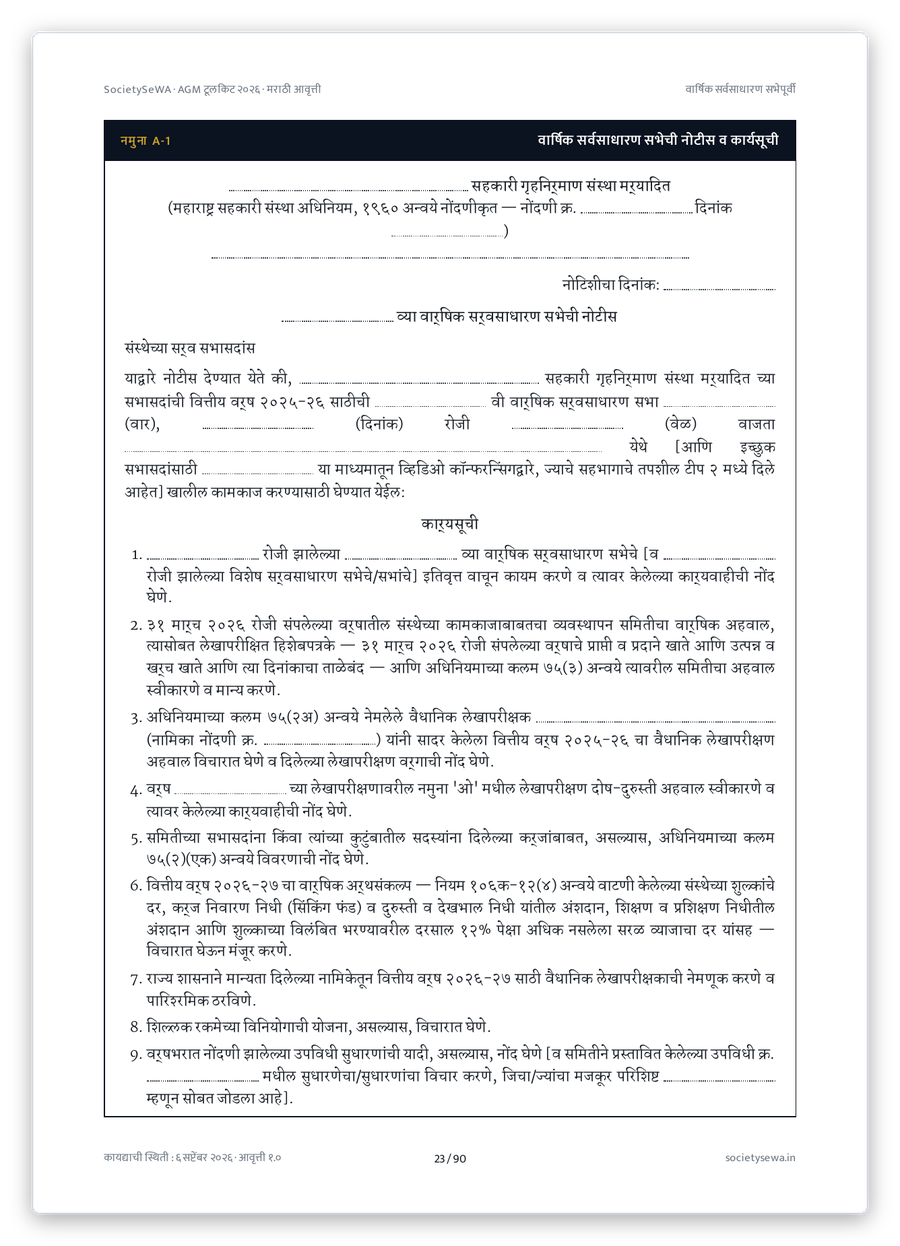
- Format A-1 — AGM notice and agenda
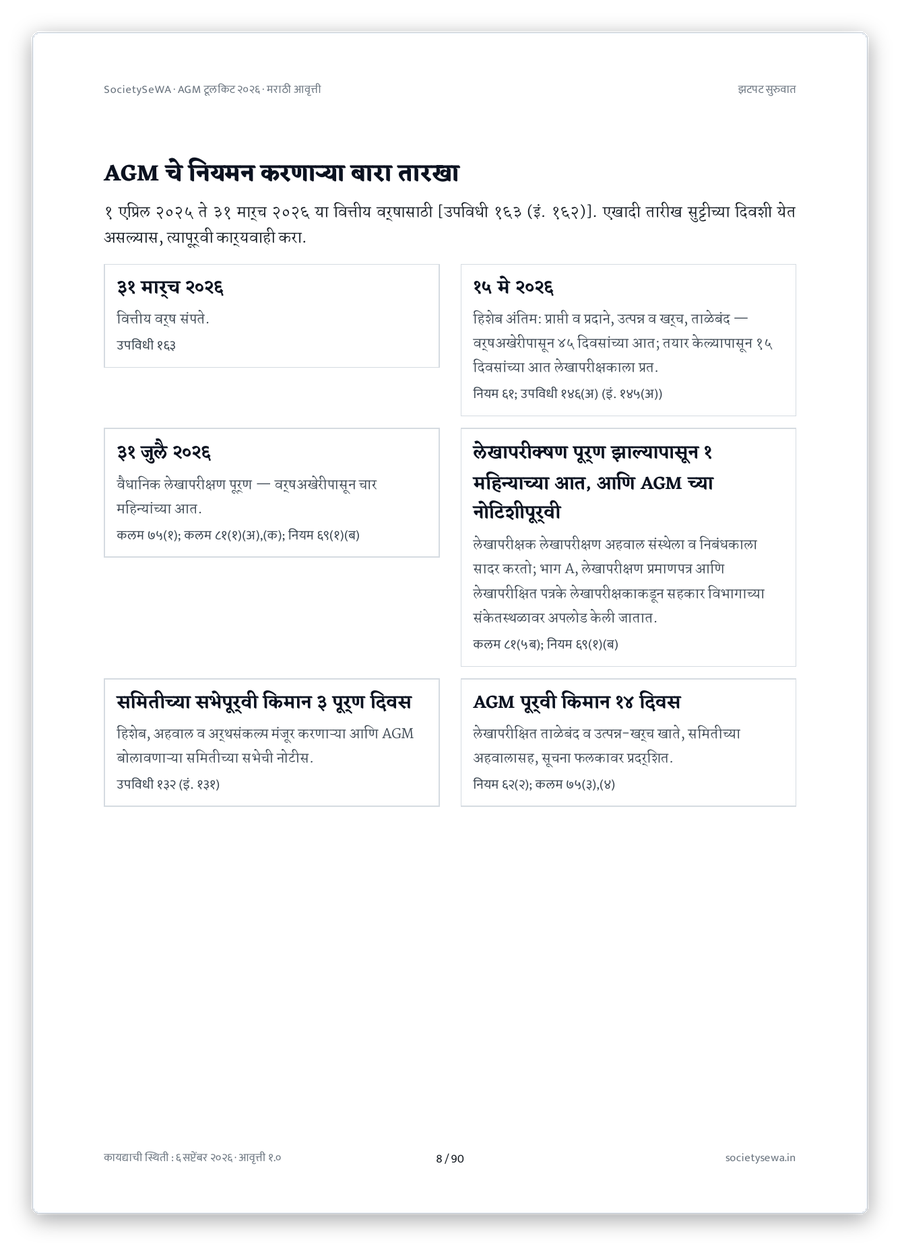
- The twelve dates that govern the AGM
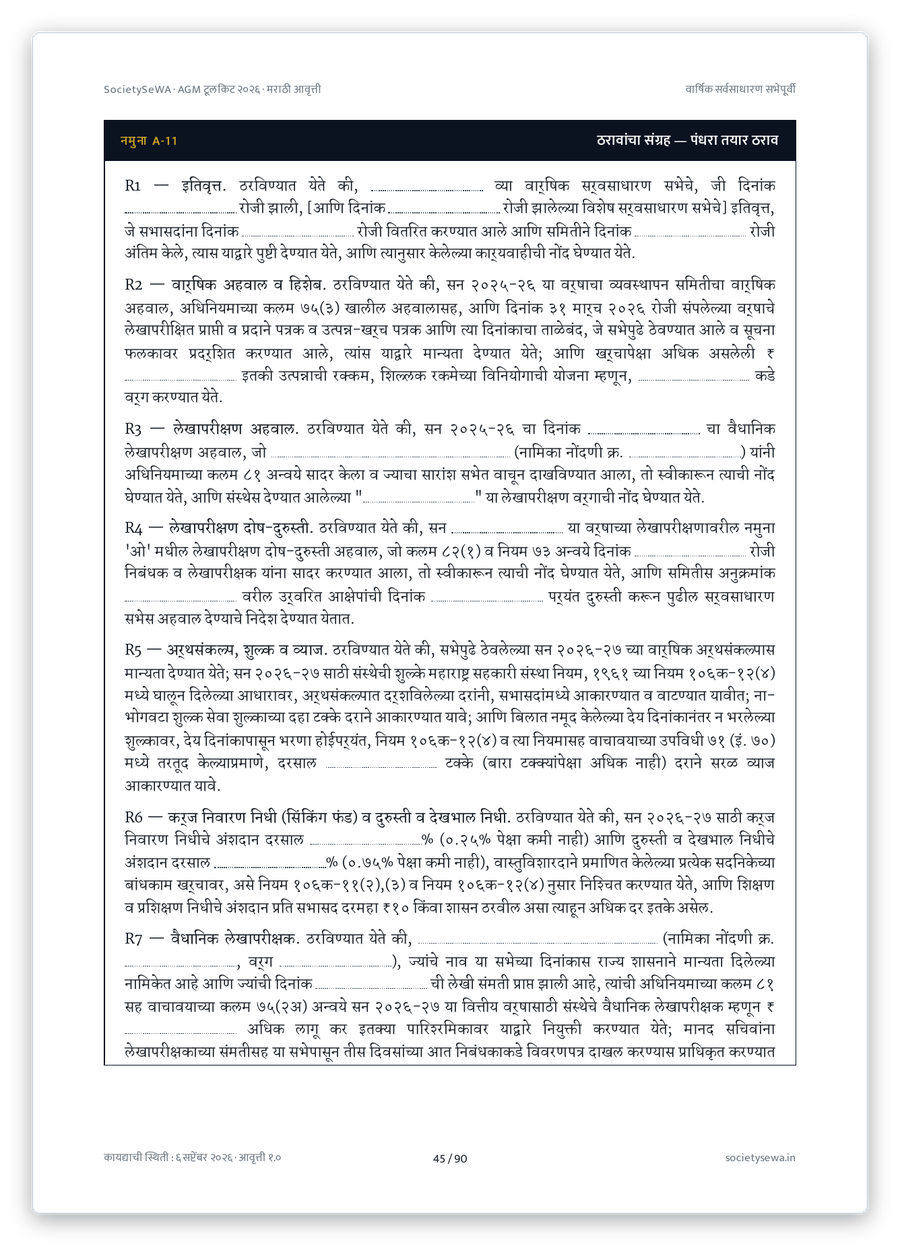
- Format A-11 — fifteen ready resolutions
- Format B-9 — rectification report in Form O
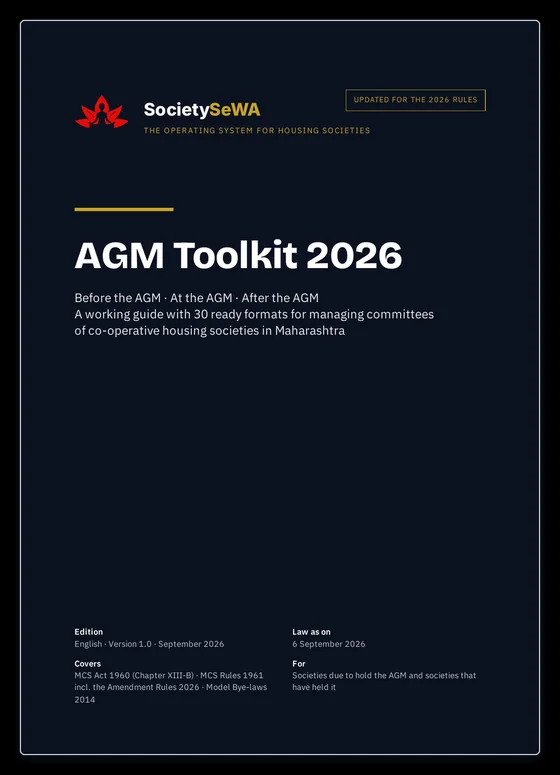
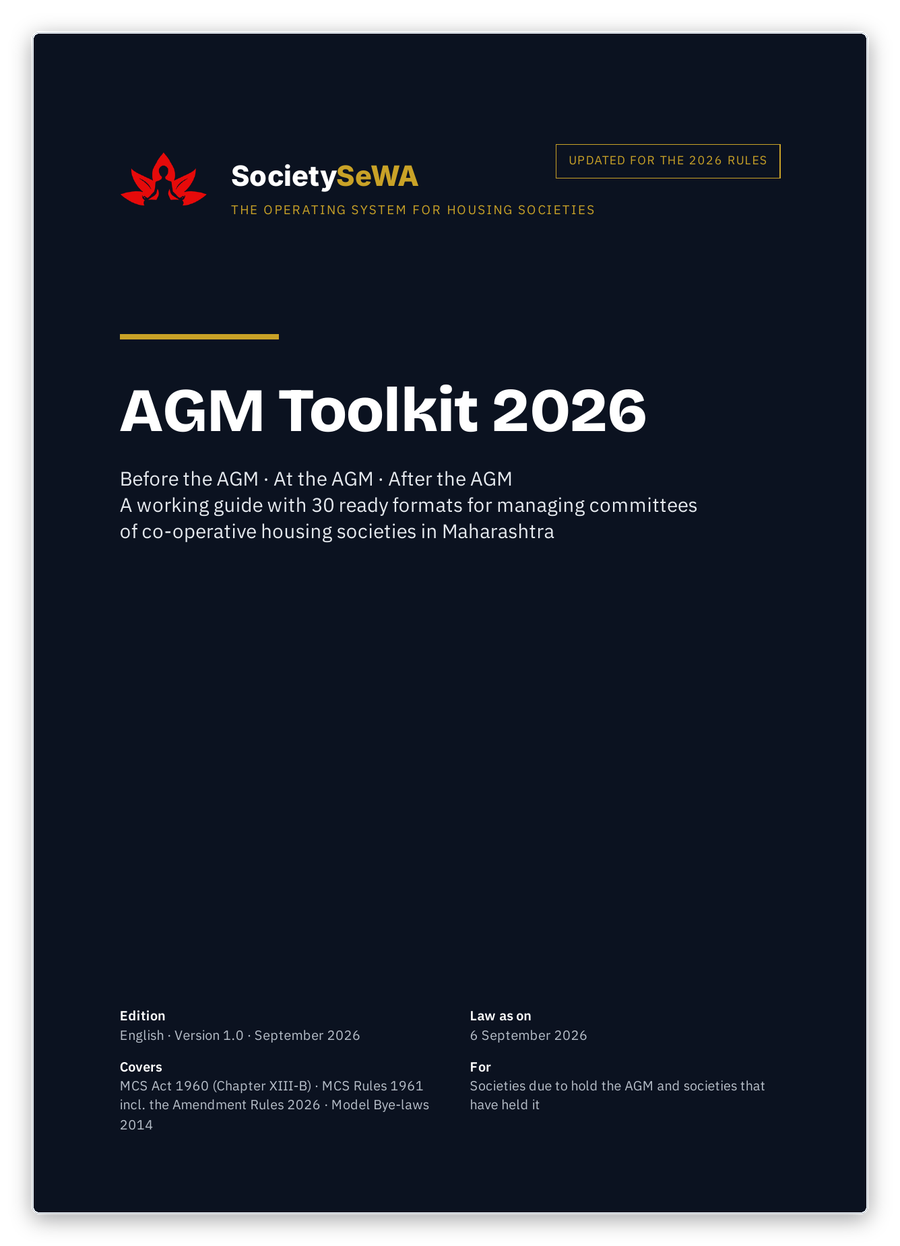
- English edition cover
30
ready formats
90
pages per edition
2
editions — मराठी + English
2026
Rules, in force 22 June
Why this edition exists
On 22 June 2026 the Rules changed. Most society books on the shelf are now partly wrong.
The Maharashtra Co-operative Societies (Amendment) Rules, 2026 — notified 18 June 2026 and published in the Gazette on 22 June — inserted a whole chapter written only for housing societies. Six of those changes land directly on the AGM.
Rule 106क-13(3)(ब)
Video-conference AGMs are now lawful
Members may attend in person or by video conferencing provided by the society — if it records, identifies who attended and stores the proceedings with date and time.
Rule 106क-13(3)(ई)
Quorum is now in the Rules
Two-thirds of total members or twenty, whichever is less — and members attending by video are counted.
Rule 106क-13(3)(ग)
Decisions need 51% of members present
Not a simple majority of those voting. The count has to be recorded, and most minutes still do not record it.
Rule 106क-12(4)
Interest on arrears capped at 12% simple
Your bye-law may still say 21%. From 22 June 2026 anything above 12% simple is unrecoverable — and weakens a Form Y-6 application.
Rule 106क-13(5)(ब)
The committee’s own spending limit is fixed
₹1,00,000 to ₹5,00,000 once in a financial year, by society size. Anything larger must go to the general body — so it must be on the AGM agenda.
Rule 106क-14
Recovery moved to Form Y-6
A recovery application now needs the AGM resolution approving the levy and the resolution approving the interest as annexures. If the AGM did not pass them properly, recovery stalls.
What it prevents
Six things that go wrong every year — and what each one actually costs
None of these are hypothetical, and none of the consequences below are our estimate. Each is the exposure the Act or the Rules provide for, with the provision named, so you can look it up yourself before you decide this is worth ₹499.
The AGM slips past 30 September
Default of s.75(1). The Registrar may call the meeting himself and order the cost paid out of the society’s funds — or by the officers responsible [s.75(1), third proviso]. Exposure under s.75(5) and s.146(f).
In the toolkit: B-11 sets out the remediation, and what to record in the committee minutes — “reasonable excuse” is the defence under s.75(5), and it has to be documented before it is needed.
The notice goes out with fewer than 14 clear days
The notice does not comply with MBL 98 / Rule 106C-13(3)(d), and every resolution passed at that meeting is open to challenge.
In the toolkit: The date table works backwards from your AGM date to the last lawful posting day. A-1 is the notice; B-11 covers re-adopting business already taken on a bad notice.
The meeting proceeds without quorum
Business transacted without quorum at the original sitting is contrary to MBL 99 / Rule 60(2). Only an adjourned meeting may proceed without quorum [MBL 100; Rule 106C-13(3)(f)].
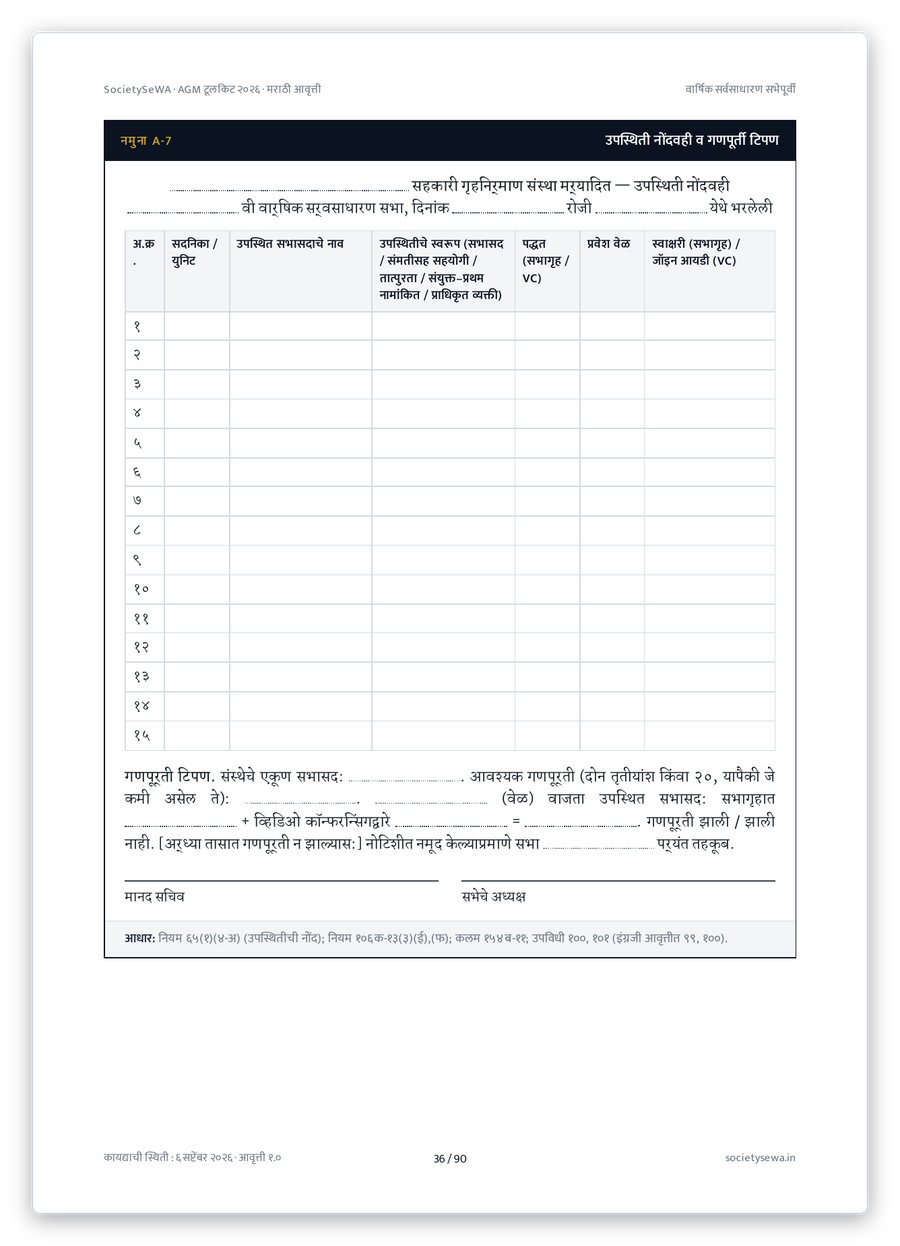
In the toolkit: A-7 is the attendance register and quorum note; A-8 is the intimation of the adjourned meeting, to be held 7–30 days later.
Annual returns are not filed by 30 September
s.79(2): the Registrar may have the work done at the society’s expense, recoverable from the society as an arrear of land revenue. Once he has, s.79(3) lets him call on the officers he holds responsible — after an opportunity of being heard — to reimburse that expense and to pay into the society’s assets up to ₹100 for each day until his directions are carried out. The failure is also an offence [s.146(g)].
In the toolkit: B-7 is the return under s.79(1A) in Form ‘Y’, with the covering letter, and B-8 the declaration of the AGM date.
Form O is not filed within three months of the audit report
s.82(4): where the report goes to neither the Registrar nor the AGM and there is no reasonable excuse, the Registrar may disqualify the officer or committee member whose duty it was from being elected or holding office for up to five years, and where that officer is a servant of the society, impose a penalty of up to ₹5,000 — in each case only after a show-cause opportunity.
In the toolkit: B-9 is the audit rectification report in Form O, with the reporting cycle that follows it until every objection is closed.
Interest above 12% is charged after 22 June 2026
Rule 106C-12(4) lets the general body fix the rate, but not above simple interest of 12% per annum. A bye-law cannot override a Rule, the excess is not recoverable, and charging it weakens a s.154B-29 recovery application against the very members you are pursuing.
In the toolkit: A-5 is the budget on the Rule 106C-12 heads, and resolution R5 in A-11 fixes the rate lawfully at the general body.
Any one of these costs more to unwind than the toolkit costs to buy.
Look inside
Real pages, not a mock-up
Swipe. These are pages from the Marathi edition, exactly as they print.
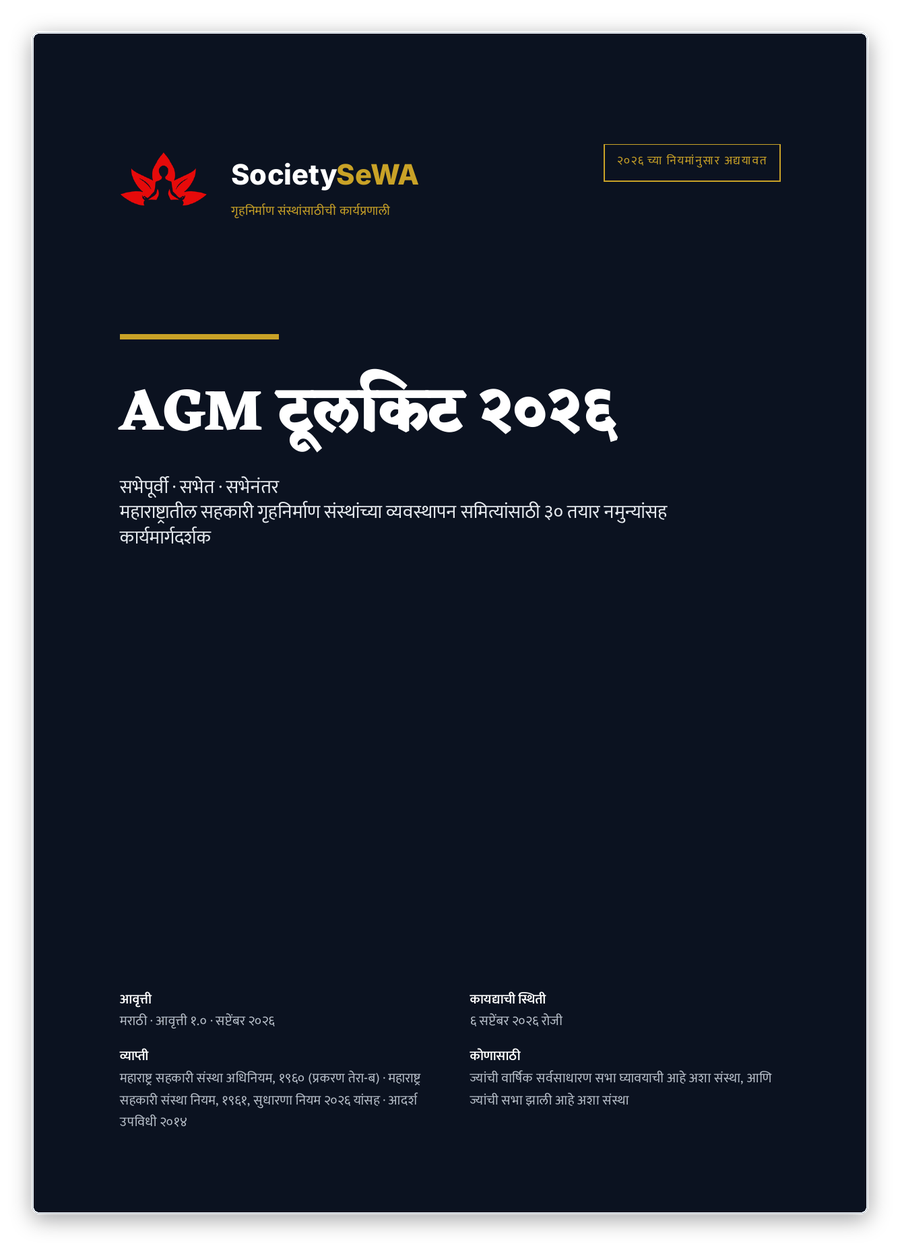
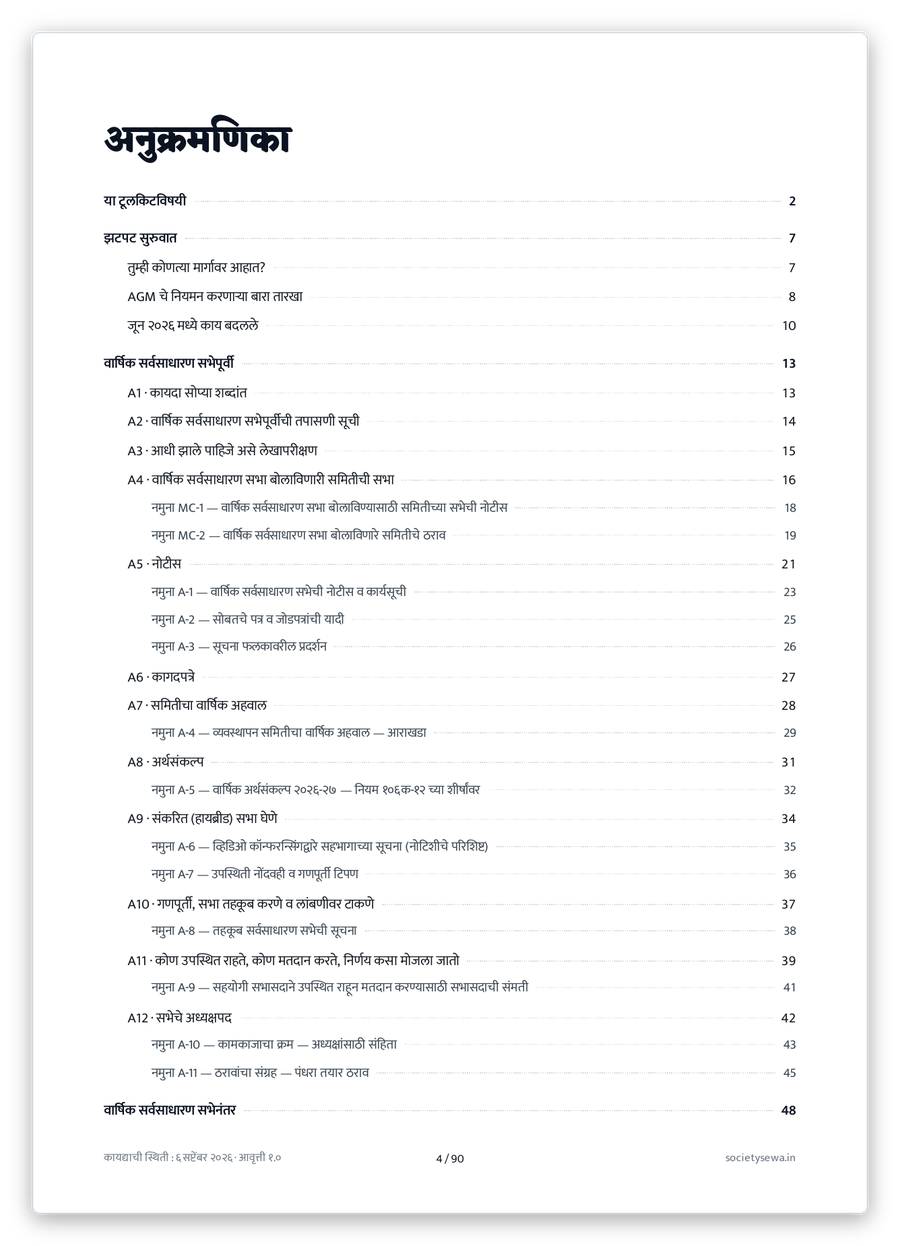
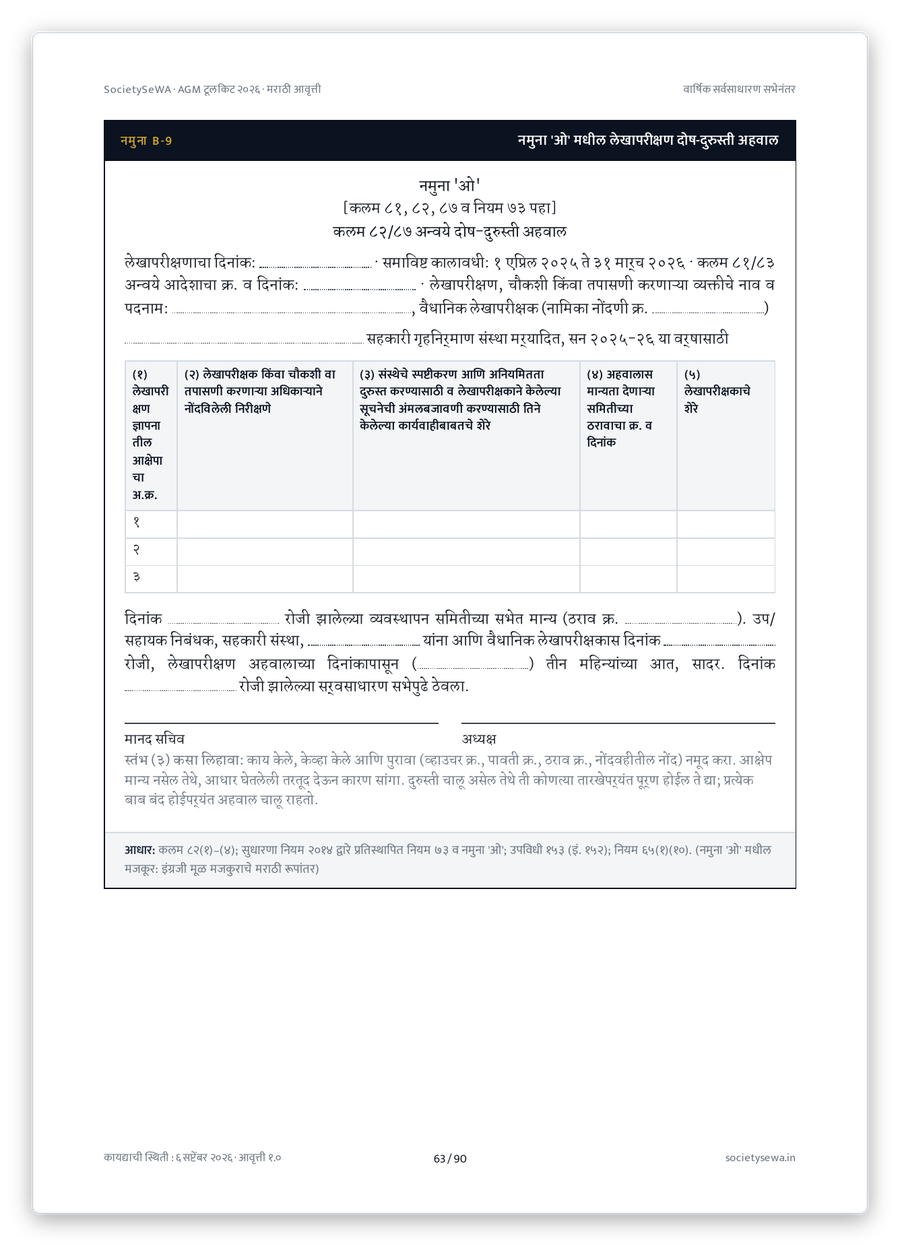
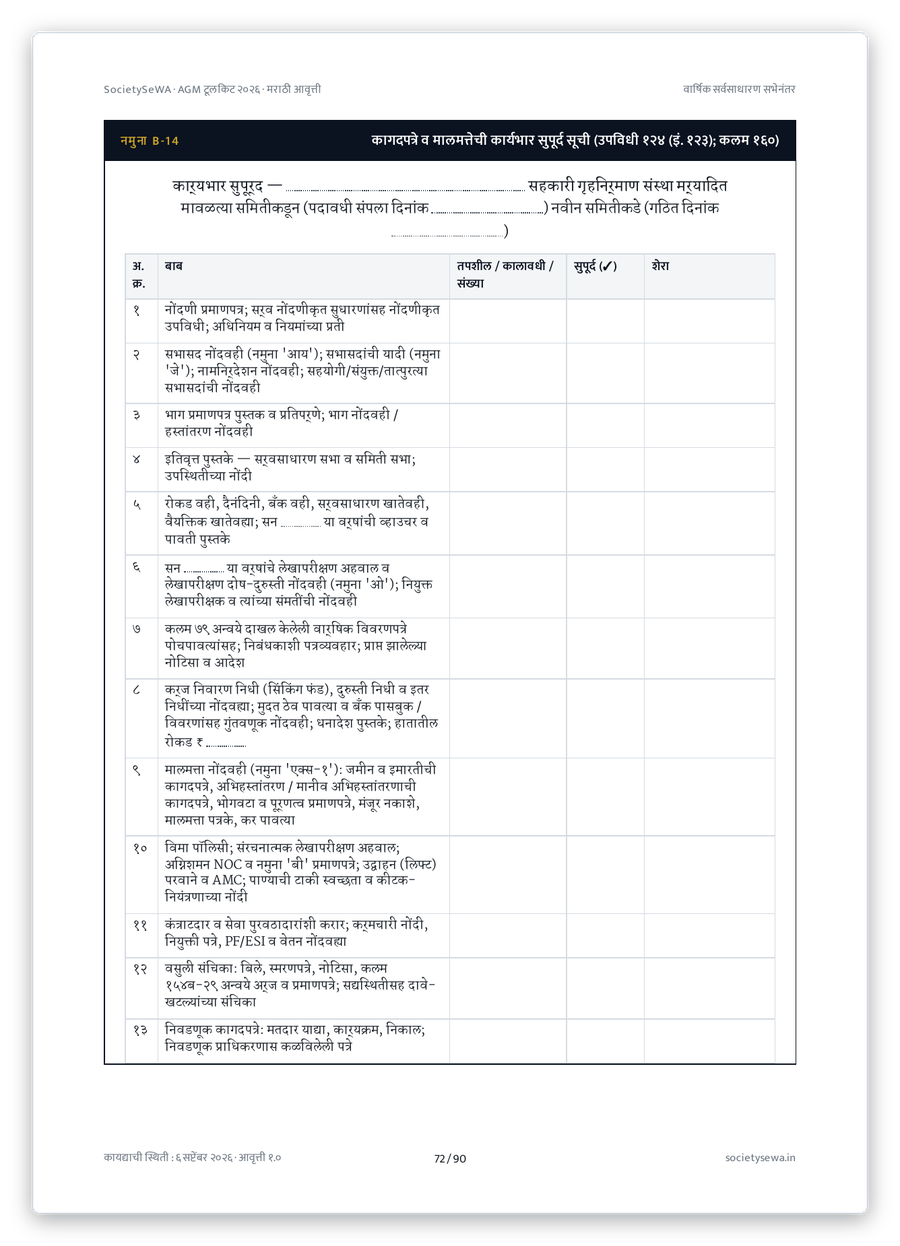
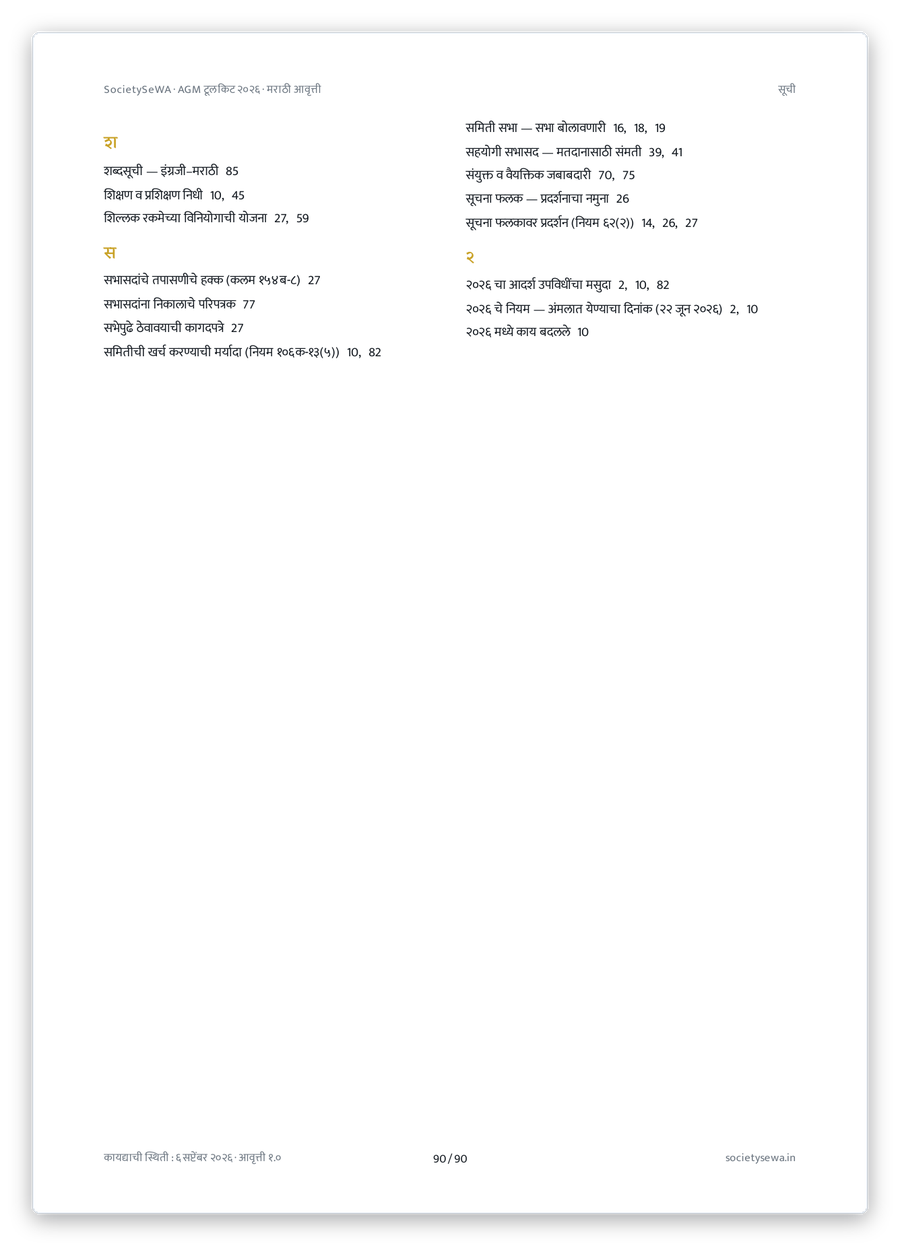
Ninety pages like these, bookmarked and searchable, in Marathi or English.
Two tracks, because societies are in two situations
One book covers both. Start wherever you actually are.
Part A — AGM not held yet
- A1 · The law in plain words — s.75, who calls the meeting, what it must do
- A2 · Pre-AGM checklist, T-120 to T-0, with the owner of each step
- A3 · The audit that must come first — four months, not six
- A4 · The committee meeting that convenes the AGM
- A5 · The notice — how to count 14 clear days, and how to prove you did
- A6 · The papers to be laid before the meeting
- A7 · The committee’s annual report, including the s.75(3) statement
- A8 · The budget, on the Rule 106क-12 heads
- A9 · Holding a hybrid meeting lawfully
- A10 · Quorum, adjournment and postponement
- A11 · Who attends, who votes, how a decision is counted
- A12 · Chairing the meeting
Part B — AGM held
- B1 · The post-AGM calendar — seven obligations with dates
- B2 · Minutes — the three-month, 15-day, 15-day cycle
- B3 · The auditor-appointment return (30 days)
- B4 · Annual returns under s.79(1A) — due 30 September
- B5 · The audit rectification report in Form O
- B6 · A bye-law amendment resolved at the AGM
- B7 · Implementing resolutions — the action-taken register
- B8 · If the AGM declared an election due
- B9 · A new committee: first meeting, office bearers, handover
- B10 · Telling the members
- B11 · If something went wrong — the remediation table
Check our work first
Six of the twelve dates, here, free
This is the most useful table in the book, and half of it is on this page. Take it to your registered bye-laws and check it. If these six are right, you can decide for yourself whether the other ninety pages are worth ₹499 — which is a better basis than anything we could tell you about ourselves.
| Date | What the law requires | Provision |
|---|---|---|
| 15 May 2026 | Accounts finalised — within 45 days of the year end; copy to the auditor within 15 days of preparation. | Rule 61; MBL 145(a) |
| 31 July 2026 | Statutory audit completed — within four months of the year end. | s.75(1); s.81(1)(a),(c) |
| 15 September 2026 | Last day to post the AGM notice for a meeting on 30 September — 14 clear days must intervene. | MBL 98, 161; Rule 60(1) |
| 30 September 2026 | AGM held, within six months of the year end. Annual returns filed with the Registrar. | s.75(1); s.79(1A) |
| AGM + 30 days | Return to the Registrar naming the auditor appointed for 2026-27, with the auditor’s written consent. | s.75(2A); s.79(1B) |
| Audit report + 3 months | Audit rectification report in Form O to the Registrar and the auditor; also placed before the general body. | s.82(1); Rule 73; MBL 152 |
The other six — the accounts on the notice board, the committee meeting that convenes the AGM, the minutes cycle under MBL 107 and the election intimation under s.73CB(14)(a) — are on page 6, with the whole calendar as one printable table.
All 30 formats
Each one starts on a fresh page so you can print it and use it as it is. Every format carries the provision it rests on at the foot, so you can show the auditor or the Registrar where it comes from.
All thirty, in one bookmarked PDF — plus the reasoning that tells you which to use when.
Pick your edition
Launch prices, until 30 September 2026. Every price includes GST.
One edition
Marathi or English — you choose below
incl. GST · one-time
- 90-page PDF, bookmarked and searchable
- All 30 formats
- Licensed to your society, named on the invoice
- Instant download + emailed copy
- GST invoice
Both editions
Marathi for the members, English for the record
incl. GST · one-time
- Everything in one edition
- Both Marathi and English PDFs
- Same formats, same numbering, side by side
- Instant download + emailed copy
- GST invoice
Pro — with editable formats
For the secretary who has to actually type them
incl. GST · one-time
- Both editions
- All 30 formats as editable Word files
- Fill in and print — no retyping
- Free update when the revised bye-laws are notified
- GST invoice
Society Licence
For managing agents, auditors and federations
incl. GST · one-time
- Everything in Pro
- Licence to use across the societies you manage
- One year of updates
- WhatsApp support through one AGM cycle
- GST invoice
Pay by UPI, card, net banking or wallet through Razorpay. Signed in with Google, we ask you nothing at all — otherwise just a name and an email, so the copy can reach you.
Do not buy this if
- —Your society is outside Maharashtra. This is the MCS Act 1960, the Model Bye-laws and the 2026 Rules — nothing in it travels to another state’s law.
- —You want the AGM conducted for you. This is a book. If you want us in the room, that is a professional engagement and a different conversation.
- —The matter is already before the Registrar, a co-operative court or an arbitrator. At that point you need advice on your facts, not a format.
If none of those apply, it will do what the page says. If the file does not reach you or does not open, write to us and we will fix it or refund in full.
Who wrote it
Adv. Jyotishwar V. Bhosale — Expert Jurist LLP
Advocate, enrolled with the Bar Council of Maharashtra & Goa (MAH/5272/2008), Managing Partner of Expert Jurist LLP, CBD Belapur. The firm practises co-operative society law — recovery under s.154B-29, Registrar proceedings, conveyance and redevelopment — and the author has served as secretary of a housing society of about 1,200 flats. This toolkit is the working method from that practice, written down.
Drafted from primary sources only
Every quotation is taken from the Gazette, the Registrar’s official bye-laws or the Law & Judiciary Department’s text of the Act — never from memory, never from a blog.
Independently verified
The text was checked line by line against those primary texts, and the corrections made before publication. Where a point could not be verified, the toolkit says so instead of guessing.
Marathi from the official texts
The Marathi edition quotes the official Marathi Gazette and bye-laws verbatim. Provisions with no official Marathi text are marked as renderings.
Straight answers
You already give formats away free on this site. Why pay for this?
The free forms are blank templates — useful if you already know which one to use, when it is due and what the law requires it to say. This is the opposite: it is the sequence and the reasoning, with the format attached at the point you need it. It also carries the Amendment Rules 2026, which the free library does not yet reflect, and it is the only version that exists in a verified Marathi edition.
Is the Marathi a translation, or the official wording?
Where an official Marathi text exists it is quoted verbatim — the 2026 Rules from the Marathi half of the Gazette, the bye-laws from the Registrar’s official Marathi edition, and the Act from the Law & Judiciary Department’s Marathi edition. Provisions enacted after that Act edition (the 2022 proviso to s.75(1), s.82, Chapter XIII-B) have no official Marathi text, so those are marked as renderings of the English. Nothing is silently translated and presented as the statute.
Our bye-law numbers do not match yours.
They will not, and that is expected. The Registrar’s English 2014 edition and the official Marathi edition number the same bye-law differently — Marathi is one higher from about bye-law 64 onwards. Every citation in the Marathi edition carries the English number in brackets so you can check it against whichever copy your society has registered.
What exactly do I get, and how fast?
A PDF, on screen immediately after payment and emailed to the address you enter. No address to fill in, and no waiting. If you are signed in with Google, the only question is Marathi or English. Your copy is licensed to your society and named on the invoice.
Will it go out of date when the new bye-laws come?
The Registrar has published the revised model bye-laws in draft (13 and 18 August 2026) but has not notified them. When they are notified, Pro and Society Licence buyers get the updated edition free. Single-edition buyers get an update notice at the email used for purchase.
Can I get a refund?
Yes, if the file does not reach you or does not open — write to us and we will fix it or refund in full. Because the file is delivered immediately and cannot be returned once downloaded, we cannot refund simply on a change of mind. The full policy is on the refund page.
Can the society claim this as an expense?
A GST invoice in the society’s name is issued with every purchase, which is what your auditor will ask for. Societies normally book it under printing and stationery or legal and professional charges — but that is your auditor’s call, not ours.
Is this legal advice?
No. It is educational material published to help committees comply, and using it does not create a professional relationship. The formats are models — adapt them to your registered bye-laws and to the facts. For a matter that has already gone wrong, talk to us properly.
Get the AGM right the first time
One committee member, one evening, one document. ₹499 is less than the cost of re-convening a meeting that was held on a defective notice.
Download starts the moment the payment goes through. A copy reaches your email too.
Seller
Expert Jurist LLP, Office C216/218, 2nd Floor, Tower-8, International Technology Centre, CBD Belapur, Navi Mumbai 400614Contact & grievances
support@societysewa.in · 022-49791116 · WhatsApp +91 79778 97768. Grievances are answered within 48 hours.Please read
Educational material, not legal advice. Law stated as on 6 September 2026. Adapt every format to your society’s registered bye-laws.